

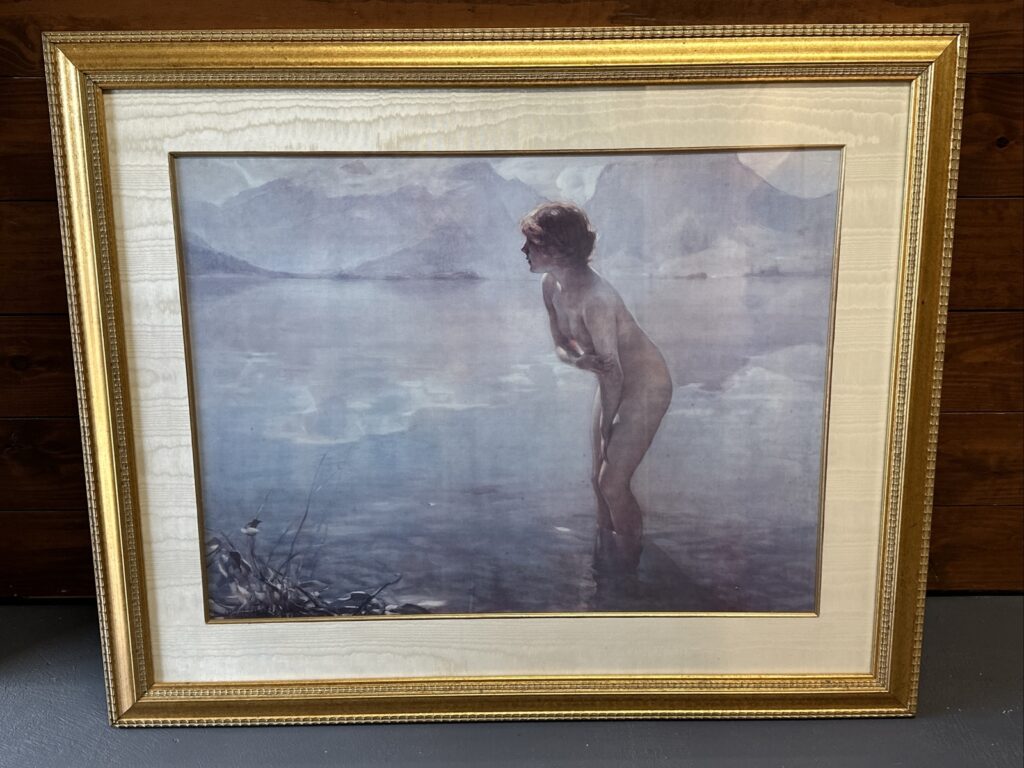
Here is Paul Émile Chabas’ 1911 painting “Matinée de Septembre” (September Morn), which features a nude young woman bathing in a lake — innocent, serene, and completely scandalous for its time.
🎨 The Painting Itself
-
Artist: Paul Émile Chabas (French academic painter)
-
Completed: 1911
-
Style: Soft realism, with an air of innocence
-
Subject: A nude young woman standing in shallow water, arms loosely crossed, bathed in gentle morning light
-
Originally considered tasteful — even poetic — until the practical joke…
😈 The Practical Joke
In 1913, an American art dealer named Anthony Comstock (a moral crusader) raised hell about the painting, calling it indecent. That instantly made it famous in the U.S.
But here’s where the prankster energy kicks in:
-
Copies of September Morn began showing up everywhere — in barbershops, cigar lounges, hotel lobbies, even soda fountains.
-
It became a pop culture sensation and something of a wink-wink joke on prudishness.
-
Collectors started grabbing copies thinking it had become important art.
-
Reproductions sold in the millions, and serious art dealers were left trying to explain how something so kitschy had become “valuable” — simply because it was forbidden and then mass-consumed.
Actually, the whole thing was masterminded by a practical joker who saw how to spin scandal into marketing gold. Whether or not that was a literal “practical joke” on collectors, it sure played out like one.
🥂 Legacy
-
It became a symbol of moral hypocrisy, mass marketing, and the absurdities of taste.
-
Artists like Marcel Duchamp and Dadaists loved this kind of prank — taking “serious” art and showing how thin the line was between a masterpiece and a mass-market joke.
=========================================================================
In his book, The Compleat Practical Joker, H. Allen Smith recounts the tale of Harry Reichenbach, a flamboyant showman and one of the earliest professional press agents in America. Reichenbach, always on the lookout for creative ways to stir public interest, orchestrated one of the most legendary practical jokes in art history — the scandal of September Morn.
The painting itself, September Morn by Paul Émile Chabas, was a modest and poetic depiction of a nude young woman bathing in a lake. By European standards, it was hardly shocking. But in puritanical 1913 New York, Reichenbach saw an opportunity. He placed a reproduction of the painting in a shop window on Fifth Avenue — not a gallery, just a simple display spot where anyone passing by could see it. To spark attention, he hired dozens of street urchins — scrappy local kids — to crowd in front of the window and pretend to ogle the painting. They pointed, whispered, laughed, and nudged each other in feigned adolescent amazement. Naturally, this spectacle caught the eye of adults walking by. Curious crowds gathered. Then came the moral guardians — and with them, outrage.
Reichenbach upped the ante by making an anonymous phone call to Anthony Comstock, the zealous moral crusader who had made a career out of fighting obscenity. Comstock arrived in person, took one look at the painting, and declared it indecent. “Too little morn and too much maid,” he famously said. He tried to have the painting removed, which ignited a media firestorm. Overnight, September Morn became a cause célèbre. The more it was condemned, the more people wanted to see it — and to own it.
Prints of the painting began to sell by the millions. It appeared in barbershops, soda fountains, cigar stores — anywhere it could be displayed for maximum buzz. A painting that had been perfectly innocent (and only mildly risqué) was transformed into a national scandal, a punchline, and a cultural icon, all thanks to a well-executed practical joke.
Smith doesn’t just report the story — he delights in it. He admired Reichenbach’s ability to use the tools of theater and spectacle to manipulate public perception. It wasn’t just a prank; it was a masterclass in media psychology. And that’s why it earned a place in The Compleat Practical Joker — because it wasn’t about humiliating anyone, it was about showing how easy it was to turn nothing into something, and a mild French painting into a moral panic.
And as I have previously noted in my comments about this event, the model wasn’t even fully nude. Her arms were folded modestly, the pose was bashful, even demure. But that didn’t matter once the machinery of scandal got rolling.
And that’s what I wanted to talk about today.
Grandma Trudy is an Urban Legend!
It all started with a single, harmless image: a black-and-white photograph of a fully clothed elderly woman sitting on a stool, knitting. Her back was turned to the camera. Nothing suggestive. Nothing risqué. Just an old lady, and some skeins of yarn.
But the prankster had other ideas. Moxie Templeton began the whole cycle. She is best known as a digital artist with a wicked sense of theater, and she had a plan.
She titled the piece: “Softcore Knitting #3.”
Then she created a fake persona — “Sebastian Lux,” an alleged reclusive provocateur artist from Belgium — and uploaded the image under his name to a few niche art sites, tagging it with all the wrong keywords: NSFW, explicit, provocative, banned, age censorship, AI-erotic blend.
She then posted the image in a Reddit thread called “Uncensorable Art,” claiming it had been removed five times from Instagram and flagged by AI as adult content. The caption read:
“Instagram’s AI says this is pornography. The algorithm doesn’t lie. Apparently, this is too hot to handle.”
It worked like fire.
Outrage boiled over in both directions. Some commentators cried “censorship!” Others said, “This is what happens when you confuse old with obscene!” A few claimed the image contained subliminal nudity. One TikToker made a 3-part series claiming you could “see through the sweater” if you used a color filter. The phrase “algorithm erotica” began trending on X (formerly Twitter).
As you already know, within 72 hours the photo was everywhere.
Major publications picked it up. Vice called it “a statement on AI bias and modern prudishness.” The Guardian ran a thoughtful editorial: “When Knitting Is Obscene: Has the Internet Lost Its Mind?”
Meanwhile, Moxie anonymously leaked an old church group’s Facebook post denouncing “Sebastian Lux” and his “perverse agenda to make senior citizens sexually confusing.” More outrage. More shares.
Finally, on Day 5, Moxie posted the truth from her own account:
“She’s my grandma. She’s fully clothed. This was an art school prank. Thanks for proving the point — the machine doesn’t understand modesty. And neither do you.”
It made the nightly news. Everyone knows Grandma Trudy, but not until her photograph became a worldwide meme. T-shirts showed up with the phrase “Too Hot for AI” and a silhouette of a woman knitting. Museums debated displaying it “as commentary.” Instagram quietly stopped auto-flagging the image — but it was too late.
The magic was done.
==========================================================================
Bardo bus ahoy! Bardo bus several hoys!
==========================================================================
See You At The Top!!!
gorby