

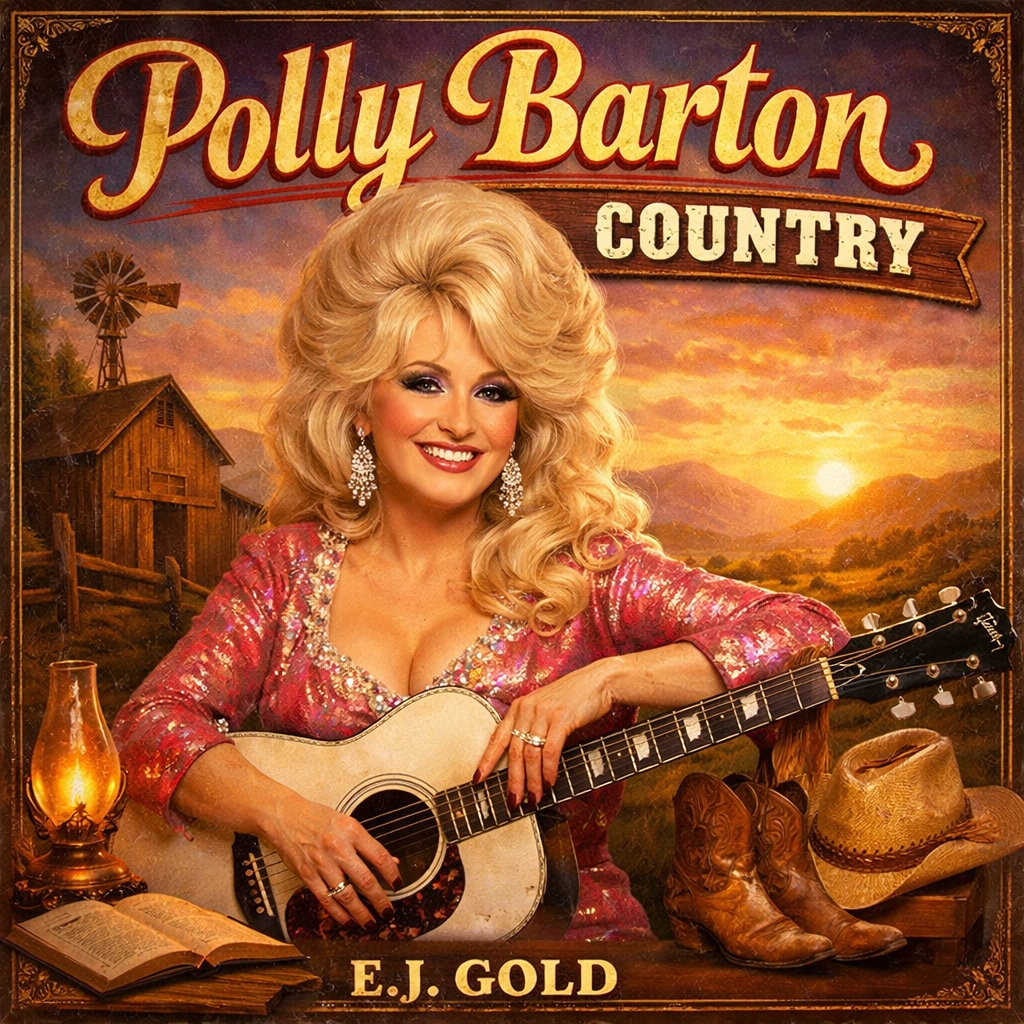
Polly Barton was born already late for chores.
That’s how she tells it, anyway. According to family legend, she arrived one humid morning in eastern Tennessee while her mother was halfway through hanging laundry and her father was fixing something that didn’t need fixing yet. From day one, Polly had a way of appearing right when work was underway, smiling as if to say, “Don’t stop on my account.”
She grew up in a house where music was never scheduled. It just happened. Somebody would hum while cooking, somebody else would answer from the other room, and before you knew it the whole place would be vibrating with half-finished songs, wrong lyrics, and good intentions. Polly learned early that music wasn’t something you performed—it was something you used, like a tool or a prayer or a joke to get through the day.
Her first instrument wasn’t a guitar. It was a voice, trained on long walks between places that were too far apart. Polly sang to keep herself company. She sang to remember lists. She sang to soften bad news before it landed. By the time she finally got her hands on a beat-up acoustic, she already knew exactly what it was for.
Polly Barton never pretended life was easy. She just refused to act surprised by it.

By her teens she was writing songs that sounded cheerful until you listened closely, and sad songs that somehow made people laugh. Folks would say, “That girl’s got a way,” which in her part of the country meant she tells the truth without scaring anybody off. Polly took that as a compliment and a responsibility.
She left home the way a lot of people do—not dramatically, just gradually. One gig led to another, one couch to the next, one friendly stranger who knew a friend who knew a place that needed music. Polly learned how to pack light, smile heavy, and sleep anywhere that didn’t actively reject her.
What set Polly Barton apart wasn’t ambition. It was stamina.
She could play a room that wasn’t listening and make them feel like they had been all along. She could smile through questions that weren’t questions and praise that came with strings attached. Polly figured out early that the world liked its women sweet, steady, and uncomplaining—and she decided to give them sweet and steady while quietly doing exactly what she pleased.
Her songs started traveling faster than she did.

People sang them without knowing her name. Radio played them slightly wrong. Other singers covered them and softened the edges, but the core stayed intact: stories about work, love, money, faith, disappointment, loyalty, and that strange optimism that shows up even when nobody invited it.
By the time Polly Barton was “discovered,” she’d already discovered herself several times over and survived the experience.
She became known for her look—big hair, bright clothes, unapologetic sparkle—but anyone paying attention could tell it wasn’t decoration. It was armor. Polly dressed like a celebration because she knew how close celebration and exhaustion lived to each other.
Behind the scenes, she worked like someone who knew nothing was guaranteed. She wrote constantly. She rewrote without mercy. She remembered names. She paid attention. Polly Barton treated kindness like a long-term investment and sarcasm like a seasoning—useful, but never the whole meal.
Her album Polly Barton Country came out during a moment when people were nostalgic for something they couldn’t quite name. The songs sounded familiar, but not dated. Traditional, but slightly sideways. Country music with its eyebrows raised just a bit.
Critics called it “comforting.” Polly called it “accurate.”
The record was full of characters who worked too hard, loved imperfectly, prayed in unconventional ways, and kept going anyway. There were songs about leaving, staying, leaving again, and realizing the road and the kitchen table weren’t enemies—they were just different teachers.
What Polly never did was pretend she had it all figured out.
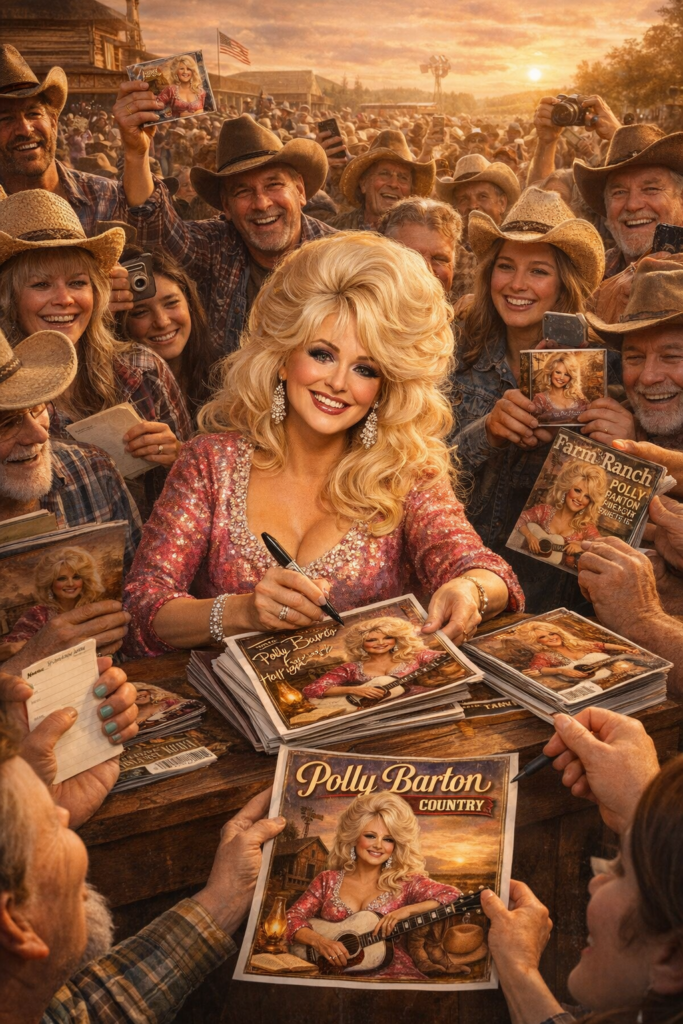
That’s why people trusted her.
Over the years, Polly Barton became something like a public secret. Everyone felt like she was singing to them, even when the song was clearly about someone else. She didn’t tell people what to think. She just stood there, smiling, telling the truth in a way that made it bearable.
Asked once how she stayed so positive, Polly laughed and said,
“Oh honey, I don’t stay positive. I stay honest. The positivity just wanders in when it feels like it.”

Now, later in her career—still touring, still writing, still surprising herself—Polly Barton is regarded less as a star and more as a fixture, like a well-loved piece of furniture that’s seen everything and still holds together.
She sings about the past without longing for it, the present without pretending, and the future like it might be listening.
And if you ask her what country music really is, Polly Barton will lean in, smile, and say:
“It’s just people telling the truth politely…
with a good melody in case the truth needs help getting in.”
===========================================================================
Here’s another album that got done in time for this blog!
===========================================================================
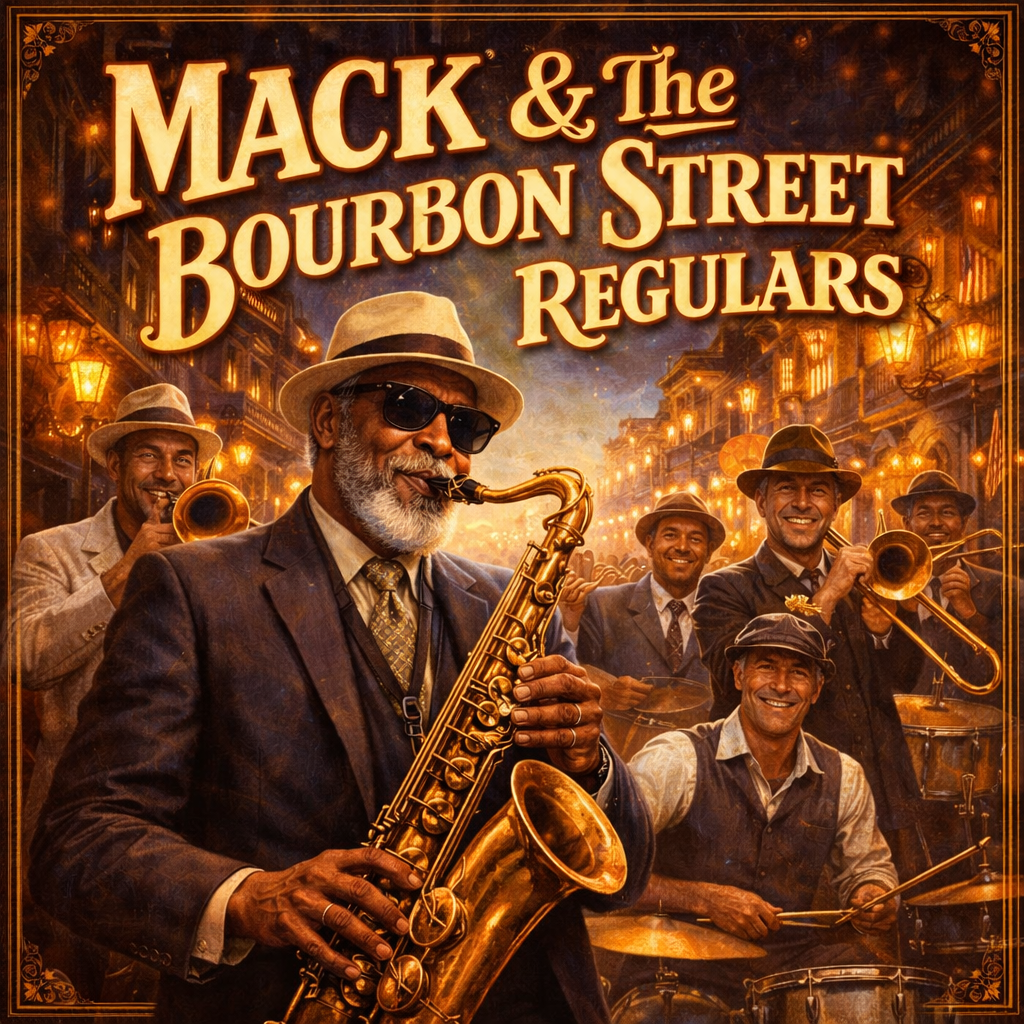
LINER NOTES
Mack & the Bourbon Street Regulars
Nobody really remembers the first night Mack played Bourbon Street — including Mack.
What is remembered is that after that night, people started saying things like, “You hear Mack lately?” and “The street sounds different when he’s on.” That’s how it goes in New Orleans. If something works, nobody files paperwork. They just let it keep happening.
Mack didn’t form the Bourbon Street Regulars. The band assembled itself the way good bands do — one chair at a time, one borrowed instrument at a time, one nod across a smoky room that said, you know this tune too, don’t you? Some nights it’s five players. Some nights it’s seven. The only fixed requirement is that you listen harder than you play.
The Regulars are veterans of every kind of gig that doesn’t come with a contract: sidewalk corners, second lines, half-lit clubs where the floor tilts just enough to make you honest, and back rooms where the music matters more than the money. They know how to stretch a song without breaking it, how to swing without rushing, and how to leave space where a story needs to breathe.
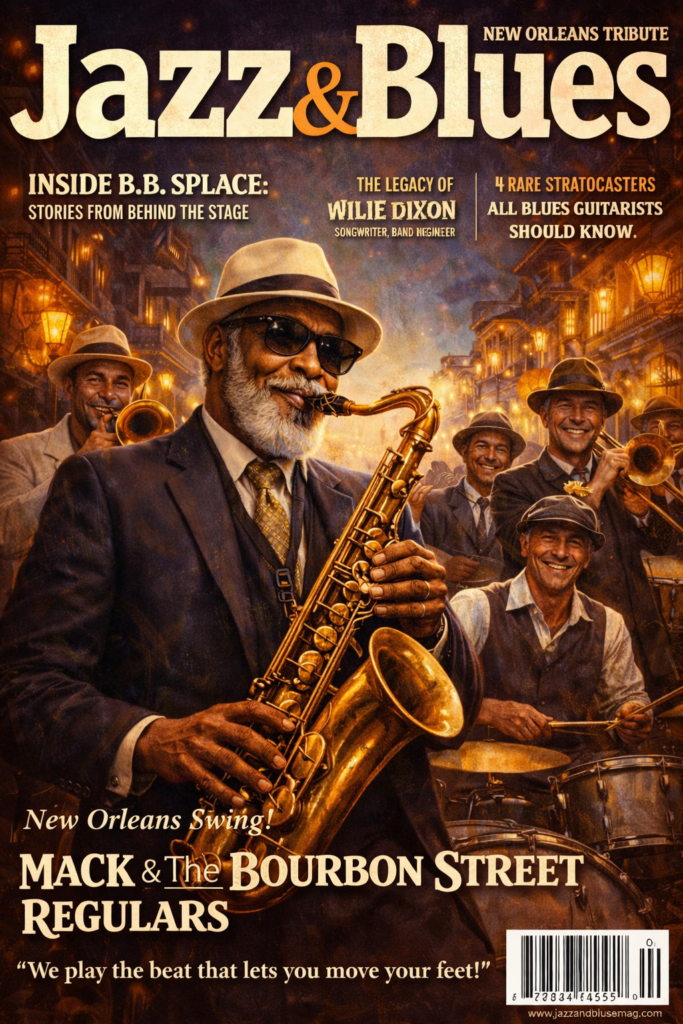
Mack leads from the keyboard, and he sings with a rough raspy voice.
The band knows where they are, and where they are going. There’s no set list in the usual sense — just a shared understanding that the groove comes first and the tune will explain itself if you let it.
This music isn’t revivalist. It isn’t museum jazz. It’s working music — blues that knows its way around joy, jazz that remembers why people started dancing in the first place. You’ll hear echoes of old masters, sure, but nobody’s trying to sound like anybody else. These players already sound like themselves.
Listen close and you’ll catch it:
the drummer laying back just enough to make the streetlights sway,
the horn section grinning through a phrase,
the tuba on the back-beat, telling the truth with a little extra weight on it,
and Mack, right there in the middle, holding it all together like he’s done a thousand times — because he has that magic voice and tempo.
Mack & the Bourbon Street Regulars don’t play to impress.
They play to keep things moving. And for the weekly check.
If your foot starts tapping, that’s intentional.
If you find yourself smiling without knowing why, that’s part of the arrangement.
And if the song feels like it could go on forever — well, some nights on Bourbon Street, it does.
Forever is a very long time. Eternity is an instant flash. Try not to forget again.
==========================================================================
Here’s the Bardo bus, folks! Climb aboard!
===========================================================================
See You At The Top!!!
gorby