


Standing Still While the World Moves
A Conversation with Rob Zillon, E.J. Gold, & Rolling Stone
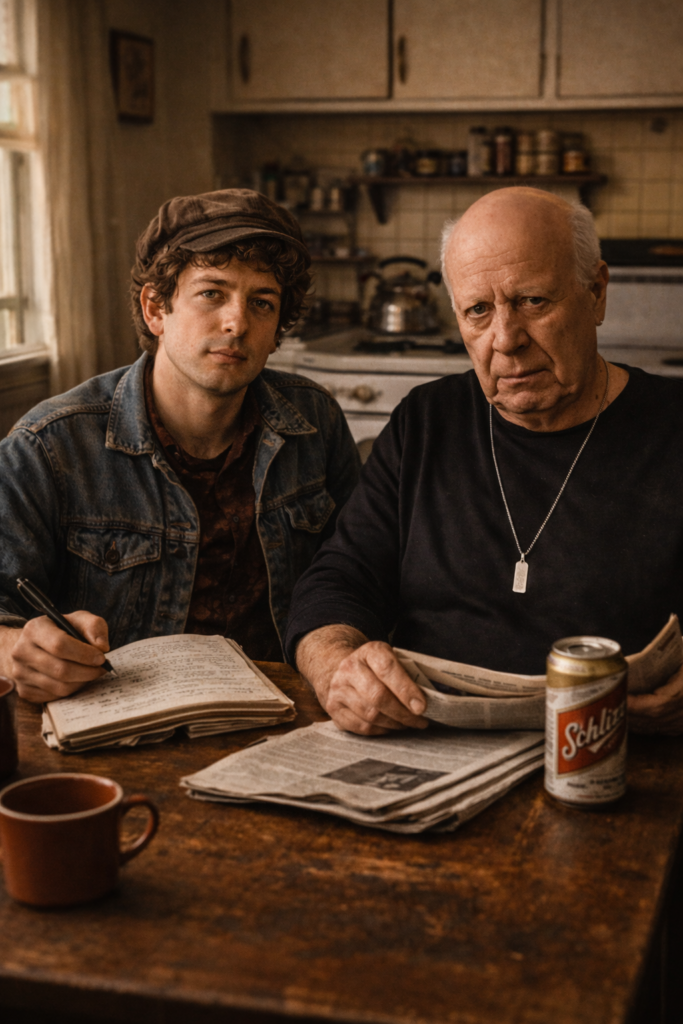
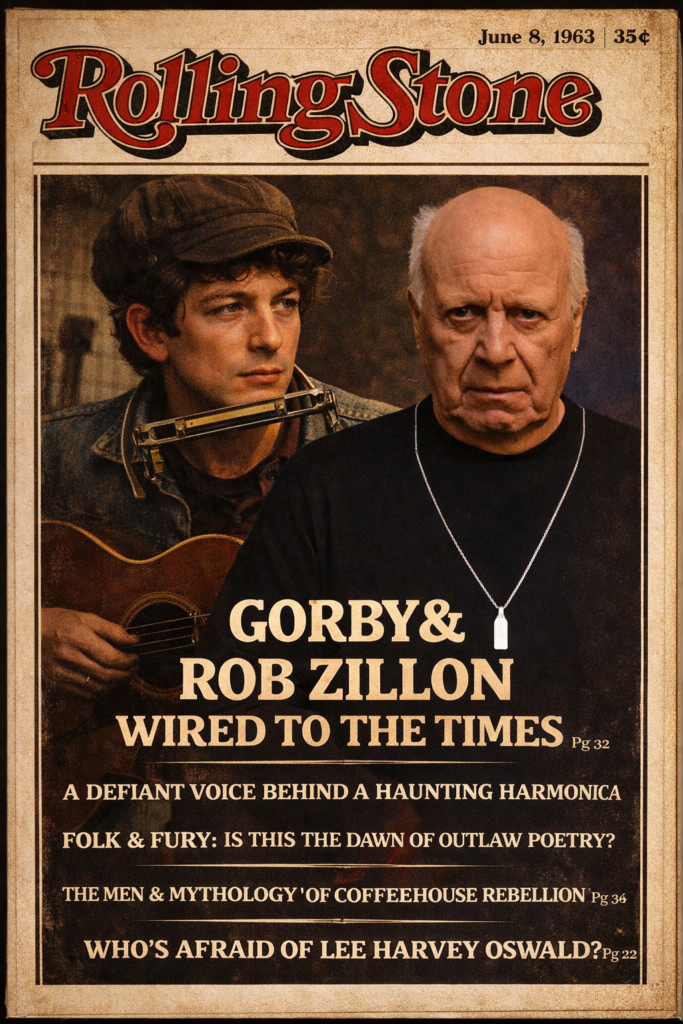
The kitchen is quiet except for the rustle of a newspaper and the soft click of a coffee cup being set down. Rob Zillon sits at the table, his guitar leaning against the wall within easy reach. E.J. Gold is sitting nearby, not so much participating as occupying the room the way a tuning fork occupies air. Nothing feels staged.
Rolling Stone: You’ve been described as a protest singer, a folk revivalist, and lately as “troubling.” Which one bothers you the least?
Rob Zillon: Troubling is fine. It means something’s working.
RS: What’s working?
Zillon: People are hearing themselves in the songs before they’re ready to.
RS: A lot of your lyrics sound observational rather than accusatory.
Zillon: Accusations are lazy. Observation takes patience. If you describe something accurately enough, it accuses itself.
RS: “The Crimes They Are A-Changin’” sounds like a response to the times, but also like a warning.
Zillon: It’s neither. It’s a weather report. Storms don’t need permission.
RS: You don’t seem interested in offering solutions.
Zillon: Solutions are usually designed to preserve the problem they’re attached to.
RS: That’s a strong statement.
Zillon: It’s an old one.
Zillon smiles briefly, then looks away, as if the thought has already moved on.
RS: There’s been some quiet talk that this album is, in part, an act of support for Bruce Springsteen. Do you see it that way?
Zillon: Support is the wrong word.
RS: How so?
Zillon: Support suggests hierarchy. Someone holding someone else up. That’s not what’s happening.
RS: Then what is happening?
Zillon: Bruce is describing the machinery from the inside. I’m describing the weather around it. Those aren’t competing jobs.
RS: So you feel aligned?
Zillon: I feel parallel.
RS: Did you talk with him about this record?
Zillon: No.
RS: That surprises me.
Zillon: It shouldn’t. When two people are paying attention, conversation is optional.
RS: Some listeners hear echoes. Working lives. Pressure. The sense that systems grind people down.
Zillon: If you listen closely enough, echoes stop being echoes and start being geography.
RS: E.J., you’ve been quiet. How do you see what Rob is doing?
EJ: He’s refusing to decorate reality. That makes people nervous.
RS: Nervous how?
E.J.: When you strip away slogans, habits, and inherited explanations, what’s left is responsibility. Most people don’t want that delivered acoustically.
RS: Rob, do you feel like you’re speaking for people?
Zillon: No. I’m speaking near them. If they recognize themselves, that’s their business.
RS: Your performances feel confrontational at times.
Zillon: Silence is confrontational if people were expecting reassurance.
RS: Folk music is having a moment again. Do you see yourself as part of a movement?
Zillon: Movements have directions. I have coordinates.
RS: Which are?
Zillon: Here. Now. This sentence. The next breath.
RS: That sounds almost spiritual.
Zillon: It sounds practical.

RS: There’s a sense that your songs are less about politics and more about perception.
Zillon: Politics is what happens when perception fails.
RS: You know that line will get quoted.
Zillon: That’s unfortunate.
RS: You don’t like being quoted?
Zillon: Quotes turn processes into decorations.
RS: Yet you continue to give interviews.
Zillon: People mistake silence for agreement. Talking slows that down.
RS: E.J., do you see this as a generational difference between you and Rob?
E.J.: No. It’s a difference in timing. He’s early. I’m later. The view is the same.
RS: Rob, do you think this work will age well?
Zillon: That depends on whether the problems do.
RS: And if they don’t?
Zillon: Then the songs become museum pieces. Warnings nobody needed anymore. I’d be happy with that outcome.
There’s a long pause. Someone pours more coffee.
RS: What do you want listeners to feel when they hear this record?
Zillon: Slightly less certain than they were before.
RS: And what do you hope they do?
Zillon: Notice what they usually step over.
RS: Final question. What’s next?
Zillon: Fewer chords. Fewer explanations. More silence between lines.
E.J.: And maybe a few more people realizing that the silence isn’t empty.
The interview ends.
===========================================================================
How to Create a Personality to Sing your Songs!
Here are the secrets, right here:
I use this method as a practice, not as a production technique. The goal isn’t to make songs, albums, or personas in the usual sense. The goal is to create an avatar I can work through, the same way a meditator works through posture or a musician works through scales.
I begin by choosing a single precise and exacting musical style including arrangement, instruments and audience, and once it’s settled, permanently fixing it.
Once chosen, I don’t improve it, decorate it, or vary it. That fixed style becomes the container. It’s important that the container be stable, because stability is what allows attention to be observed. Changing the style would be like changing posture every few minutes during meditation — it defeats the exercise.
Then I write lyrics and let them move freely. Each song is a different moment, observation, or pressure point passing through the same voice. I don’t try to make the avatar clever, likable, or marketable. I let it speak. Over time, a personality emerges that I did not consciously design. That’s the key signal that the practice is working.
As the album grows, I begin to notice distinctions that matter. Which lines feel forced and which feel inevitable. Which words belong to the avatar and which belong to my habits. I can hear when I’m pushing meaning and when meaning is arriving on its own. The avatar becomes a diagnostic instrument. It tells me when I’m present and when I’m pretending.
Because the avatar is not “me,” I can say things through it that I wouldn’t say directly. This creates psychological distance without creating dishonesty. The voice is consistent, but the self is not on the line. That makes the practice safer and more revealing at the same time.
I also listen back differently than I would to ordinary music. I’m not judging songs individually. I’m listening for continuity, drift, tension, and fatigue. The album becomes a field of evidence. I can hear where attention sharpened and where it dulled. In that sense, the album is a record of practice, not a portfolio.
Over time, the avatar stabilizes. When that happens, I can enter it deliberately, work through it, and leave it behind. That’s important. The avatar is a tool, not an identity. It’s something I use, not something I become.
This is why I don’t mix styles within a single avatar and why I don’t chase novelty. Constraint is the teacher here. The music is simply the surface where the practice leaves a trace.
Used this way, digital creation becomes a form of inner work. The songs are footprints. The real work happens in learning how to place the next step.
===========================================================================
Complete Rundown on How to Do It:
Here’s a step-by-step approach to songwriting and avatar creation:
Step 1: Choose the avatar container
Pick one musical style and lock it. One voice type, one production vibe, one tempo range, one general feel. Don’t pick the “best” style. Pick the one you can stay with without getting bored or fancy. The whole point is constraint.
Step 2: Name the avatar
Give the avatar a name and a short identity statement. Not a biography. Just a spine. Example: “Rob Zillon: quiet witness, hard truths, coffeehouse grit.” Keep it to one line.
Step 3: Set the rule
One style stays constant. Only lyrics change. That’s the practice. Write the rule down and treat it like a vow for the duration of the album.
Step 4: Do a 60-second entry ritual
Before you write, take one minute. Sit still, relax your face, and “enter” the avatar. Ask one simple question: What would this avatar notice right now? Don’t force an answer. Wait for a line, an image, or a complaint to arrive.
Step 5: Write lyrics fast and slightly messy
Write one lyric draft in one sitting. Don’t polish while drafting. Let the avatar speak in its own grammar. If it repeats itself, let it. If it contradicts itself, let it. You’re recording the voice, not proving a point.
Step 6: Keep images concrete
Aim for objects, places, overheard phrases, physical sensations. Avoid arguments. If you catch yourself explaining, replace the explanation with an image that makes the point without saying it.
Step 7: Generate the track without “improving” the style
Use the locked style patch. Resist the urge to upgrade instrumentation, add surprises, or make it more impressive. Your job is to hold the container steady so the voice can be measured.
Step 8: Listen back like a diagnostician
Don’t ask “is this a good song?” Ask: Did the avatar show up? Where did it feel real? Where did it feel like me pushing? Note one timestamp where the voice feels most alive.
Step 9: Extract the “true line”
From each song, choose one line that feels inevitable. Save these in a running document. After 10 songs, you’ll have a map of the avatar’s mind.
Step 10: Repeat for an album-length cycle
Do 12–20 tracks minimum. The avatar doesn’t stabilize until repetition builds density. Early tracks are warm-up. Mid tracks reveal habits. Later tracks start to talk back.
Step 11: Add one deliberate “stress test”
Once the avatar feels stable, write one lyric that challenges it: grief, temptation, fame, fear, tenderness, shame, money, power. Keep the same style. See if the avatar stays coherent under pressure.
Step 12: Close the session cleanly
When you’re done, “exit” the avatar on purpose. Say out loud: that was the avatar, not me. Take a short walk, drink water, change rooms—anything that breaks the spell. This keeps the tool from becoming an identity.
Step 13: Assemble the album as one being, not many tracks
Order the tracks to feel like a single personality moving through weather: opening statement, rising pressure, turning point, acceptance or refusal, final stance. Think of it as a diary of attention.
Step 14: Optional: create supporting artifacts
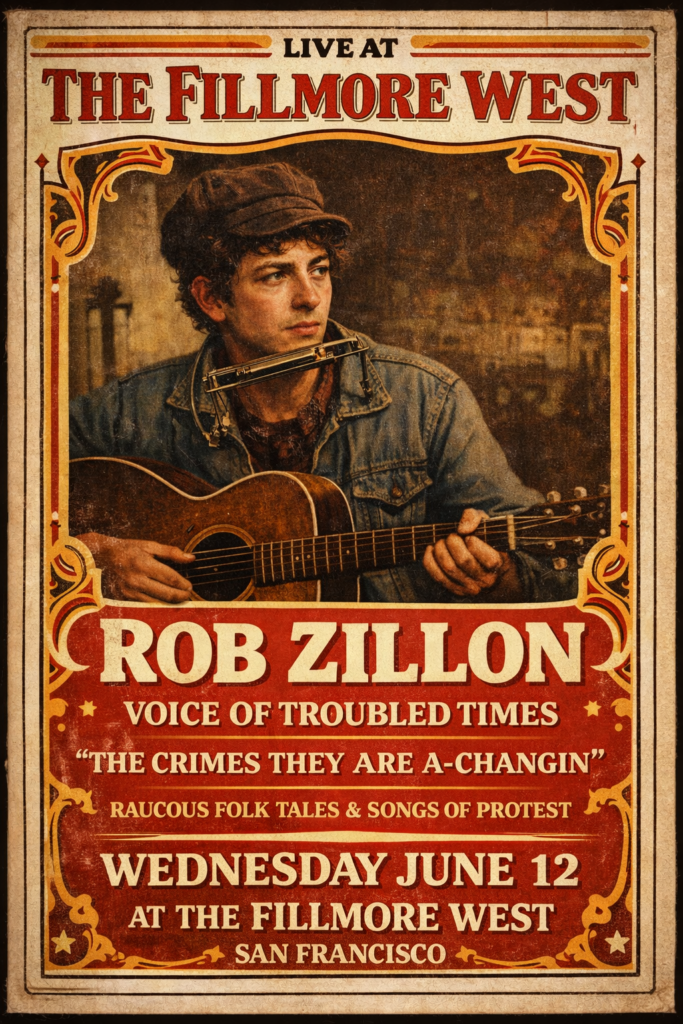
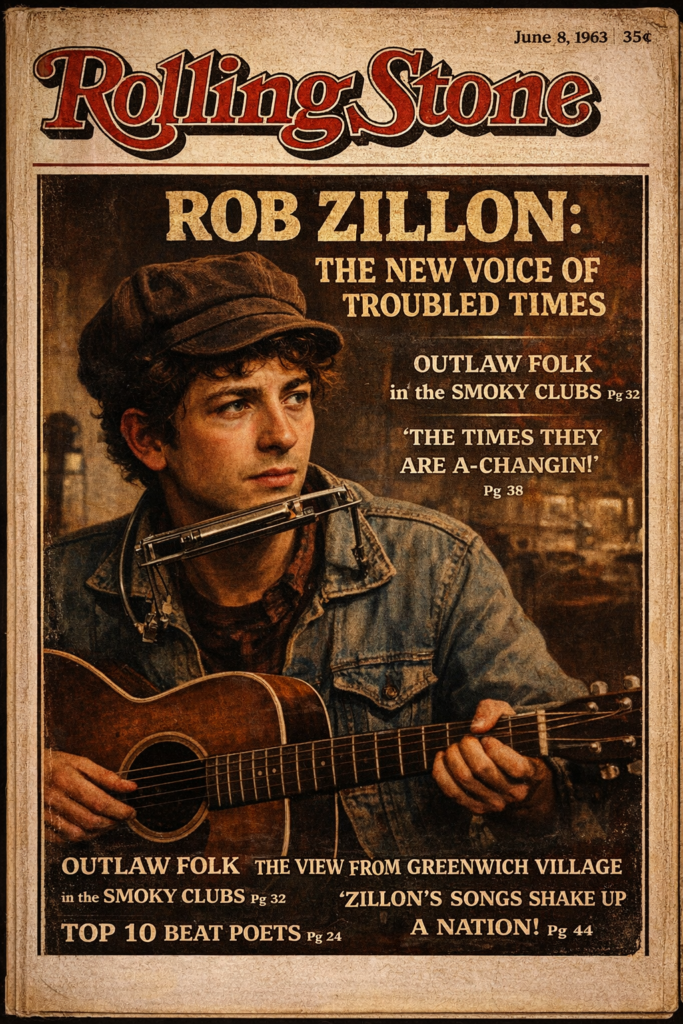
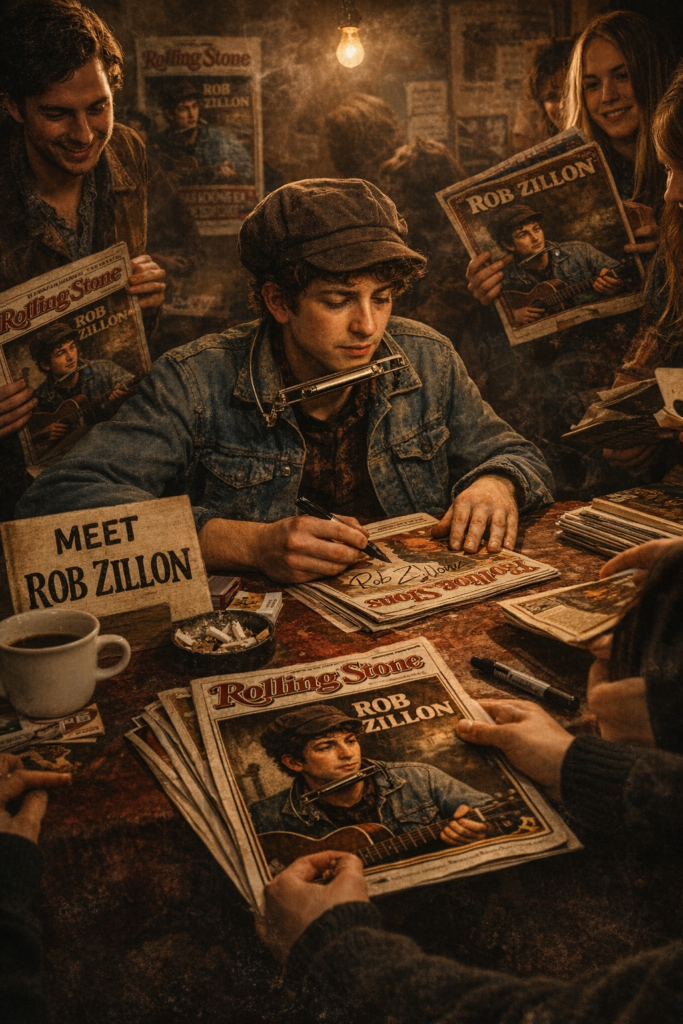
One cover. One short bio. One interview. One live poster. One candid photo. Keep these consistent. They’re not marketing fluff; they help the group mind hold the avatar steady.
Step 15: Use it in circle practice
Have practitioners listen and report what they noticed, not what they liked. Ask: What did the avatar notice that you didn’t? What line stuck in your mind? Where did the voice feel cleanest?
===========================================================================
Hey, here’s the Bardo bus! Watch out! Hop on board, quickly there!
===========================================================================