


Sister Sara Simmons
LINER NOTES
There are some voices that don’t belong to a person. They belong to a room. Sister Sara Simmons is one of those voices.
No one can quite agree when she first sang in public. Some say it was in a borrowed church with folding chairs and a piano missing three keys. Others insist it happened outdoors, under a stormy sky that wouldn’t make up its mind, with people gathering because they heard something before they saw anything. What is agreed upon is this: when Sister Sara opened her mouth, the room leaned in.
She never advertised herself as a singer. She didn’t need to. People simply noticed that when she sang, things loosened. Shoulders dropped. Arguments paused. People remembered why they came.
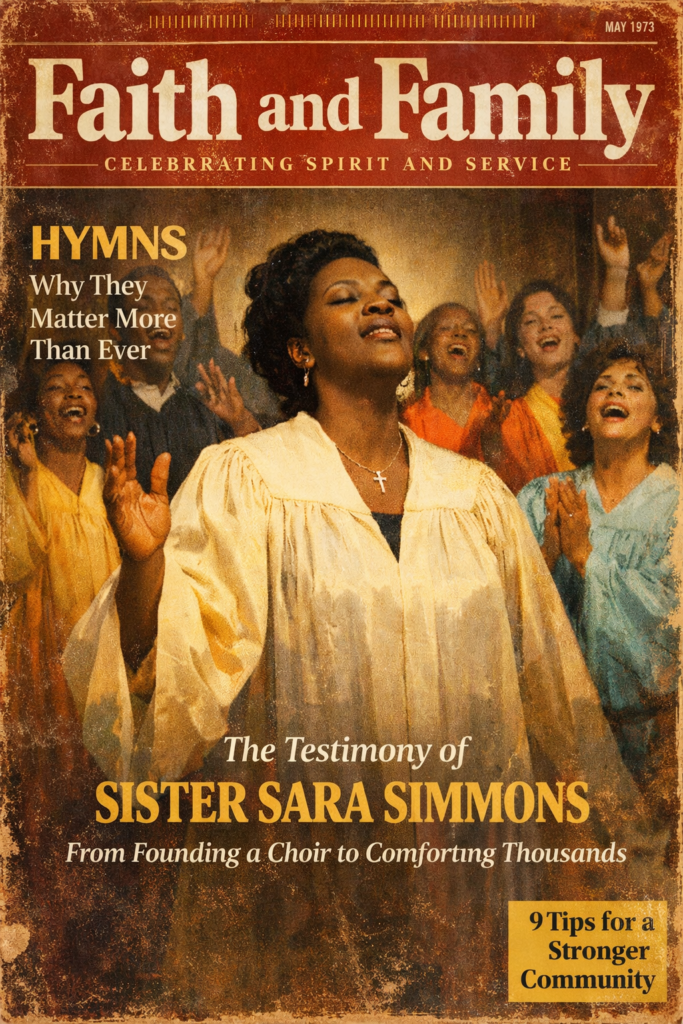
The choir came next — not recruited, not auditioned. They arrived the way choirs always arrive in the real world: one voice staying behind after rehearsal, another stepping forward from the pews, someone humming harmony without realizing they were doing it. Before long, there were too many voices for the room, and the room had to learn how to hold them.
They came to be known, eventually, as The Rising Light Choir, though Sister Sara herself rarely used the name. “A choir is just a crowd that learned to breathe together,” she once said, and that was the end of the explanation.
This record does not attempt to capture a performance. It couldn’t. What it captures instead is a condition — that moment when song stops being something you listen to and becomes something that happens to you.
Listen closely and you’ll hear it.
You’ll hear how the choir doesn’t push the rhythm forward — it waits for it. You’ll hear how the clapping isn’t decoration, but navigation. You’ll hear the way voices lean against one another, not to show strength, but to share weight. And above it all, you’ll hear Sister Sara, never dominating, never disappearing — guiding, signaling, opening doors and then stepping aside so others can walk through.
There are no solos here in the usual sense. When Sister Sara steps forward, it’s only to point back to the group. When the choir swells, it does so not to overwhelm, but to carry. This is music built for rooms where people have known loss, hope, confusion, laughter, and the quiet realization that they’re not alone after all.
These songs were recorded in fragments — some late at night, some early in the morning, some when no one could quite remember why they’d gathered except that it felt necessary. You may notice breaths left in. You may notice hands brushing microphones. That’s intentional. This is not polish. This is presence.

If you’re looking for perfection, you won’t find it here. If you’re looking for alignment, you will find what you’re looking for.
Sister Sara Simmons does not claim to heal anyone. She would tell you that healing is a group activity, and that song is just a way of reminding the body what it already knows how to do. The choir would nod. Someone would start clapping. And before you realized it, you’d be standing too.
Play this record loud enough to fill the room, or soft enough to fill yourself. Play it alone, or play it when others are nearby. Let it run from start to finish, or drop the needle where your hand happens to land. It will meet you there.
And if, somewhere between tracks, you find yourself humming along without remembering when you learned the melody — don’t worry.
That’s how it works.
===========================================================================
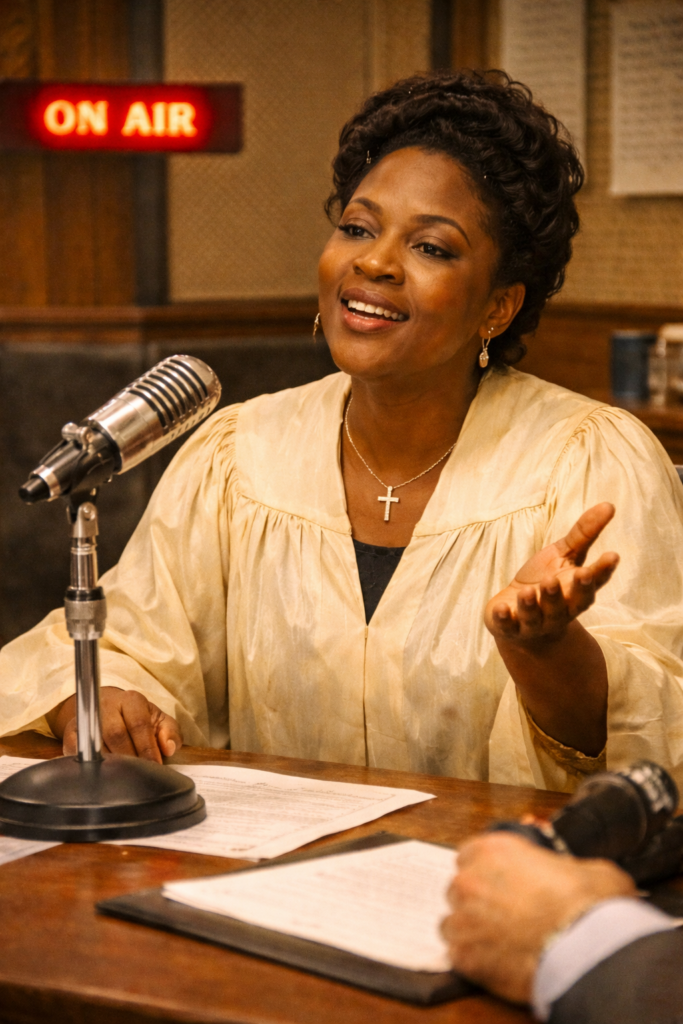
AN INTERVIEW WITH SISTER SARA SIMMONS
Q: People talk about your voice as if it were something separate from you. How do you hear that?
SISTER SARA: I hear a room. I don’t hear a voice. A voice by itself doesn’t do much. A room does.
Q: When did you realize people were coming specifically to hear you sing?
SISTER SARA: When they stopped leaving right away. You can tell. Folks linger. They sit down again. They don’t rush the door.
Q: You never billed yourself as a soloist, even early on.
SISTER SARA: I wouldn’t know how. A solo doesn’t last very long. A group can hold something open.
Q: How did the choir form?
SISTER SARA: I don’t think it did. I think it appeared. One person would stay behind. Another would start answering back. Somebody would find a harmony without looking for it. That’s not organizing — that’s noticing.
Q: Did you ever audition singers?
SISTER SARA: No. You don’t audition a heartbeat.
Q: The Rising Light Choir is known for blending voices instead of highlighting them.
SISTER SARA: We’re not trying to be heard. We’re trying to be felt. If one voice sticks out too much, it’s usually because something else hasn’t found its place yet.
Q: Some people say the choir sounds different every night.
SISTER SARA: It should. People don’t arrive the same way twice.
Q: These songs feel less like performances and more like… events.
SISTER SARA: That’s because they’re not finished until someone listens. Singing is only half the work.
Q: Do you think of this music as gospel?
SISTER SARA: Gospel just means good news. If it brings good news to your body, then yes.
Q: What kind of preparation goes into a revival meeting?
SISTER SARA: Chairs. Water. Enough space for people to stand up if they need to. The rest takes care of itself.
Q: You often let the choir carry the song while you step back.
SISTER SARA: Someone has to hold the door. Someone has to walk through it. You can’t do both at the same time.
Q: What do you hope listeners take away from this record?
SISTER SARA: I hope they take themselves a little less tightly. I hope they remember what it feels like to answer back.
Q: Answer back to what?
SISTER SARA: To life. It’s always calling. Most folks just forget they’re allowed to respond.
Q: One last question — do you believe music can change people?
SISTER SARA: Music doesn’t change people. People change people. Music just reminds us how.
===========================================================================
Here’s the Bardo bus!
===========================================================================
See You At The Top!!!
gorby