

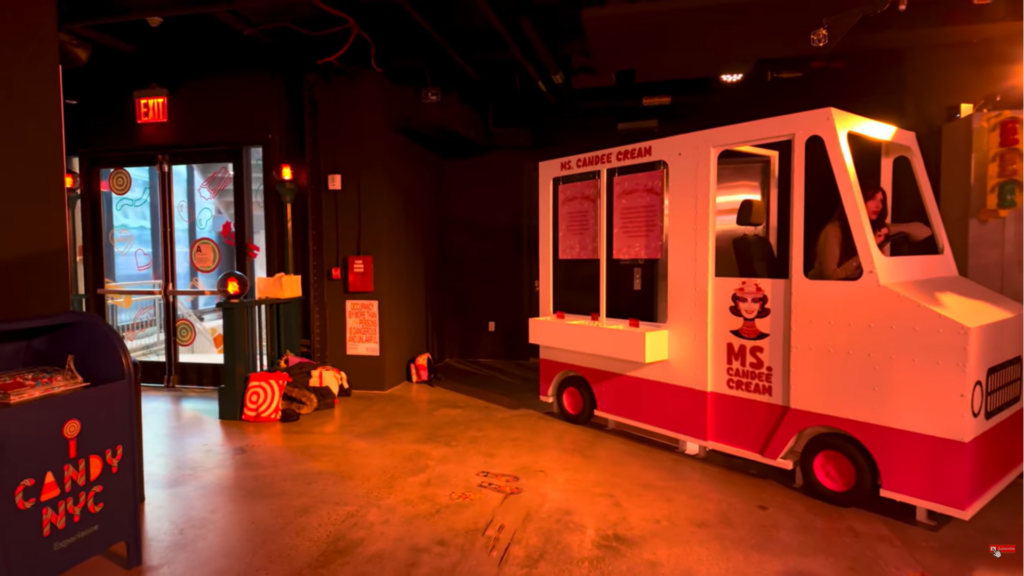
I was watching a video by Afraz on YouTube today. He’s on YouTube every day from New York City, and this one was about New York City’s newest candy store — an experiential walk-through.
You’re surrounded by that unforgettable Times Square brightness. You enter a building at One Times Square. Inside, it feels like a Disney World “Tea Cup” ride crossed with a Pirates of the Caribbean walk-through — except everything is sugar.
Candy is everywhere. The clerk casually mentions gummies. The place looks like Willy Wonka signed a lease and hired a Broadway lighting designer.
It’s called iCandy NYC. At first glance, it’s a sugar carnival — colors blasting, surfaces gleaming, everything engineered for delight and selfies.
But then something clicked.
This isn’t a street-level candy shop.
There’s no casual drifting in from the sidewalk. No window shopping while waiting for a bus. You don’t just wander through a door because it happens to be there.
You buy a ticket — about forty dollars.
You go upstairs.
You ascend into it.
And that changes everything.
A ground-floor store depends on foot traffic and impulse. It lives off the randomness of the street. But when retail moves upstairs — into lofts, into vertical space — it stops being convenience and becomes intention.
You are no longer shopping. You are entering a constructed world.
In older New York, you climbed stairs or took shaky industrial elevators to reach artists’ studios, experimental theaters, garment workshops. Upstairs meant something deliberate was happening. It required effort. It filtered the casual browser from the person who came with purpose.
Now those same vertical spaces can house immersive candy worlds.
Candy becomes the pretext. Environment becomes the product.
You move through curated floors, controlled lighting, designed transitions. You rise into a constructed reality and eventually descend back to the sidewalk — of course, always through a shop where you can buy special products and souvenirs.
It’s a subtle architectural signal: this is not merely merchandise. This is experience.
The street remains noisy, chaotic, democratic. But above it — behind elevator doors and stairwells — worlds are being built.
Not storefronts.
Worlds.
You leave with a bucket full of candy in your hand — more if you purchased something special on the way out.
What you really purchased was participation.
And that’s where it gets interesting.
More and more of modern life has moved upstairs. Music has moved upstairs. Art has moved upstairs. Even identity has moved upstairs. You don’t just buy a record — you enter a sonic environment. You don’t just look at a picture — you step into a framed field of attention. You don’t just browse — you commit.
The vertical move matters.
Upstairs has always meant something psychologically. You rise out of street-level noise. You leave the mechanical drift of foot traffic and enter something chosen. Something constructed. Something intentional.
In older traditions, climbing stairs symbolized moving from the outer world to the inner chamber. From distraction to design. From randomness to awareness.
Maybe that’s why this candy loft feels more like ritual than retail.
You pay.
You ascend.
You participate in a designed reality.
You descend.
You return to the street.
But if you were paying attention, you may have noticed something subtle: the real product wasn’t sugar at all. It was the experience of stepping into a created world — and recognizing that someone built it.
And once you see that, you start noticing something else.
There are worlds above the sidewalk everywhere now.
Some are built of candy.
Some are built of light and sound.
Some are built of stories.
Some are built of vibration.
The question isn’t what they’re selling.
The question is:
Which stairs are you willing to climb?
=================================
Here’s the Bardo bus!
=================================
See You At The Top!!!
gorby