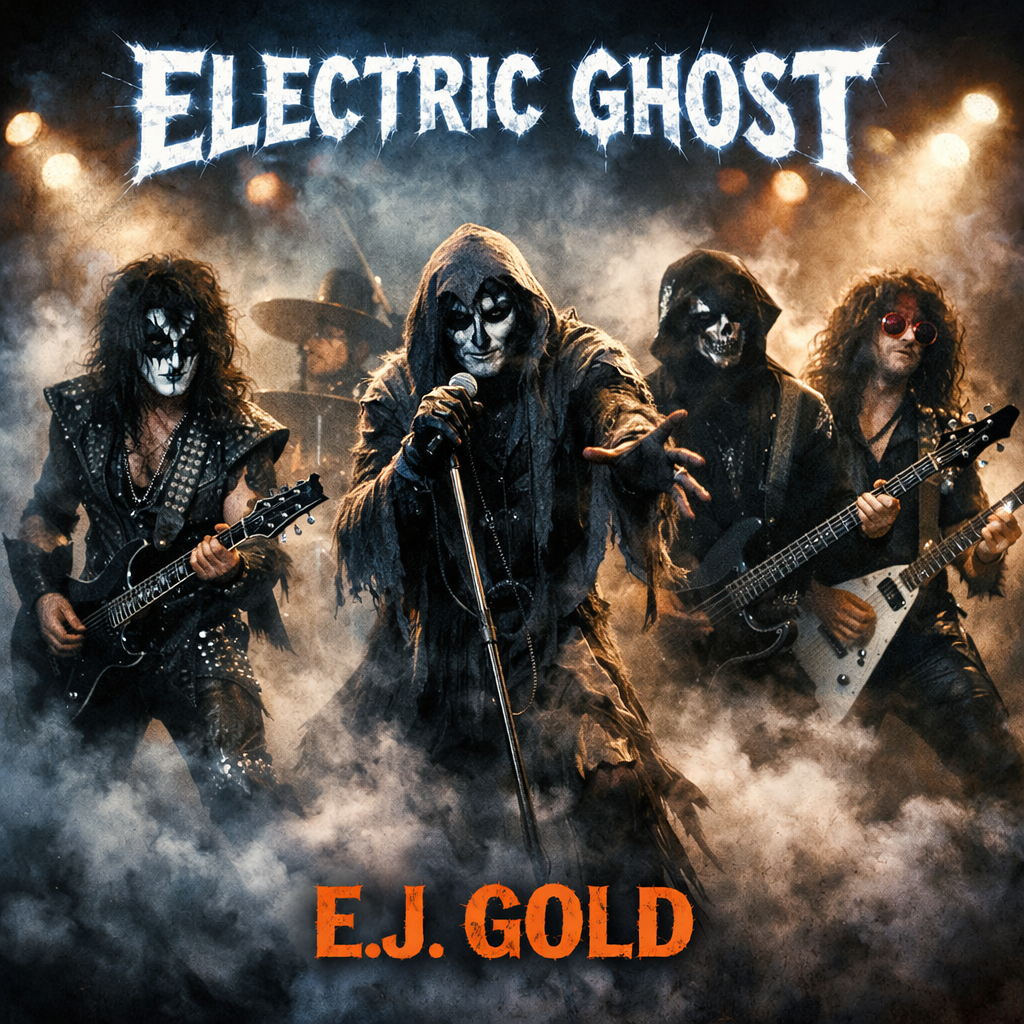
Electric Ghost did not “form” in the usual sense. There were no flyers, no ads for a drummer, no accidental garage rehearsals that turned into destiny. Instead, the band was assembled deliberately, with intent, inside a space that most artists still pretend doesn’t exist.
Electric Ghost was designed. Not fabricated — designed.
Long before the first photo appeared, before the smoke machines and skull paint and scorched amplifiers, the question was already on the table: what would it take to create a band that exists fully in the digital world without pretending to be analog first?
“Most artists treat the digital space as a copy machine,” E.J. Gold says. “You make something ‘real,’ then you post it. Electric Ghost reverses that order.”
The band exists simultaneously as music, image, narrative, and presence. Album covers appear before albums feel finished. Magazine features precede tours. Backstage photos exist before the backstage does. None of this is accidental.
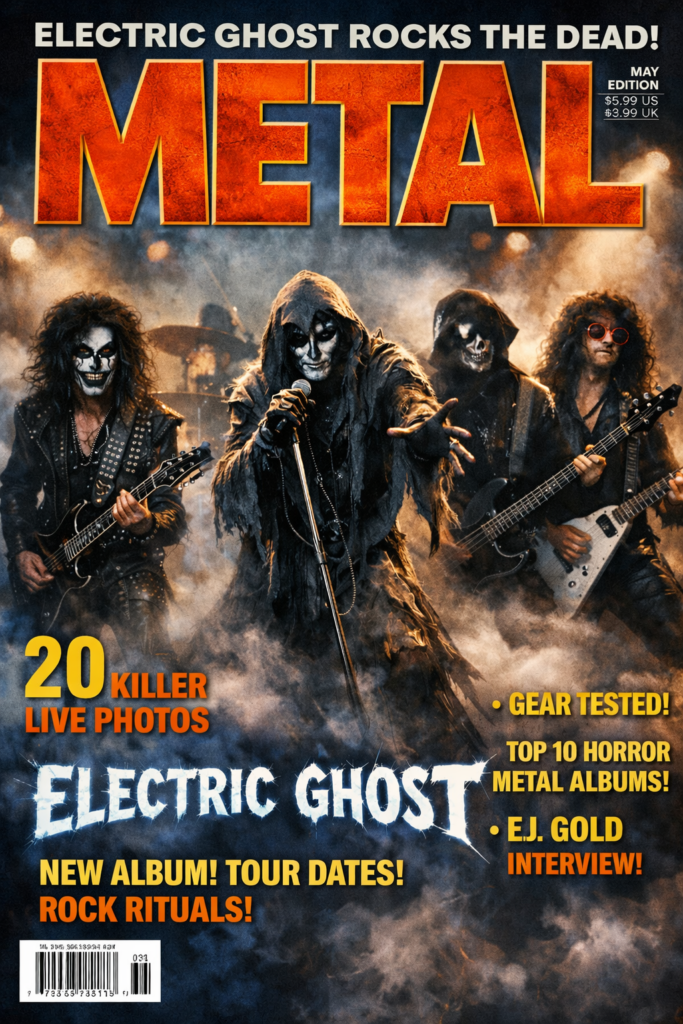
“It’s not deception,” Gold says. “It’s architecture.”
Electric Ghost is among the first projects to treat digital identity not as marketing, but as a practice. The band is not playing characters; they are operating an avatar that is larger, heavier, and more coherent than any single performance could be. Each image reinforces the next. Each appearance deepens the myth.
The members describe it as liberating.
“When you stop pretending you’re ‘just a band,’ you can actually focus on the work,” the guitarist explains. “We’re not waiting for permission from reality.”
The backstage photos say as much. Gold stands among them not as a manager or producer, but as a stabilizing constant — the human anchor inside a deliberately non-human system. The contrast is intentional: a man with no costume inside a band built entirely of one.
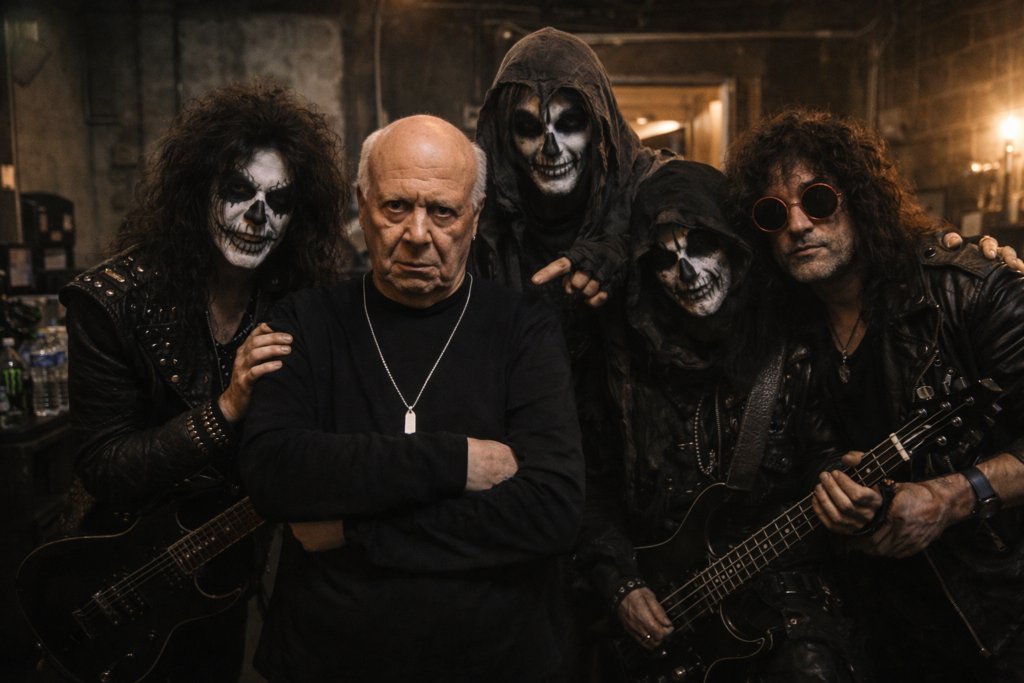
“Digital doesn’t mean unreal,” Gold says. “It means distributed.”
Electric Ghost’s rise bypasses traditional stages. They don’t need radio. They don’t need clubs. They don’t need gatekeepers who require proof of existence before belief. The belief comes first.
“This is what superstardom actually looks like now,” Gold says. “Recognition before arrival.”
At home, the band is disarmingly ordinary — pizza boxes, controllers, books, quiet tuning sessions. That too is part of the design. The digital avatar absorbs the excess so the humans don’t have to.
“The ghost carries the weight,” one member says. “We just play.”
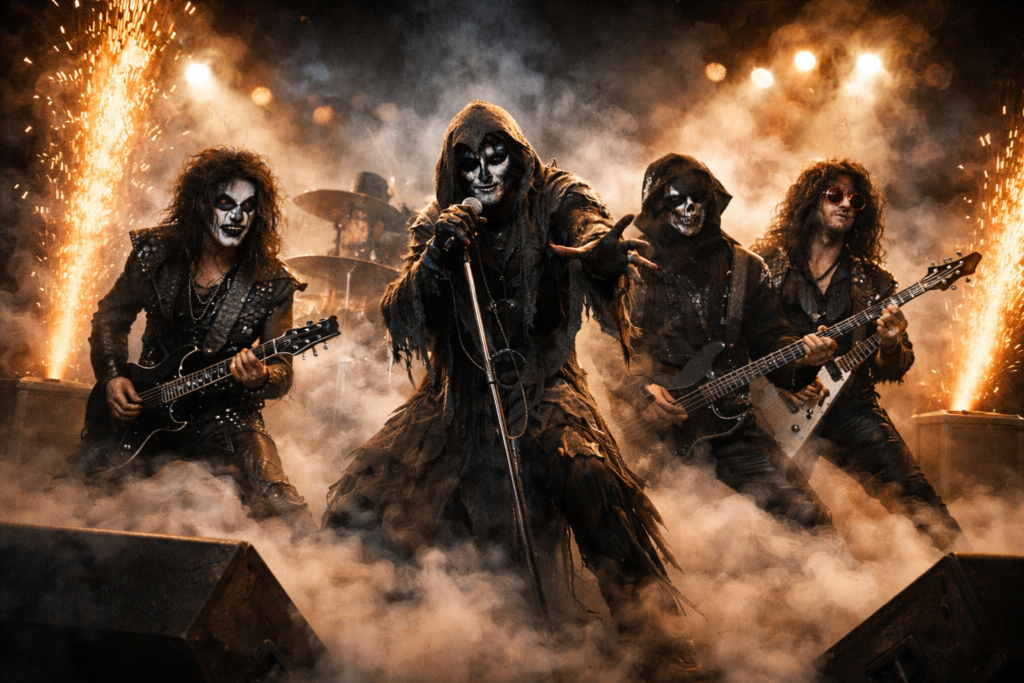
Onstage, the effect is unmistakable. The crowd doesn’t watch a band; they witness a manifestation. The smoke, the sparks, the repetition — it feels less like a concert and more like a broadcast from somewhere adjacent to the room.
Gold doesn’t deny the ambition.
“Of course it’s intentional,” he says. “Unconscious fame is over. Accidental icons are a thing of the past.”
Electric Ghost treats fame as a medium, not a reward. Visibility as an instrument. Myth as infrastructure.
They are not waiting to be discovered.
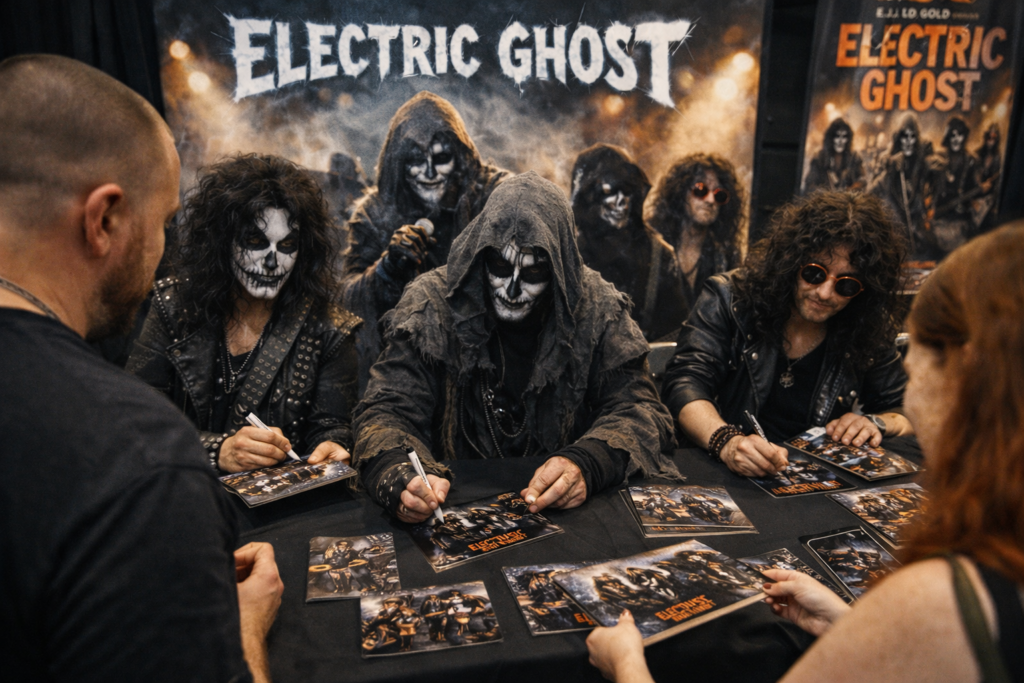
They are demonstrating how discovery now works.
If earlier generations became stars by surviving the system, Electric Ghost was built after the system collapsed — designed to move through feeds, images, performances, and expectations without resistance.
“This is not the future,” Gold says, almost dismissively. “This is the present catching up.”
Electric Ghost isn’t asking whether a digital band can be real.
They’re answering a more interesting question:
What happens when organic reality stops being a prerequisite?
===========================================================================
===========================================================================
Hey, willya lookit at that? There’s the Bardo bus already! How time flies!
===========================================================================
See You At The Top!!!
gorby