

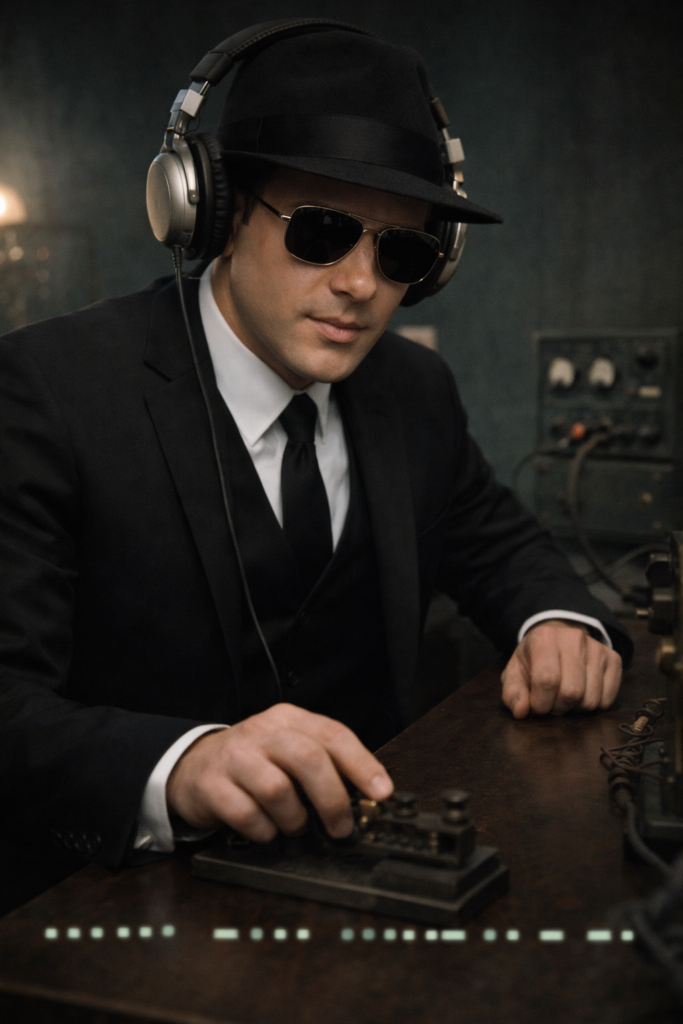
The Quiet Language:
Secret Communication Through Morse Code
Long before the internet, long before encrypted messaging apps, there existed a remarkably simple system that allowed human beings to communicate across great distances — and sometimes right under the noses of people who did not want them to communicate at all.
That system was Morse code.
Morse code was used in telegraphy before voice communication became practical. In combat, human voice is often muffled or blocked, and the dits and dahs of code could break through and overcome the static and distortion of voice comm.
Morse code is not really a language. It’s a rhythm system. A pattern of short and long pulses that represent letters and numbers. Once you understand that idea, the door opens to something interesting: Morse code can travel through almost anything.
It can move through sound, through light, through vibration, through motion.
That flexibility made it one of the most adaptable communication systems ever invented.
I first encountered Morse code in the early 1960s when I was serving in the U.S. Army.
My job involved listening to signals and translating them into keystrokes. At first, beginners think of Morse as dots and dashes on a chart. But after enough hours with headphones, the brain stops translating. The patterns become sounds, almost like little musical phrases.
There are only two possible choices: short dot and long dash, but it isn’t all that easy. You don’t think “dot dash dot dash.” You simply hear a rhythm, and your fingers type the letter automatically.
That experience reveals something important: Morse code is not really visual at all. It is rhythmic. And rhythm can hide almost anywhere.
Because of that, Morse code has always had a quiet reputation as a tool for secret communication. Throughout history people have used Morse patterns in surprisingly subtle ways.
Prisoners of war, for example, sometimes communicated between cells by tapping on pipes or walls. A short tap followed by a longer tap could represent different characters. Guards might hear only random knocking, while trained ears recognized words forming in the rhythm.
In other situations the signal might travel through light instead of sound. A flashlight beam briefly covered and uncovered can form the same patterns. Short flash, long flash, pause. The message travels invisibly to anyone who does not know the code.
Even everyday objects can carry the rhythm.
A pencil tapping on a table.
A sequence of knocks on a door.
Two squeezes of the hand, then a pause, then another squeeze.
Coughing in dih-dah patterns.
Singing or playing instruments.
To an observer it may look like nervous movement or casual fidgeting. To someone trained in the rhythm, it can be an entire conversation.
One of the most famous Morse signals in the world is the distress call:
SOS
Three short pulses
Three long pulses
Three short pulses
That pattern became universal because it is unmistakable, even through weak or distorted signals. Sailors could flash it with lamps, radio operators could send it through static, and anyone who knew Morse would recognize it instantly.
The power of Morse lies in its simplicity. It requires almost no equipment. A radio transmitter helps, but it is not necessary. A surface that can carry vibration is enough.
And because the system is rhythmic rather than spoken, it can exist quietly inside ordinary movements.
In a strange way, Morse code demonstrates a deeper truth about communication. Human beings are extraordinarily good at recognizing patterns in sound and time. We do it with music. We do it with speech. And once trained, we can do it with Morse as well.
The rhythm carries the meaning.
So remember, long before digital encryption and secure messaging networks, people discovered that sometimes the most effective way to send a message was simply to hide it in plain sight — inside a pattern that only trained ears would notice.
A table tap. A flicker of light. A sequence of knocks on a wall. To most people, nothing at all. To someone who knows the rhythm, a message is passing quietly through the air. And once you have learned to hear those patterns, you never quite stop noticing them.
===========================================================================
HERE’S THE KEY TO THE MATRIX:
- Gorby on Bourbon Street
- Janice & Lost Horizons
- Polly Barton Stone Country
- Jim Morsen
- British Invasion Acid Rock
- Barbershop
- Cabaret
- Anders Sisters Swing
- Sotchomo Brass
- Grand Opera
- Rob Zillon Folk
- Victorian Operetta
- Minkeez
- Doo-Wop
- Sister Sara
- LIVE Festival
- Zulu Village
- Progressive Modern Jazz
- Psychedelic
- Beatles 1
- Mississippi Delta Blues
- Broadway Musical
- Beatles 2
- Beatles 3
- Beatles 4
- Mersey Beat
The single extra style is the Mersey Beat, sometimes used, sometimes not. The numbers will correspond to the song title in most cases, although there are exceptions.
So when we do an exercise with the songs, you’ll know exactly what you’re listening to.
The different Beatles patches represent different times in their career. You’ll want to personalized these — I don’t intend that you’d cut & paste, when you have the glorious opportunity to invent a “band-sound” for yourself.
I’ll gladly help you figure it out, at the Easter Workshop, “Power of Song”, which is coming up very soon, hope to see you there! In the meantime, use this short list to help you identify the genres of the songs that I’ll be demo’ing each day.
===========================================================================
Oh! The Bardo bus is here! Get on board fast before it’s too late!
===========================================================================
See You At The Top!!!
gorby