Friends, blog readers, and everyone in our Zoom circle—
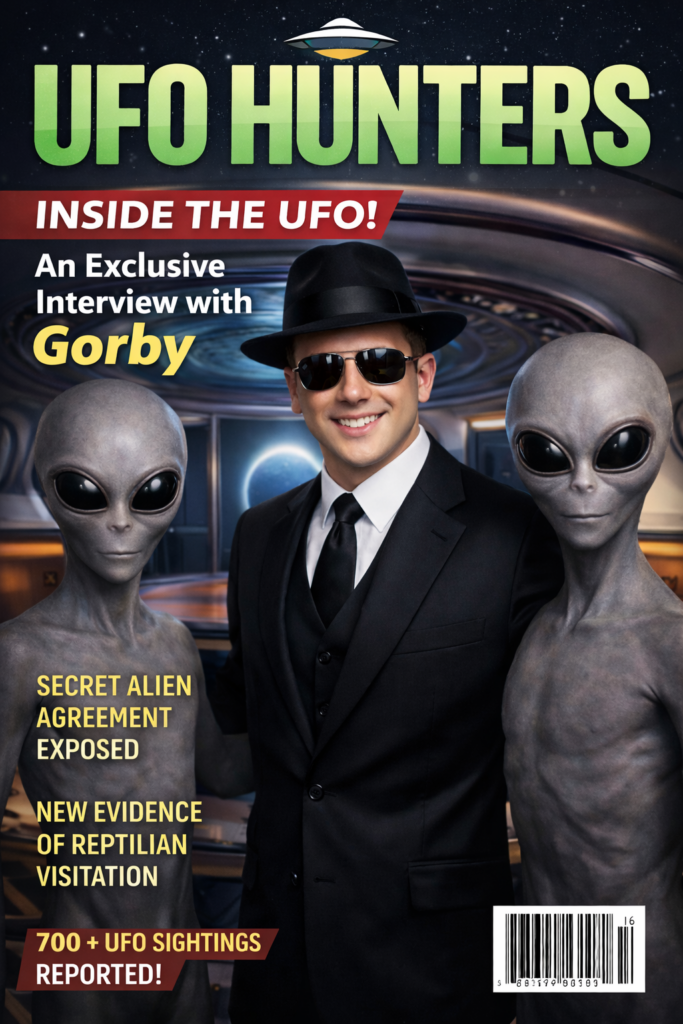
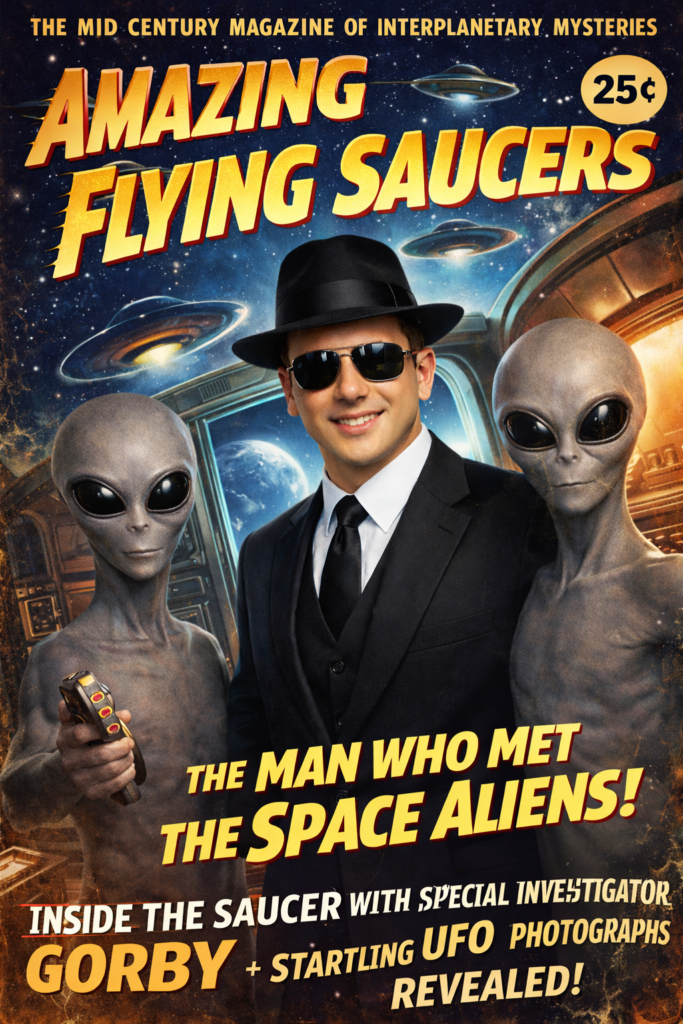
Something interesting happened tonight while we were playing around with images. We produced what started as a humorous photo—me standing inside a UFO with two Greys—and then turned it into a magazine cover. The result was surprising. It didn’t just look like a joke or a novelty graphic. It looked like a real pulp magazine cover you might see on a newsstand.
That’s worth thinking about for a moment.
There is a very specific formula those old UFO and paranormal magazines used. If you follow that formula, the human mind instantly reads the image as a legitimate publication. The elements are simple but powerful:
A big, dramatic title across the top.
One bold headline promising a shocking revelation.
Several smaller teaser stories hinting at hidden knowledge.
A dramatic photograph or illustration.
And the little details—barcodes, blurbs, and layout clutter—that make it feel authentic.
Once those ingredients are present, the brain fills in the rest. Suddenly it feels like something you could pick up at a checkout counter in the grocery store.
The photo composition helped a lot. Putting a human figure in the center—with two Greys standing on either side—creates the sense of an “exclusive encounter” or a press photo taken at a secret meeting. That’s exactly the kind of visual pulp magazines love. It looks like evidence. It looks like a scoop.
The hat and sunglasses help too. That little detail changes the story instantly. Instead of looking like a tourist who wandered into a spaceship, the figure suddenly reads as an investigator… a contactee… maybe even a whistleblower who knows something the public doesn’t know yet.
That’s pure pulp-magazine territory.
What’s interesting about this is that it opens up a fun creative direction for anyone working with images, stories, or music in our group. You can take a single photograph and turn it into an entire fictional world simply by presenting it in the format of a magazine cover.
Imagine a continuing series of covers such as:
“The Gorby Contact Files”
“Inside the Craft: What the Aliens Told Me”
“The Night the Greys Landed in California”
“Secret Meeting Aboard the Saucer”
“Government Files They Tried to Destroy”
Each one would feel like another issue in an ongoing investigation.
For those of you who like storytelling, visual art, or even songwriting, this is a useful little lesson. Format and presentation are incredibly powerful. When you place something inside a recognizable framework—a magazine cover, a concert poster, an album sleeve—the audience instantly understands the story you’re telling.
In other words, the frame creates the reality.
And in a way, that connects beautifully with the old pulp tradition. Those magazines were dramatic, exaggerated, and sometimes outrageous—but they invited people to imagine worlds just beyond the edge of ordinary life.
Which, if you think about it, is exactly the territory we enjoy exploring together here.
So don’t be surprised if you start seeing a few more “mysterious magazine covers” appearing from time to time. Once you realize how easy it is to create them, it becomes a wonderful playground for imagination.
I’m tempted to open a magazine shelf somewhere. UFO confessions — or UFO Crime Detective — maybe?
===========================================================================
People sometimes frame AI music as a replacement for musicians, but what it’s actually doing is creating a huge new layer of creative production — especially for indie artists, storytellers, game makers, and experimental musicians.
In other words, the “record industry” may resist it, but the creative frontier markets are wide open.
Functional music (music that does something)
This market is exploding.
Instead of entertainment, the music has a purpose:
-
sleep tracks
-
meditation / focus music
-
anxiety reduction
-
study music
-
sound baths
-
healing or “frequency” music
We’re actually already in this territory with our Music Medicine ideas and meditation tracks.
What’s happening commercially is that people buy or stream this music because it solves a problem, not because it’s a hit single.
Typical markets:
-
wellness apps
-
meditation platforms
-
therapists and coaches
-
yoga studios
-
sleep apps
This category is enormous and still expanding.
Something interesting about our work
We’re all accidentally sitting right at the intersection of several of these:
-
functional music (meditation / healing)
-
fictional bands
-
game soundtracks
-
personality-driven storytelling
That combination is actually very unusual.
Most musicians only work in one lane.
===========================================================================
Grab a hold of the Bardo bus as it whips around the corner!
===========================================================================
See You At The Top!!!
gorby