


🎻Suite: Eight Slavonic Dances
by E.J. Gold
Long ago, beyond the reach of maps and memory, there was a village that appeared only in the mist — a place of ritual, rebellion, love, loss, and laughter. Some say it still dances just beneath the surface of our waking world. This ballet is a reconstruction of the village’s final day, told through movement, light, and the ghost of folk melody.
1. Dance of the Weather Witches
The curtain rises on a crossroads at dawn. Cloaked figures swirl and sweep, stirring wind and thunder with their skirts and staffs. The witches are not evil — they are elemental, balancing sky and soil. They summon the day and spin fate like wool.
2. Midnight Wedding at the Moss Chapel
Under moonlight, two lovers flee to the ancient grove, where the moss-draped spirits of the forest serve as silent witnesses. Their vows are whispered, and the veil between worlds briefly lifts — the dead bless the living.
3. The Turnip Rebellion
Morning comes. The villagers rise up against the corrupt mayor and his tax men. What begins as a muttering storm of feet becomes a chaotic dance of overturned carts and swinging scythes. Turnips fly. So does dignity.
4. Lament of the Clockmaker’s Daughter
In the aftermath, the clockmaker’s daughter stands alone amid broken gears and silent chimes. She dances through memories of her vanished lover — time falters, loops, and finally… stops.
5. Festival of the Nine Lanterns
Night falls, and the village remembers joy. Children in masks, elders in ribbons, lanterns in every hand. The festival begins — not despite grief, but because of it. The dance turns wild, radiant, half-drunk on the flickering firelight.
6. Hearth Blessing (For the Returning Dead)
The music quiets. Candles are lit in every home. The villagers kneel, calling out names in the smoke. The ancestors return, not as phantoms, but as warmth. Dancers swirl as flames, drifting through memory and marrow.
7. Baba Yaga’s Shoe Repair
Just before dawn, the strange old witch appears. Her hut scuttles in on chicken legs. She offers new shoes — but at a price. The villagers dance uncertainly in oversized boots and clownish steps, caught between comedy and dread.
8. The Last Dance Before the Thaw
Snow begins to melt. The village gathers one last time. The dance is light-footed, hopeful, tinged with sadness. Something is ending. Something else is beginning. The final gesture is not a bow, but an open hand.
==========================================================================
In Review: “8 Slavonic Dances” by E.J. Gold
By Moira Feldman, Staff Critic
In a season already full of tired revivals and algorithmic ensembles, 8 Slavonic Dances arrives like a barefoot intruder at a black-tie gala — uninvited, undeniable, and oddly more authentic than anything on the program.
Composed by E.J. Gold, an artist whose work refuses to stay politely within the margins of genre, the suite unfolds like a long-lost village folktale retold after several glasses of plum brandy and a séance. Each movement acts as a miniature scene, a danceable myth: witches conjuring sunrise (Dance of the Weather Witches), a ghostly elopement under moss-draped oaks (Midnight Wedding at the Moss Chapel), and, memorably, an agricultural uprising (The Turnip Rebellion) rendered with all the chaos and dignity of a Prokofiev food fight.
Gold’s sound is hard to pin down. There are echoes of Janáček, perhaps a touch of Szymanowski if he’d grown up next to a haunted cabbage field. But the dominant voice here is unmistakably Gold’s — sly, unhurried, emotionally precise. It’s not pastiche. It’s invocation.
One track, Lament of the Clockmaker’s Daughter, spins heartbreak through broken meters and lopsided waltzes, a kind of time-traveling grief that lands with unexpected grace. Later, in Baba Yaga’s Shoe Repair, the suite veers into dark absurdity, as if Tom Waits and Stravinsky co-wrote a ballet for bad dreams.
But what lingers is the finale — The Last Dance Before the Thaw — a quiet, spacious piece whose delicate harmonies suggest not just closure, but possibility. As if the village, the dancers, the listener, might all step forward into something new, if only they can bear to let go of the snow.
In short: 8 Slavonic Dances doesn’t just hold up a mirror to folk tradition. It smashes it, picks through the shards, and makes something sparkling and new. This isn’t nostalgia. It’s conjuration.
==========================================================================
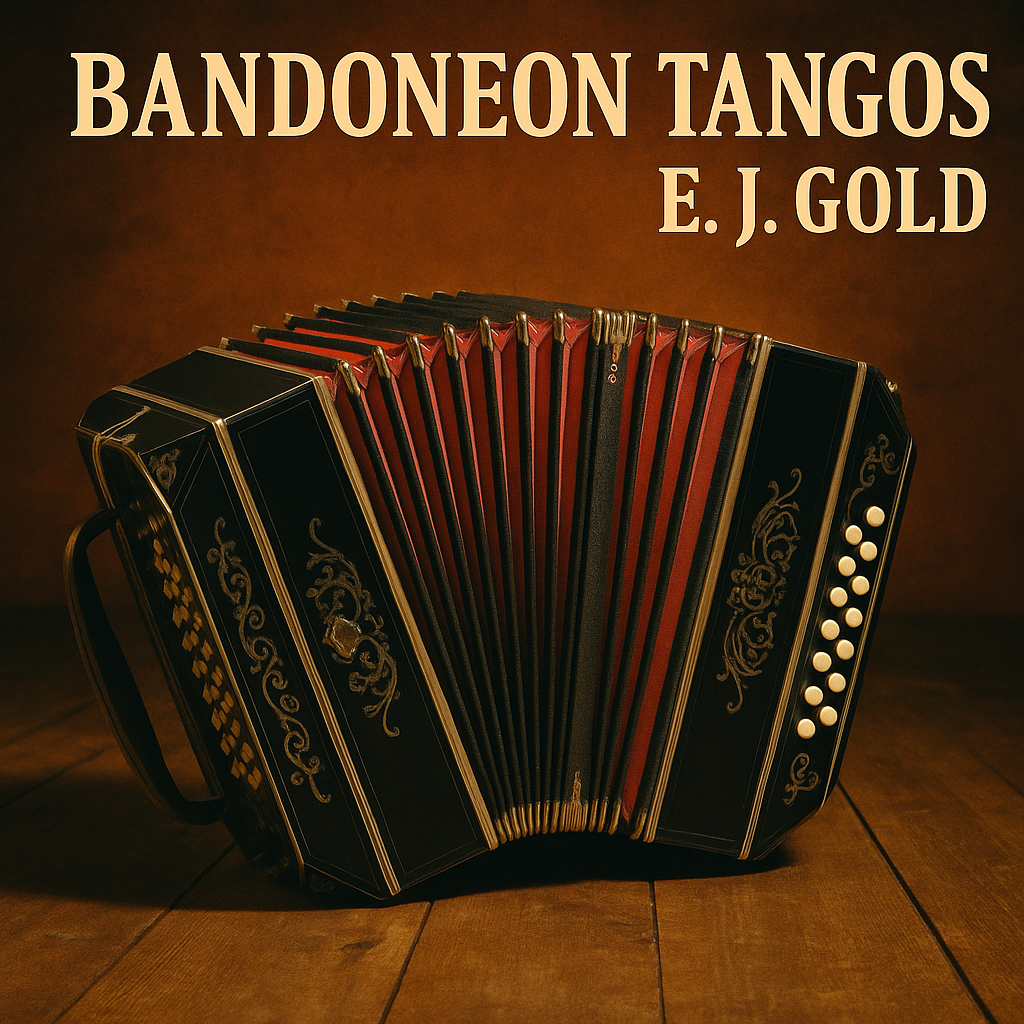
Bandoneon Tangos
by E.J. Gold
1. Tango del Zapatero Rápido
“The Cobbler’s Quickstep”
He fixes soles and steals hearts. Click, snip, polish — the bandoneon flirts while he taps his rhythm out on a wooden floor.
2. El Gato y la Silla
“The Cat and the Chair”
She was sitting in his spot. He gave her one glance — then tangoed around her, furious, elegant, and deeply petty.
3. Milonga del Ascensor
“Elevator Milonga”
Trapped between floors. A stranger, a tune, and no eye contact. Somehow, by the second chorus, they’re dancing.
4. Café con Fantasmas
“Coffee with Ghosts”
At 3 a.m., the old café fills up with regulars from another century. They take their espresso black and their tangos sad.
5. La Vuelta de la Media Luna
“Return of the Croissant”
A runaway pastry, a clumsy waiter, and a five-block chase with music in hot pursuit. Pure crumb-flecked joy.
6. Beso en Contratiempo
“Kiss on the Offbeat”
Their timing was always strange — but somehow, in the half-beat between steps, it finally happened.
7. Tanguito para un Paraguas Roto
“Little Tango for a Broken Umbrella”
It’s raining sideways. He twirls his useless umbrella like a cane, and suddenly the sidewalk becomes a stage.
8. Fin de Fiesta (pero no del Todo)
“End of the Party (But Not Quite)”
The lights are up, the wine is gone, but the bandoneon keeps breathing. One last spin before the door closes.
=========================================================================
Review: In “Bandoneon Tangos,” E.J. Gold Breathes New Life into a Classic Instrument
By Clarissa Benét, Arts Critic
It is easy to revere the bandoneon. Harder still to surprise us with it.
In Bandoneon Tangos, composer and performer E.J. Gold manages to do both, crafting a suite of eight concise, tightly wound pieces that neither mimic Astor Piazzolla nor bow too reverently at the altar of tradition. Instead, Gold lets the instrument speak in full: playful, brittle, breathy, sharp — like a dancer who refuses to repeat the same steps twice.
There is mischief here. Tango del Zapatero Rápido opens the album with a caffeinated swagger, full of heel-clicks and tongue-in-cheek tension. In Milonga del Ascensor, syncopations stutter and hum, echoing the awkward hush of two strangers sharing confined space. And in Café con Fantasmas, Gold allows a moment of stillness — a bittersweet reverie — before the melody slips once more into shadow and motion.
These are not long pieces. Most end before they outstay their welcome. But each is built with care: melodic arcs that feel improvised but aren’t, harmonic shifts that nod toward tango nuevo without leaning on its tropes. The standout, Beso en Contratiempo, lands like a poem — a kiss arrived late, offbeat, but exactly on time.
Bandoneon Tangos is, at its heart, a celebration of motion: of cities that hum after midnight, of flirtation spun into sound, of the elasticity of breath itself. Gold may not be from Buenos Aires, but he understands the dance. And more importantly, he knows when to step out of the way and let the instrument lead.
===========================================================================
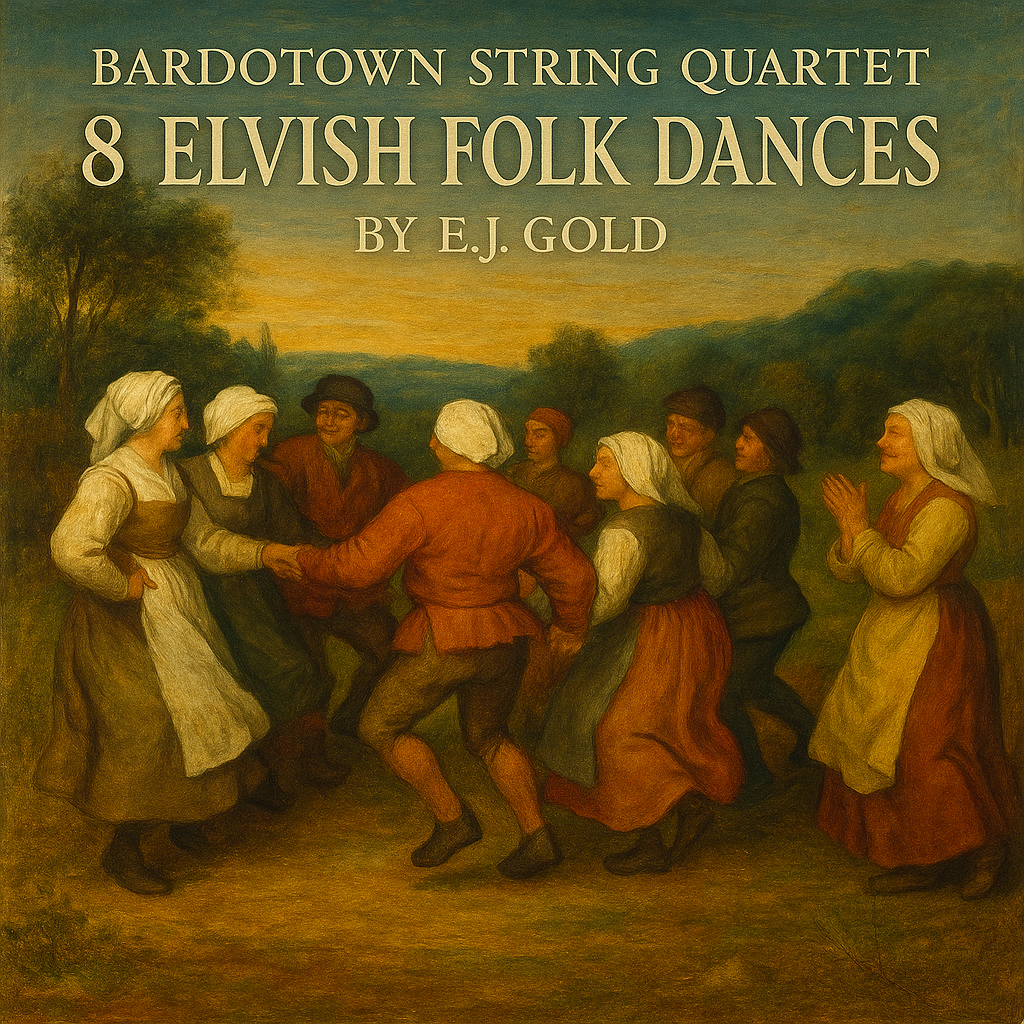
8 Elvish Folk Dances
by E.J. Gold
1. Dance of the Hollow Hill
At dusk, the hill opens. Lanterns flicker. The fiddles begin. The elves rise barefoot from the moss, spinning in silent delight until the first rooster crows.
2. The Spinner’s Jest
A nimble-footed prank woven into a jig — this dance loops and tangles like a thread too fine to follow. Blink, and your shoes are missing.
3. Pipeweed and Pebbles
Two village cousins challenge each other to a duel of steps and smirks. By the end, neither wins — but everyone’s cheeks hurt from laughing.
4. The Cobbler’s Invisible Daughter
You never see her — only the faint clatter of shoes on stone, and the movement of dust in the light. She dances every midsummer, always alone.
5. Shimmering Ale, Spinning Sky
After three tankards of elderflower brew, the dancing gets wilder — and so does the air. Elves stumble through starlight, laughing until gravity forgets them.
6. Lanterns Along the Rootpath
A slow circle, candlelit, barefoot. A ceremony to honor the ancient trees, who once danced too — but now only hum through bark and time.
7. The Fishwife’s Revenge
This one is sharp, foot-stomping, and a little salty. Inspired by an elvish woman who once hexed a merchant for short-changing her trout.
8. Farewell to Mistwood
A final waltz in a forest that no longer exists. The trees remember the tune, even if the mapmakers don’t.
========================================================================
Review: “8 Elvish Folk Dances” by E.J. Gold and the BardoTown String Quartet
By J.L. Nardo, Staff Shaman-at-Large
Los Angeles Free Press, Arts Underground
If you’re still chasing acid echoes in Laurel Canyon or thumbing old Tolkien paperbacks at the Bodhi Tree Bookstore, you’ll want to wrap your ears around 8 Elvish Folk Dances. The latest from E.J. Gold — yes, that E.J. Gold — and the string-leaning mystics of the BardoTown Quartet, this record isn’t just music. It’s a map.
The suite plays like a field recording from a village that shimmered out of phase sometime after the Bronze Age. Think Bartók raised by druids, or Béla Fleck on mushrooms in a mossy glen. These aren’t your standard fairytale jigs — they’ve got teeth, and moss in their cuffs.
The opener, Dance of the Hollow Hill, creaks and spins like an invitation scratched on a bark scroll. By the time Pipeweed and Pebbles rolls in, you’re knee-deep in the kind of rural mischief that makes even gnomes blush. But it’s Shimmering Ale, Spinning Sky that steals the cauldron — a wobbling, transcendent groove that feels like getting lightly drunk with your past lives.
What’s wild is how tight the quartet plays. These aren’t aimless freakouts — the arrangements are clean, rich, a little wry, and full of old-world character. They know when to lean in, when to drop back, and when to just let the ghosts do the talking.
It ends with Farewell to Mistwood — a tune so bittersweet and gently unhinged, you’ll swear you remember the place, even though it never existed.
Put it on. Light something. Open the window. And if you hear fiddles in the trees… don’t be alarmed.
You were probably invited.
===========================================================================
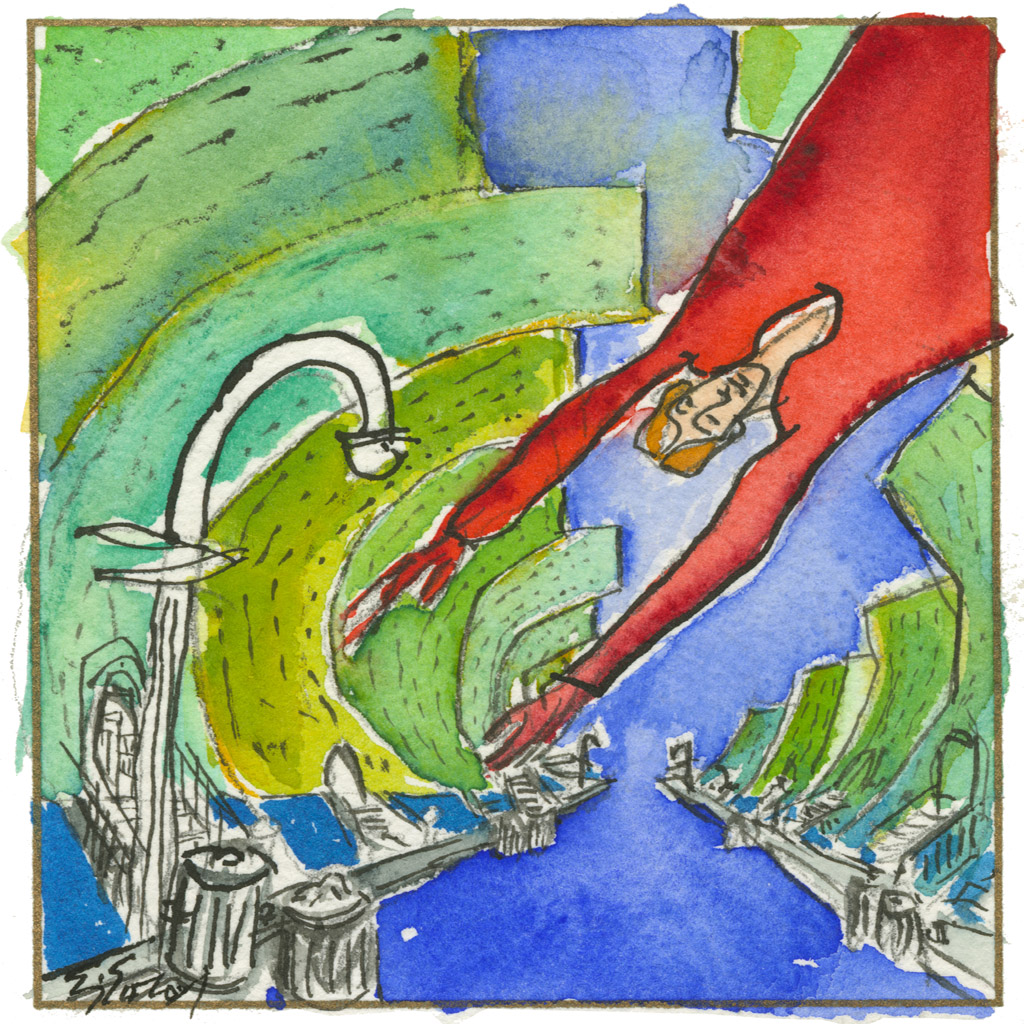
🌀 Why You’d Want a Portal on Your Wall
Dover Prints by E.J. Gold — Portals, Anchors, and Thangkas for the Modern Mystic
These aren’t just prints. These are thangkas — not Tibetan, but universal. Not bound to a single tradition, but tuned to the same purpose: awakening.
Each image is a portal — a psychic window into an “other” space. That space may not have a name, or a map, or even a boundary. But it’s real. You’ll know it when you feel the pull.
The advantage isn’t decoration. It’s connection.
In times of turbulence, it helps to have a stable reference — not a belief, but a beacon. These prints serve the same purpose as traditional thangkas: to hold presence, clarity, and sacred direction within view.
Stand before it. Sit with it. Let the gaze soften. This is not symbolic art — it’s functional. The Dover print acts as a resonance device, tuned to inner travel and multidimensional awareness. Just like a traditional thangka, it offers a visual entry into unseen teachings.
Rooms change in its presence. The field gets clearer. Some report better dreams, steadier emotions, fewer stray thoughtforms. This is no accident — the image holds the frequency. It works quietly, like a monk at a distant prayer wheel.
Use the print as a meditation anchor. As a field stabilizer during God State work. As a silent teacher in times of fog. Let it replace the need for explanation — it knows what you’re doing, even if you don’t.
Don’t be surprised if it subtly shifts. The energy behind the print is not fixed. These aren’t dead things. Like true thangkas, they evolve with the viewer. They respond to attention. They function.
To own one is to live with a thangka for this era — portable, potent, and free from dogma. It isn’t “just art.” It’s an invitation to take a tour with us in zoom.. We meet every morning at six-thirty a.m. — contact me for the address.
Signed 8 1/2″x11″ Original prints on genuine Dover Paper — 1 Goldback each.
===========================================================================
The List That Never Was
[VERSE 1]
They said there was a list, but no one had it
(no one had it)
Locked inside a drawer with a diplomatic rabbit
(you never saw that rabbit)
The names were sealed, the press was bought
And anyone who asked got memory-wiped or caught
(click—shhh—gone)
[VERSE 2]
The party guests arrived with faces made of masks
(masks, masks, masks)
Champagne in one hand, the other full of tasks
They danced around the truth with a cabalistic spin
While the band played hush and the curtains closed in
(hush now… hushhh…)
[CHORUS]
Oh, we know — yes, we know — but we’re not allowed to say
(no-no-no, shhh)
The truth is just a melody that never wants to play
(won’t play, won’t play)
It’s a rumor, it’s a whisper, it’s a wink behind a door
It’s the list that never was… but everybody swore
(everybody swore…)
[VERSE 3]
There’s a judge in Paraguay, a sultan on a plane
(whoosh)
A juggler with credentials and a duchess with no name
The records “didn’t print,” the files all “went to paste”
But the rhythm of denial has a strangely familiar taste
(mmm… tastes like scandal)
[BRIDGE]
They said it would be shocking—
(would be shocking…)
But we barely blinked at all
(didn’t blink…)
When the spotlight hit the ceiling
(up there!)
There was silence in the hall…
(heartbeat fade in)
[CHORUS]
Oh, we know — yes, we know — but we’re told to look away
(look away, look away)
It’s a myth we all remember from a slightly darker day
It’s a shadow with a pension, it’s a smile that’s out of place
It’s the list that never was… but everyone can trace
(trace, trace, trace…)
[OUTRO]
So don’t ask for confirmation, just nod and let it go…
(nod, nod, nod)
The names are gone, the walls are clean, the lights are soft and low
But somewhere in the archives, a tango softly plays…
For the list that never was…
(but never fades away)
(crackle… hiss… silence)
===========================================================================
Bardo bus approaching. Climb on board, for our daily video tour!
===========================================================================
See You At The Top!!!
gorby