I plan to run through some items on my hard drive in the zoom meeting, some that will be prints, but other things, too, maybe — we’ll see how it goes.
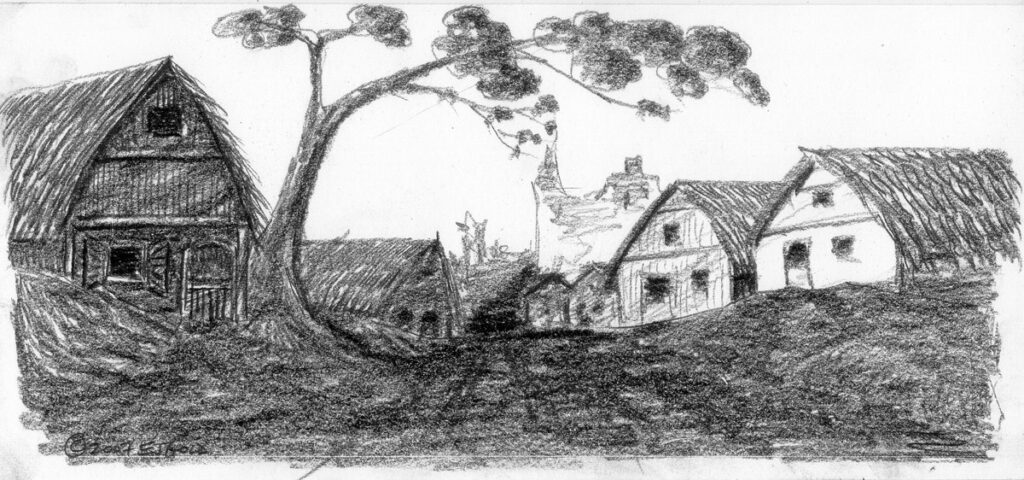
I mainly want to see if there’s any interest in the pencil drawings and the pen work, but I’m open to exploring anywhere as long as it’s in my hard drives.
A Short History of Pencil Drawing
The humble pencil — born of earth and fire, made of graphite and wood — began its quiet revolution in the 16th century, when a major deposit of pure graphite was discovered in Borrowdale, England. At first, the stuff was used to mark sheep. But artists quickly saw the magic.
Before pencils, drawing meant ink, metalpoint, or charcoal — precise, messy, or unforgiving. But with graphite, artists found control. A tool that could whisper or shout. It slid across paper like thought itself, erasable, subtle, alive.
By the 17th and 18th centuries, the pencil had become a staple for draftsmen and painters, especially in studies and sketchbooks. The Romantics loved it — capturing the raw pulse of nature, fleeting expressions, the ghost of a face before it vanished.
In the 19th century, pencil drawing became an art form all its own. Artists like Ingres and Seurat proved that a graphite line could rival any brushstroke for elegance and depth. And in the 20th century, with the rise of modernism and beyond, pencils were used to sketch dreams, nightmares, cities, memories, and truths too fragile to say out loud.
Today, pencil drawing is a silent craft — overlooked by flashier media, maybe — but still here. Still essential. A direct line from soul to surface. When you pick up a pencil and draw a house, a face, a tree — you’re joining a centuries-old current.
And the best part?
The pencil never asks questions.
It just goes for a little walk.
A Short History of Pen, Ink & Wash
Before the pencil came to town, it was all about the pen — a quill, a reed, a stick of bamboo cut to a point and dipped in ink made from oak galls, soot, or iron salts. Pen and ink drawing goes back thousands of years: from ancient China and Egypt to the monks of medieval Europe copying sacred texts by candlelight.
But when artists got hold of it — that’s when things really started flowing.
By the Renaissance, pen and ink became a powerhouse. Leonardo, Michelangelo, Dürer — all drew with pen to lock down their ideas. Sharp, clear, decisive. You couldn’t fudge with ink. No erasing. Just line and commitment. You either meant it, or you didn’t.
Then came ink wash — a little water, a little brush, and suddenly, the drawing could breathe. Wash turned flat ink into a mist, a shadow, a suggestion. The Chinese had been doing it since forever — painting mountains, trees, the Tao itself with a few flicks of the wrist. The West eventually caught on: Rembrandt used ink wash to make light glow. Turner did whole landscapes with just ink, spit, and a brush.
Pen gives structure.
Wash gives atmosphere.
Together, they dance.
These tools are ancient, but still here — because nothing beats them for immediacy, for elegance, for that feeling of one line, one lifetime. When you sit down with a pen and a pot of ink, you’re tapping into a long, unbroken tradition.
Not just drawing —
mark-making.
As old as language.
As bold as silence.
===========================================================================
Aha! Here’s the Bardo bus to carry us through our video journey!
===========================================================================
See You At The Top!!!
gorby