

If It Listens Good, It IS Good
E.J. Gold reflects on six decades in music — from coffeehouses to AI — and why good sound has always been about heart, not hardware.
As a kid, I went to Norman Studer’s Downtown Community Center, where Pete Seeger taught us how to find songs, sing songs and play instruments, mostly folk and tribal.
Then I started hanging out in Greenwich Village at the coffee houses, and met Dave Van Ronk, Shep Sherbell, Bob Dylan, Carol Hunter, Ramblin’ Jack Elliott, Judy Henske and many more.
I played in Washington Square Park on Sundays with the New Lost City Ramblers and the Holy Modal Rounders and eventually played the downtown clubs with the Rounders.
When I first started playing professionally in 1959 at the Village Playhouse, there was no such thing as “AI music.” There was just music. You played it, or you didn’t. You made it sound good, or you didn’t.
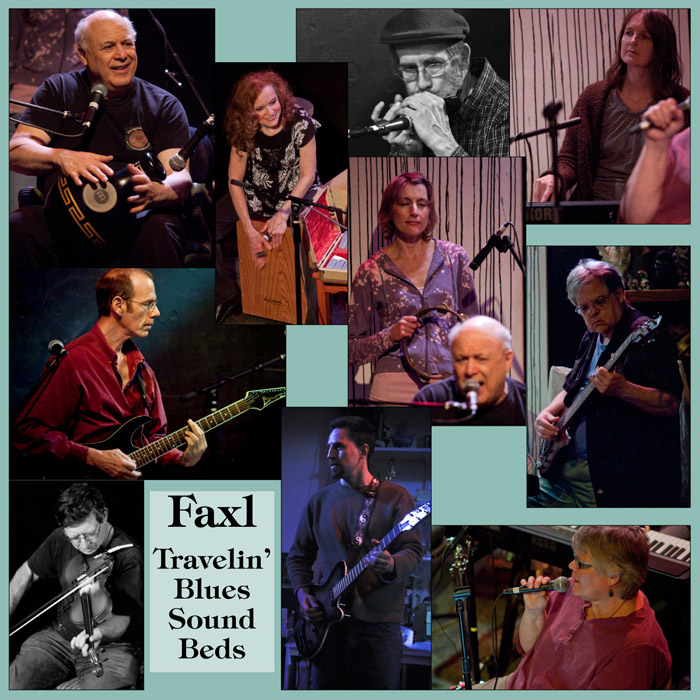
Since then, I’ve made over a hundred albums — no caps: not songs, albums — with my band FAXL, over the past half-century, long before AI, and I’ve paid my dues many times over.
At 84, I can’t play the way I used to, and most of the other band members will say the same. None of us can manage a full band night, even once a week, as we did just a few years ago.
But the thing is, I’m still writing songs, and they still need expression, band or no band.
So in order to make my songs come to life, I’ve switched instruments. These days, I play on Suno and Hedra — that’s how I make my sounds come true, and once in a while I add “real” vocals and “real” instruments, but only seldom do I do this anymore.
Years ago, when I played live music in jazz and folk venues, I played with — and got along with — many performing greats, and I have the video footage to prove it, although they could all be deep fakes, and how would you know or measure that in reality terms?
In 1964, Herbie Hancock showed me his Fender Rhodes electric piano in his apartment. People said it wasn’t a “real” piano. Herbie laughed and played circles around them — and he’s still doing it, switching between synths and Steinways like it’s all one big instrument. Because it is.
Last time I talked with Herbie, he was playing a Fairlight synth, so go tell it to the Marines.
Every generation has gone through this. When Les Paul invented the electric guitar, they said it was blasphemy — a gadget that would “ruin” real guitar playing. His partner, Mary Ford, recorded her voice in multiple layers on tape — what we now call multitracking — and critics sneered that it was “unnatural.” Today, you can’t imagine modern music without either of those breakthroughs.
Same story with the electric organ, the tape recorder, the DX7 synth, the sampler, even the drum machine and the auto-tuner.
When microphones first appeared, people said, “That’s not real sound — it’s electricity!” But we kept using them, because they worked. They let us reach more ears and make better recordings. You can’t record live music without some sort of input.
Now we’ve got Suno and Hedra, and suddenly the Luddites are howling again. They say, “You’re just pushing a button.” Nonsense. I’ve got over a hundred albums recorded long before AI was even a thought, and I’ve charted number one on MP3. I know what it takes to make music. You don’t “just push a button.” You write, you arrange, you direct, you listen. These are instruments, not song-writing robots.
When I work with AI systems, I still author the lyrics, guide the sound, and make the calls — same as I would in a studio. The music could be arranged a hundred ways, but the lyrics, the feeling, the intent, and the arrangement — that’s mine. That’s the art.
And there’s a lot more to making music than just playing. The public never sees what’s behind the music — the editing, the mixing, the mastering, the publishing, the endless admin that nobody sees. Anyone who’s done it knows.
Most people only ever hear the finished product on the radio or streaming. They don’t realize that what I produce is actually just a demo. A band that plays my music has to work hard to get the feel, timing, and sound they want out of it. That’s their art. Mine is giving them a living framework to build on, a suggestion of how it could be framed and arranged.
Same song, different bands — totally different sound. And I can prove that.
Anytime someone wants to get into a song-war about who has the “best” song, leave me out of it. I make songs to have fun making songs, not to impress anyone. I’ve had more than a dozen of my pre-AI songs chart, and several reached #1 — but that proves nothing if people don’t listen to them NOW.
A song that dies on the charts after a week or two of glory isn’t any more “real” than one that never charted at all. (With the exception of Thriller, which has apparently decided never to leave the charts.)
Take out the synth sounds and the auto tune — what’s left of most pop songs? Nothing.
If the music listens good, it is good. Period. Doesn’t matter if it came through a microphone, a tape deck, a Moog, or a neural net — or if it was made with a cow bone or a DX7. The only thing that matters is whether it reaches somebody, whether it stirs something real inside them.
Stop asking “But is it real?” or “How was it done?”
Just enjoy the music. Is that a new idea for you? The rest of it is just people being afraid of the new — and I’ve been participating in that same “new sound” movie since 1959. The complaints never stop.
As a musician, I have to ignore the critics, even the ones that like my stuff. When you’re making music, it’s all about the music — and it takes real devotion to get past the bitching.
Also, I play dozens of instruments — flutes of all kinds, tenor sax, Martin D-28, American Stratocaster, full harp set, ukelele, banjo, double bass, electric fretless bass, drum kit, all kinds of percussion, oboe, clarinet, and many more.
If I use it in a mix, I was once able to play it on a physical instrument, and might be able to struggle through it even now. I never play a synth like a keyboard, unless I want a piano sound, and I have a breath-controller for my brass and woodwinds.
I have also written sheet music which has been published.
Music’s job has always been to evolve, to stay alive. It embraces the new — otherwise, it dies on the vine. Is there a problem with that?
===========================================================================
Ahoy — make that several hoys — here comes the Bardo bus now!
===========================================================================
See You At The Top!!!
gorby