

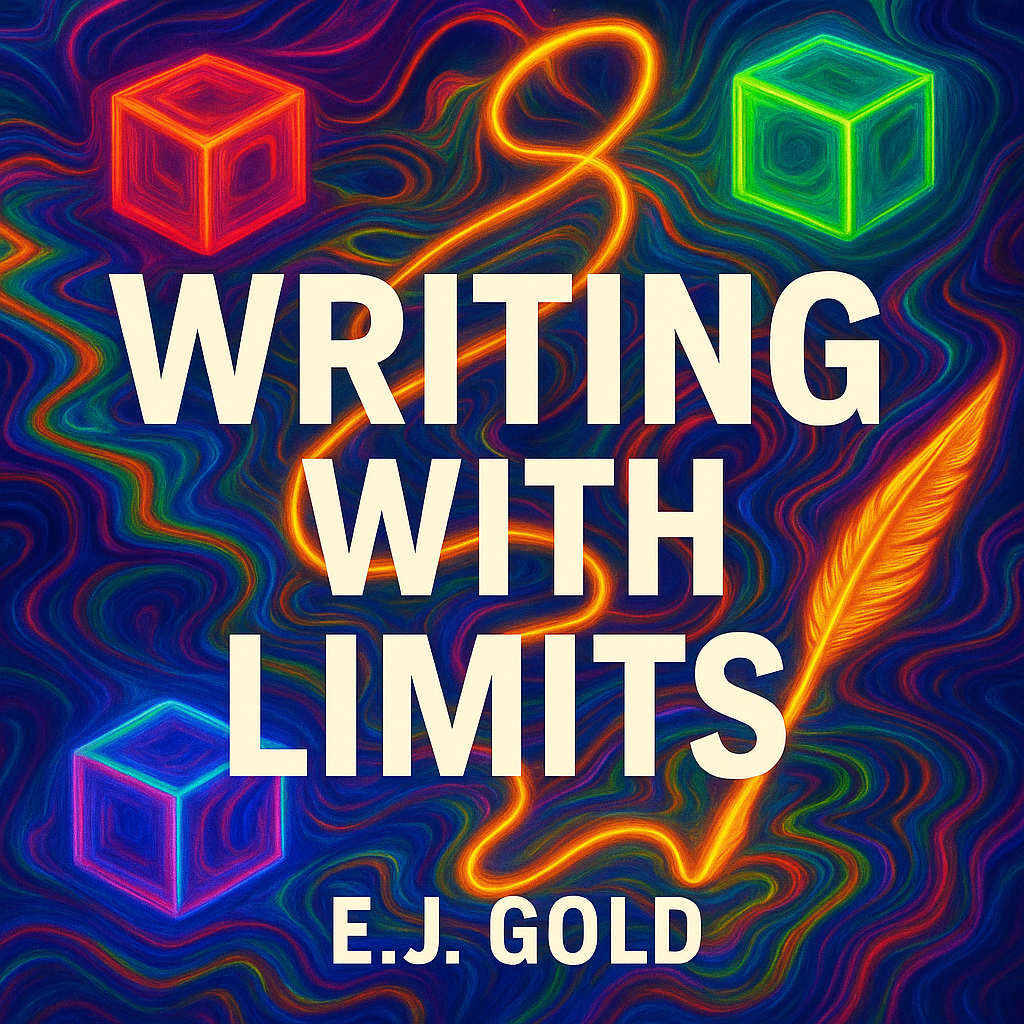
Chapter 11
Writing With Limits: Why Constraints Make You Better
Back in the mid-sixties, when I was at Otis Art Institute in L.A., I took a 3D design class where the legendary art teacher Bob Glover cheerfully announced, “No limitations — bring in whatever you like, so long as it’s a 3D object.”
You’ve never seen a room go blank so fast.
About thirty of us sat there, suddenly stranded in an infinite and chaotic void. No rules, no boundaries, no assignment shape — just anything. And out of that whole class, only two of us actually turned in a project.
That’s when I learned the big secret nobody tells beginners:
when there are no limits, most people can’t move.
Give them total freedom, and they freeze.
Give them a fence, and they’ll climb it.
Give them a box, and they’ll fill it.
Give them a line to walk, and suddenly they’re dancing on it.
That Otis lesson stuck with me:
creativity doesn’t thrive in empty space — it thrives on resistance.
And that’s what this chapter is about.
===========================================================================
Most people think creativity lives in wide-open fields with nothing in sight but freedom. Nah. That’s where you get lost and start checking your email. Real creativity happens when something pushes back.
Give a writer infinite time, infinite space, and zero boundaries, and they’ll spend three hours deciding whether to rhyme moon with June ironically. But give them 60 seconds and a strict rule set — boom, suddenly they’re a ninja.
Limits sharpen the mind. They kick the panic button just enough to make your instincts take over. And your instincts are ‘way smarter than your committee brain ever was.
Here’s why limits work so well:
-
They turn off the inner critic.
You don’t have time for “hmm, is this good?” You go straight into doing. -
They pop you out of your usual grooves.
It’s hard to write clichés when the rules forbid them. -
They force you to notice rhythm, sound, shape — the bones under the words.
-
They show you what you lean on too much.
(Looking at you, wandering adjectives.) -
They give you little games to play, and the mind LOVES games.
Now let’s throw some tools at you:
Timed writing — the adrenaline button.
Set a timer for two minutes. Write nonstop. No stopping, no fixing. You are now a runaway train and the rhyme scheme is trying to hang on to the caboose.
Beat patterns — the secret metronome.
Pick a pulse:
da-DA da-DA da-DA da-DA.
Stick to it. Suddenly you’re dancing with the words instead of chasing them.
Syllable caps — the slap on the wrist.
Pick a number: 7 syllables a line. Or 5. Or something weird like 11. Then cram your idea into that shape until it squeaks and sparkles. Who knew discipline tasted like champagne?
Forbidden-word exercises — because mischief is fun.
Write a whole verse without using the letter “E.” Or no adjectives. Or no verbs longer than one syllable. Your brain will curse you… then hand you gold.
Borrowed forms — poetry with training wheels.
Haiku, limericks, blues structures, sea shanty repeats, round songs, nursery rhyme cadences. They’re not traps — they’re scaffolding.
And the best part?
Once you’ve written inside the limits, you break out of them like a jailbreak artist with pockets full of diamonds.
You come away faster, sharper, clearer — and with a hell of a lot less fear of the blank page.
Because now you know the secret:
constraints don’t limit creativity — they ignite it.
==========================================================================
SONG: Writing with Limits
[VERSE 1]
I got a timer on the table and it’s glaring at me,
Says, “You got sixty seconds, kid — let’s see who you can be.”
No time for hemming, hawing, chewing on doubt,
Just grab a beat and ride it till the ink runs out.
[CHORUS]
Oh, limits, sweet limits, you push me to fly,
You shut down my excuses, make the muse swing by.
When the walls get tighter, the words get bright—
I’m writing with limits, and it feels just right.
[VERSE 2]
Seven little syllables marching in a row,
Trying to squeeze a wild idea where it doesn’t wanna go.
But it pops like fireworks when space runs thin,
’Cause pressure makes diamonds — that’s where songs begin.
[CALL & RESPONSE — optional backing vocal]
Lead: “What can you do with just one beat?”
Back: “Oh, honey, watch me cook this heat.”
Lead: “What can you do when the rhyme line’s small?”
Back: “I’ll build a whole damn castle with no bricks at all.”
[CHORUS]
Oh, limits, sweet limits, you sharpen my mind,
You make the rhythm clearer and the phrasing aligned.
When the cage gets smaller, the sparks ignite—
I’m writing with limits, and it feels just right.
[BRIDGE]
Give me rules, give me fences, give me numbers on a page,
I’ll turn those tight conditions to a tiny cosmic stage.
You think constraints are shackles, but I know the twist—
The tighter the doorway, the more magic gets in.
[VERSE 3]
Try a forbidden-letter verse, try a one-note groove,
Try writing while your heartbeat picks the tempo for you.
You don’t need a wide horizon or a thousand-mile view,
Just a box with bright edges you can push right through.
[FINAL CHORUS]
Oh, limits, sweet limits, you open the door,
You make me braver, faster, stronger than before.
Let the rules close in—I’ll still take flight,
I’m writing with limits…
Yeah, I’m writing with limits…
And it feels just right.
===========================================================================
And, as expected, here comes the Bardo bus around the nearest corner.
===========================================================================
See You At The Top!!!
gorby