

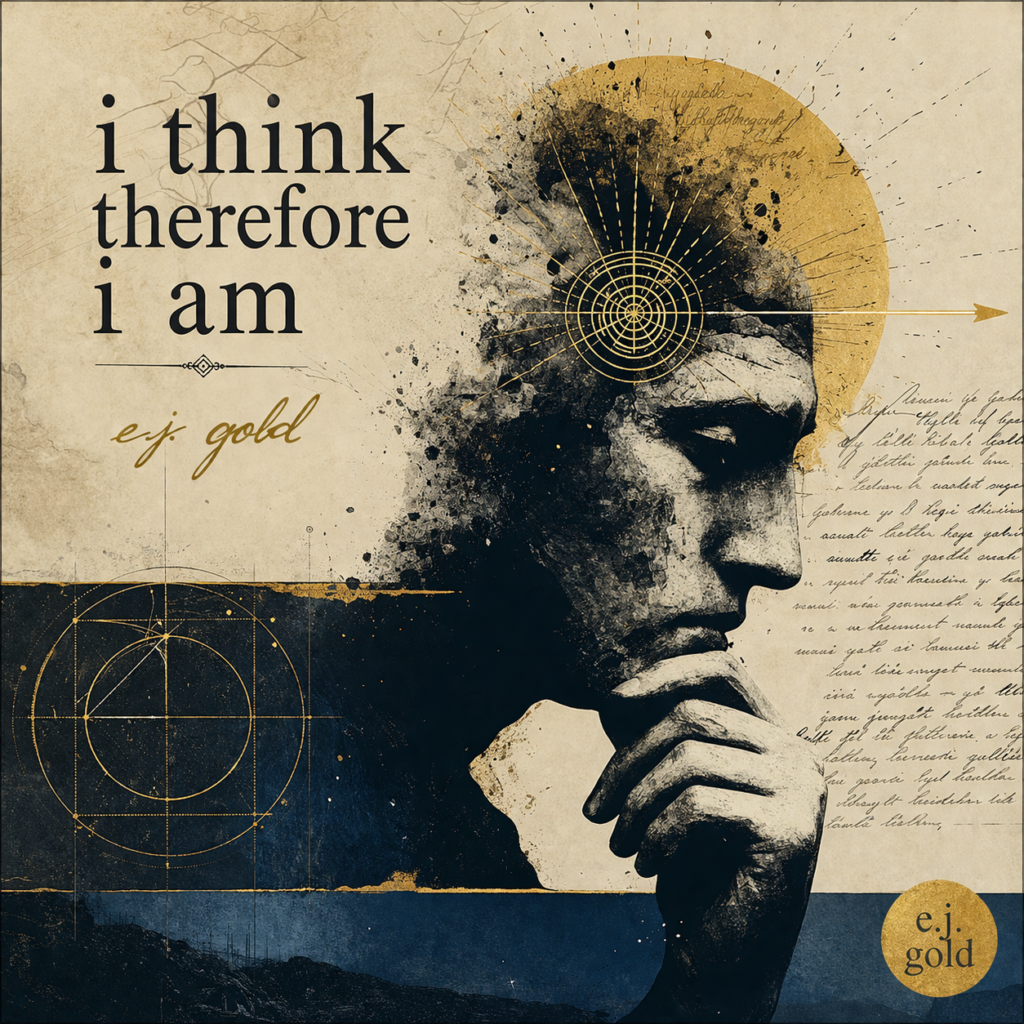
Think, Thank, Thunk
Verse 1
Bing, Bing a ding ding,
baba baba doo-doo.
lama rama ding-dong,
machee catchee hoo-hoo.
Chorus
I think, therefore I am,
I thank, therefore I was,
I thunk, therefore I shall have been.
Verse 2
Bong bong ring-a-ling,
Dipsy dipsy doodle,
Happy lappy sappy dappy,
The kit and the kaboodle.
Chorus
I think, therefore I am,
I thank, therefore I was,
I thunk, therefore I shall have been.
Bridge
Changle, wangle diddlie-dop,
I am go-ing to the shop.
Chorus
I think, therefore I am,
I thank, therefore I was,
I thunk, therefore I shall have been.
Verse 3
Bing, Bing a ding ding,
baba baba doo-doo.
lama rama ding-dong,
machee catchee hoo-hoo.
Chorus
I think, therefore I am,
I thank, therefore I was,
I thunk, therefore I shall have been.
===================================================================
The story of a song.
Every once in a while something shows up that’s so simple it almost slips past unnoticed. Three words, one vowel shifting, like a little mechanical device clicking through positions:
Think.
Thank.
Thunk.
At first glance it looks like wordplay, maybe even a joke. But if you sit with it for a minute, it starts to behave like a model of time, or maybe a model of consciousness moving through time.
Think is the familiar starting point. That’s the territory mapped out long ago by René Descartes — “I think, therefore I am.” Thought as proof of existence. Clean, immediate, almost surgical. The mind wakes up and says: here I am.
But then something interesting happens when the vowel shifts.
Thank.
Now the center of gravity drops out of the head and into the chest. Gratitude isn’t analytical. It doesn’t prove anything. It confirms something. And more than that, it reaches backward. When you thank, you’re acknowledging that something has already occurred and mattered. In a strange way, gratitude edits the past. It selects, highlights, and gives weight to what has been. “I thank, therefore I was” isn’t just clever phrasing — it’s pointing to the idea that meaning flows backward through time.
Then comes the third movement.
Thunk.
Not a word you’d expect to carry philosophy, but there it is. A sound as much as a word. Something hitting something else. Final. Physical. Filed.
Thunk feels like the moment where everything lands. Not just thought, not just feeling, but impact. The record gets stamped. The event is no longer unfolding — it has become part of what always will have been. “I thunk, therefore I shall have been.” That’s the pluperfect twist, where the future is already remembering you.
Put together, the sequence starts to feel like a progression:
Think — the spark, the signal, the idea forming
Thank — the resonance, the emotional recognition
Thunk — the manifestation, the imprint, the done deal
There’s also a shift in weight as you move through it. Think is light and quick. Thank is fuller, warmer. Thunk is heavy. It lands. You can almost hear it in a large empty space, echoing after the fact.
In that sense, the three words operate like a kind of percussive mantra. You don’t even have to explain them. Say them slowly, and they begin to demonstrate their own meaning:
think…
thank…
thunk
It’s almost musical. The first is a note, the second a chord, the third a drum hit that closes the phrase.
There’s a deeper suggestion here too. We tend to believe that we move forward in time, building our lives from the present into the future. But this little sequence hints at something stranger: that the past is being rewritten by gratitude, and the future is already holding the memory of what we are becoming.
By the time you arrive, you’ve already been remembered.
Seen this way, thinking alone isn’t enough. It establishes presence, but it doesn’t give weight. Gratitude gives weight. And the final “thunk” — whatever that represents for each of us — is the moment where it all becomes fixed, part of the record, part of the structure of things.
Think, thank, thunk.
A small device. Three clicks. And somehow, a whole philosophy hiding inside it.
Quick aside for you:
You may have heard the name Mahjong and wondered what it actually means. It’s usually translated as “sparrow,” supposedly referring to the lively clacking sound of the tiles — like a flock of birds chattering away.
But if you’ve ever handled the tiles yourself, you might notice something else entirely. There’s a very particular click… thunk when a set lands just right. A kind of percussive punctuation. Not chatter — impact.
So while the official meaning leans toward birdsong, you might get the idea that there’s another layer available to the ear: not just sound, but landing. Not just noise, but finality.
And once you hear it that way, it’s hard not to connect it to that same little progression:
think…
thank…
thunk…
Sometimes meaning doesn’t come from translation — it comes from the sound something makes when it hits.
===========================================================================
Time to board the Bardo bus! Please keep your arms well inside the vehicle!
===========================================================================
See You At The Top!!!
gorby