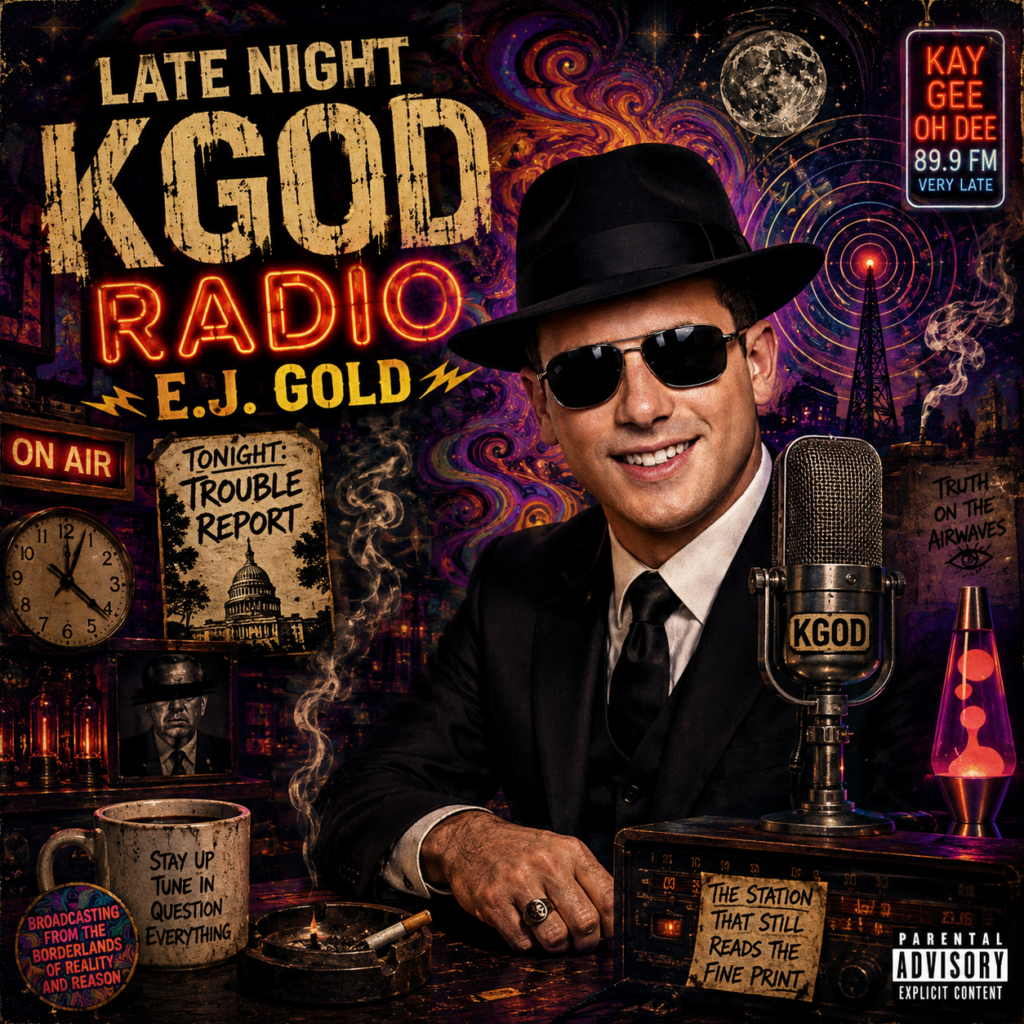
KGOD Late Night:
More Than a Radio Station
Several people have asked me recently about other things labeled KGOD.
One person pointed out that there are actual stations using the letters KGOD. That’s true enough. Radio call letters have been around a long time, and sooner or later almost any combination turns up somewhere. But that observation helped me realize something important.
KGOD Late Night, as I use it, is not really a radio station at all.
It’s the title of a song. More accurately, it’s the title of a growing collection of songs. And perhaps even more accurately, it’s the doorway into a world.
What began as a simple song title — KGOD Late Night — has gradually developed into a setting, a stage, a place where stories happen. It’s a series, like “The Honeymooners” on the Jackie Gleason show in the fifties.
The moment the announcer says:
“This is Kay Gee Oh Dee… Kay GOD… the station that makes it…”
the listener is transported somewhere else.
Suddenly there are night travelers, insomniacs, callers from impossible locations, strange commercials, static-filled broadcasts arriving from uncertain dimensions, and a Hammond organ playing softly in the distance. A signal emerges from somewhere between Bardotown and consensus reality.
In a sense, the station exists only inside the imagination.
There may be transmitters. There may be studios. There may be announcers and engineers. But the real station is constructed inside the listener’s mind, exactly how the universe works — emanations of your own Being.
That’s what makes the KGOD format so much fun.
Radio has always possessed a unique power. Television shows you everything. Radio requires the audience to participate. The listener must help create the world being described. The result is often far larger, stranger, and more personal than anything visible on a screen.
KGOD Late Night takes advantage of that ancient radio magic.
Every broadcast becomes a miniature theater piece. Every caller becomes a character. Every commercial becomes an opportunity for humor. Every late-night conversation becomes part of an ongoing mythology.
What surprises me most is how quickly listeners seem to understand the concept. They don’t experience it as merely another song. They experience it as a place they can visit.
A world with its own rules. A world where anything might happen. A world where the host might interview an alien, a philosopher, a truck driver, a time traveler, or a retired dictator — often in the same program. As the series grows, the idea becomes even more interesting.
Different musical styles create different versions of the station:
Doo-wop KGOD.
Jazz KGOD.
Psychedelic KGOD.
Country KGOD.
Broadway KGOD.
The same station appears through different cultural lenses, almost as though listeners are tuning into parallel broadcasts from neighboring timelines.
The station remains the same. Only the frequency changes. Perhaps that is the real secret behind the project. KGOD Late Night is not a station. It is a continuing exploration of imagination itself.
The sign on the transmitter tower may read “KGOD Late Night”, but the actual broadcast originates from a place far more mysterious than any transmitter site.
It originates in the endless territory where stories, dreams, music, memory, and possibility all meet.
If you happen to hear the signal, pull up a chair. The coffee is probably terrible. The static is unavoidable. Reality is under constant review.
And the broadcast is still on the air. 📻
===========================================================================
Here’s the Bardo bus!
===========================================================================
See You At The Top!!!
gorby