

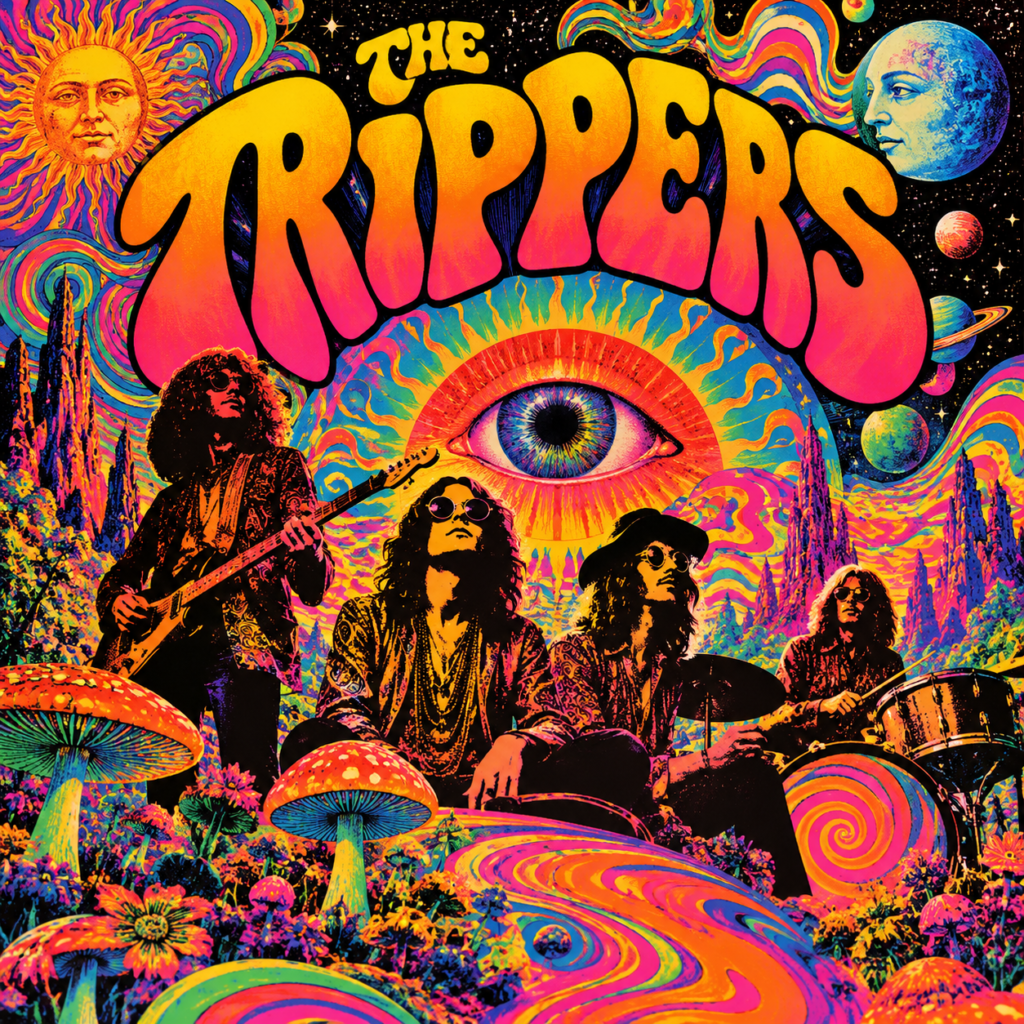
THE TRIPPERS
The Psychedelic Songbook
23 Excursions Beyond the Ordinary
An E.J. Gold Musical Production
THE MUSIC THAT ESCAPED FROM THE SIXTIES
There was a brief period in the history of popular music when absolutely anything seemed possible.
Guitars stopped behaving like guitars. Organs began making noises that suggested electrical disturbances in neighboring galaxies. Drummers abandoned the responsibility of keeping time and began investigating whether time existed in the first place.
And singers, having exhausted the usual subjects of love, heartbreak, automobiles, and teenage romance, began addressing such matters as the dissolution of the ego, the elasticity of reality, the architecture of dreams, and the possibility that the universe was actually a very large practical joke.
This was psychedelic music.
And somewhere in that extraordinary territory, The Trippers have established their headquarters.
THE BAND THAT WENT SOMEWHERE ELSE
The Trippers are not particularly interested in taking you back to the sixties. They are more interested in taking you somewhere the sixties were trying to reach.
Their music inhabits a peculiar intersection of rock and roll, electronic experimentation, surrealist poetry, cosmic speculation, and the occasional suspicion that somebody has slipped something unusual into the punch bowl.
The instrumentation is familiar enough: electric guitars, bass, drums, keyboards, voices, and the assorted sonic equipment traditionally associated with making a considerable racket. What happens to those instruments, however, is another matter.
A guitar may begin a perfectly respectable musical phrase and end it somewhere near the Crab Nebula. A keyboard may produce a sound resembling a cathedral organ being played underwater by an extraterrestrial octopus. A vocal harmony may start with three singers and finish with what sounds suspiciously like an entire civilization. None of this should be considered a malfunction.
TWENTY-THREE PORTALS
This collection contains twenty-three individual musical excursions, each occupying its own peculiar corner of the psychedelic landscape. Some are playful. Some are mysterious. Some are downright peculiar.
The listener may encounter shifting rhythms, unexpected harmonic changes, distorted instrumental textures, peculiar lyrical propositions, and occasional passages that appear to have been composed in a dimension where conventional musical rules have not yet been invented.
Yet beneath the apparent chaos lies something quite deliberate. Psychedelic music, at its best, is not simply a collection of unusual sounds. It is an invitation to reconsider the familiar.
A repeated musical phrase becomes a landscape. A simple chord change becomes a doorway. A lyric that initially appears nonsensical may suddenly reveal an unexpected meaning. Or it may remain nonsensical. There is no law requiring every mushroom to contain a message.
A BRIEF HISTORY OF THE IMPOSSIBLE
The psychedelic revolution did not arrive without warning. Its ancestors included experimental jazz, electronic composition, Indian classical music, surrealist poetry, avant-garde theater, and the increasingly adventurous recording techniques of the early 1960s.
By the middle of that decade, recording studios had become laboratories. Tape could be reversed, slowed, accelerated, spliced, layered, and otherwise persuaded to behave in ways its inventors had never anticipated. Amplifiers could be driven into distortion. Electronic effects could transform ordinary instruments into extraordinary sound sources. Multitrack recording allowed musicians to construct performances that could scarcely have existed on a conventional stage. And the audience was changing, too.
People were no longer listening exclusively for a melody they could whistle or a rhythm they could dance to. They were listening for experiences. A record was becoming something you could enter. The Trippers belong to that tradition of musical exploration, without being confined to its historical moment.
THE THIRD EAR
Most people have two ears. Psychedelic music occasionally requires a third. Not an anatomical third ear, of course. That would make buying earbuds horribly complicated.
The third ear is the faculty that hears beyond the obvious arrangement of notes and rhythms. It notices the spaces between sounds, the peculiar emotional effects of repetition, and the strange transformations that occur when familiar musical patterns are placed in unfamiliar surroundings.
A sound may seem to approach from a great distance. A rhythm may appear to turn inside out. A voice may become an instrument, while an instrument seems to acquire a voice. The listener is invited to participate in the construction of the experience. Headphones are recommended, although not compulsory. An open mind is useful. An open refrigerator is optional.
PSYCHEDELIA AND THE QUESTION OF REALITY
One of the enduring fascinations of psychedelic art is its willingness to question the reliability of ordinary perception. What exactly are we experiencing when we experience the world? How much of what we call reality is constructed by habit, expectation, memory, and the peculiar machinery of human consciousness?
Music offers a particularly interesting way to investigate these questions. Unlike a painting or a sculpture, a musical composition unfolds through time. The listener cannot experience the whole piece at once. Each moment arrives, transforms the meaning of what came before, and disappears into memory. In that sense, music is already a small experiment in consciousness. Psychedelic music merely makes the experiment more conspicuous. It asks whether the listener can hear without immediately categorizing, anticipate without insisting, and encounter the unexpected without demanding that it explain itself. Sometimes the result is insight. Sometimes it is laughter. And sometimes it is a seven-minute guitar solo.
THE TRIPPERS’ LISTENING INSTRUCTIONS
There is no correct way to listen to this collection.
You may play the songs individually, in sequence, at random, or in an order determined by throwing twenty-three numbered slips of paper into a hat. You may listen while working, resting, drawing, painting, contemplating the universe, or attempting to determine why the toaster has suddenly become so philosophical.
However, we recommend giving the music your full attention at least once. Let the arrangements unfold. Notice the instrumental details. Follow the lyrics wherever they happen to wander. And remember that a musical journey need not arrive at a recognizable destination to have been worth taking.
A FINAL WORD FROM THE DEPARTURE LOUNGE
The psychedelic era left behind a remarkable legacy. It demonstrated that popular music could be experimental without abandoning entertainment, philosophical without surrendering humor, and technically sophisticated without losing its capacity for sheer exuberance. It also demonstrated that a perfectly ordinary three-minute song could occasionally contain a universe considerably larger than three minutes.
The Trippers continue that exploration across twenty-three musical adventures. No special equipment is required. No passport is necessary. There are no baggage restrictions. And the management accepts no responsibility for changes in your understanding of the universe.
THE TRIPPERS
The Psychedelic Songbook
Twenty-three songs. An indefinite number of realities.
Produced by E.J. Gold
Please remain seated until the universe has come to a complete stop.
===========================================================================
Here’s the Bardo bus now!!!
===========================================================================
See You At The Top!!!
gorby