

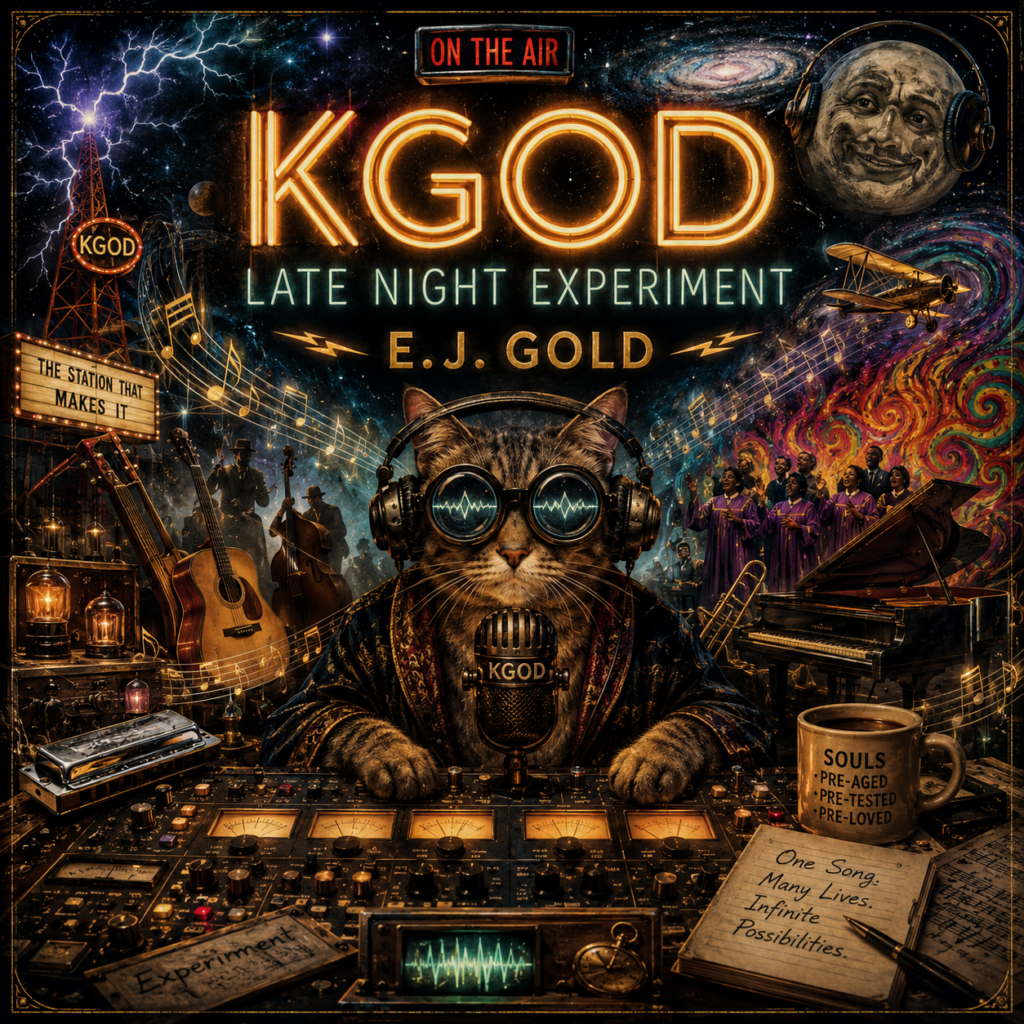
The Many Lives of a Song
One of the most interesting discoveries I’ve made recently came from a song I wrote and brought into mp3 reality, called “Second Hand Soul”.
The lyric itself remained exactly the same. The melody remained essentially the same. The title remained the same.
Yet each time the song was performed by a different virtual band, with a different arrangement, a different mood, and a different musical attitude, it became an entirely different experience.
Listening to these versions side by side revealed something that many songwriters eventually learn:
A song is not a finished object. A song is a set of possibilities. Most beginning writers assume that the words are the song. Some musicians assume the melody is the song. Others assume the singer is the song.
But in practice, the emotional experience of a piece is created by a combination of many elements working together.
The lyric.
The melody.
The tempo.
The instrumentation.
The arrangement.
The production.
The style.
The performance.
Change any one of these and the emotional message shifts. Change several of them and the transformation can be astonishing.
A folk arrangement of Second Hand Soul feels intimate and reflective, as though someone is sitting on a porch at sunset thinking about the long road behind them.
A country arrangement turns the song into a story of memory, loss, and perseverance.
A blues version introduces hardship and survival. Suddenly the lyric sounds as though it has traveled through storms and disappointments before arriving where it is today.
A gospel arrangement can transform the entire piece into a meditation on redemption, reincarnation, or spiritual continuity.
A psychedelic treatment makes the song feel as though it has drifted through multiple realities and timelines.
A jazz interpretation may emphasize mystery and ambiguity.
A Broadway arrangement may make the song feel like a dramatic revelation in the middle of a stage production.
And yet the words themselves never changed.
The same lyric that sounds playful in one arrangement may sound profound in another. The same line that sounds romantic in one version may sound mystical in another.
The same phrase may suggest reincarnation, memory, karma, old love, spiritual awakening, or simple human experience depending entirely upon the musical environment surrounding it.
This is one of the reasons I encourage students to experiment aggressively. Many songs are abandoned long before they have revealed what they truly are. A songwriter may hear a weak version and assume the song is weak. Often the opposite is true.
Sometimes a strong song is simply wearing the wrong clothes. A different band. A different groove. A different tempo. A different vocal approach. Suddenly the song opens up and reveals dimensions that were hidden before.
In that sense, songwriting resembles sculpture more than construction.
The artist gradually removes what doesn’t belong until the form concealed inside the material begins to appear.
The modern tools available to musicians make this process especially exciting. We can now hear the same composition interpreted by styles, genres, and ensembles that would once have required years of effort and a room full of musicians.
The result is not merely convenience. It is education. It is experimentation. It is discovery.
By listening carefully to multiple versions of the same song, we begin to understand how mood, arrangement, instrumentation, and performance shape meaning itself.
The exercise becomes a lesson in psychology as much as music.
What changes when the tempo slows? What changes when the harmony becomes darker? What changes when a choir appears? What changes when the rhythm section begins to swing? What changes when the singer sounds hopeful instead of weary?
These are not merely technical questions. They are questions about perception.
Second Hand Soul turns out to be a perfect example because the title itself is rich with possibilities. A second-hand soul could be a soul returning through many lifetimes. It could be accumulated wisdom. It could be inherited memory. It could be old karma. It could be a heart that has loved before and learned from experience.
Every arrangement shines a different light on the same mysterious idea.
The lyric remains fixed. The meaning continues to evolve. Perhaps that is true of human beings as well. The soul may remain the same. But the costume changes.
The scenery changes. The role changes. The circumstances change. The story changes. And from one lifetime to another, the music keeps playing, and the beat goes on.
The miracle isn’t that a machine can make music.
The miracle is that a songwriter can finally hear multiple professional-level demo concepts without assembling a studio, an engineer, an arranger, a rhythm section, and a pile of cash.
For somebody who spent years around studios and session players, that’s not a small change.
===========================================================================
Here’s the Bardo bus now!
===========================================================================