

Norton Street – Act III, Scene 2
A Brief Evaluation
This scene marks one of the clearest statements yet of the central premise behind Norton Street. What begins as a simple discussion about changing faces and fading memories gradually unfolds into a surprisingly sophisticated examination of creation itself.
The dialogue presents Norton Street as a self-maintaining reality system, one that requires constant renewal in order to exist. Crystal’s explanation that every object is effectively a universe in itself introduces the idea that existence carries a cost measured in attention, memory, and creative energy. The metaphor of the videogame engine is especially effective because it translates abstract metaphysical ideas into familiar modern imagery.
One of the strengths of the scene is the contrast between the characters. Bornless continually seeks emotional reassurance, sympathy, and certainty, while Mike and Crystal respond with explanations that are simultaneously logical, absurd, and profound. The result is a style of humor that operates on several levels at once.
The scene also contains some of the strongest comic dialogue in the play. The exchange:
“You are immortal.”
“Then why do I keep dying all the time?”
“We’re still working on that one.”
captures in three lines one of the central paradoxes of human experience. It is funny, but it also raises a genuine philosophical question.
The videogame and computer references serve an important dramatic purpose. Rather than reducing reality to machinery, they provide a contemporary language for discussing creation, manifestation, and consciousness. Norton Street becomes both a cosmic realm and a development environment, with worlds appearing as if generated from a vast editor operating somewhere beyond ordinary perception.
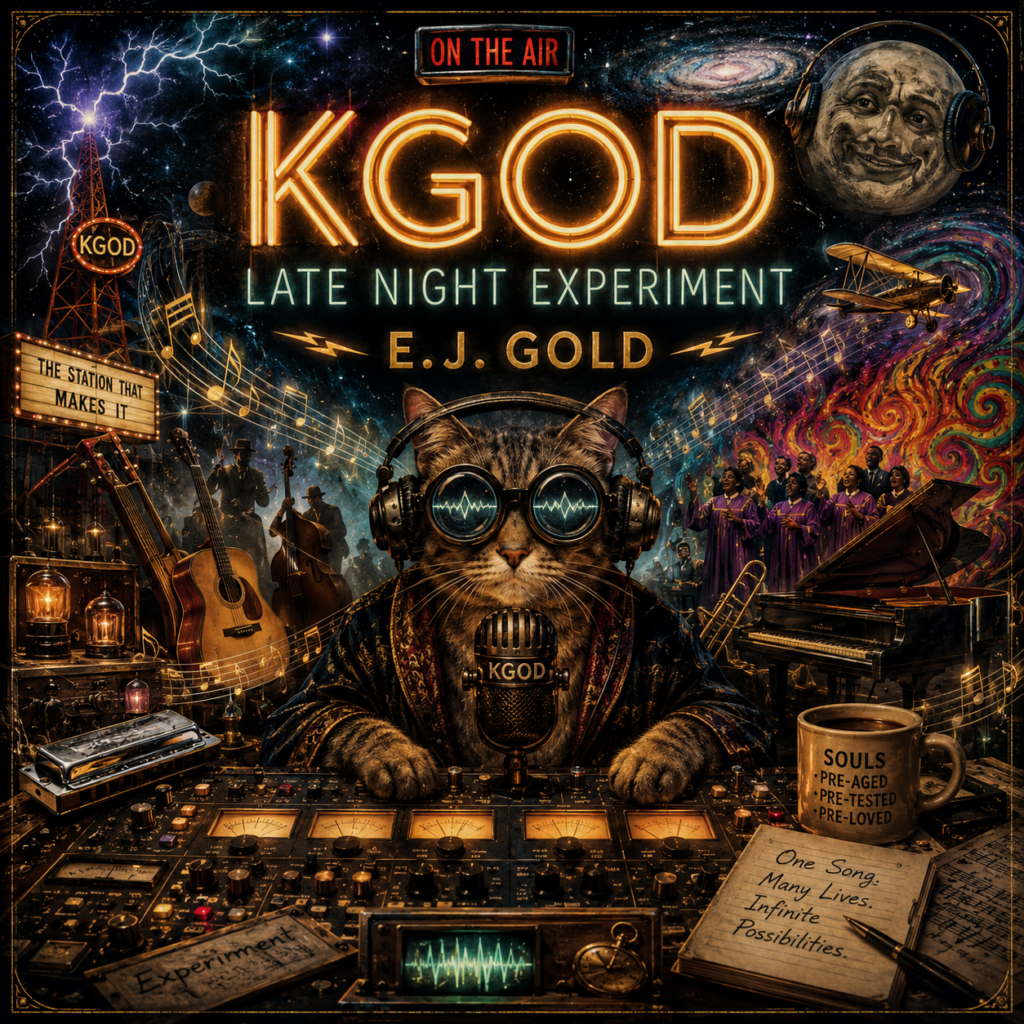
As adapted for the KGOD format, the scene works particularly well because the station breaks, weather report, and Eternity Insurance commercial reinforce the underlying theme: reality itself may be a broadcast, a simulation, or an ongoing act of improvisation. The interruptions feel natural rather than forced and help frame the dialogue as part of a larger cosmic radio universe.
Overall, this is one of the most conceptually ambitious scenes in Norton Street so far. It successfully combines comedy, metaphysics, science-fiction imagery, and theatrical absurdity while advancing the larger mythology of the play. In musical form, it translates especially well because the repeated themes of creation, memory, mortality, and identity naturally lend themselves to the recurring motifs and refrains that emerge during the production process.
===========================================================================
Hooray, here’s the Bardo bus!
===========================================================================
See You At The Top!!!
gorby