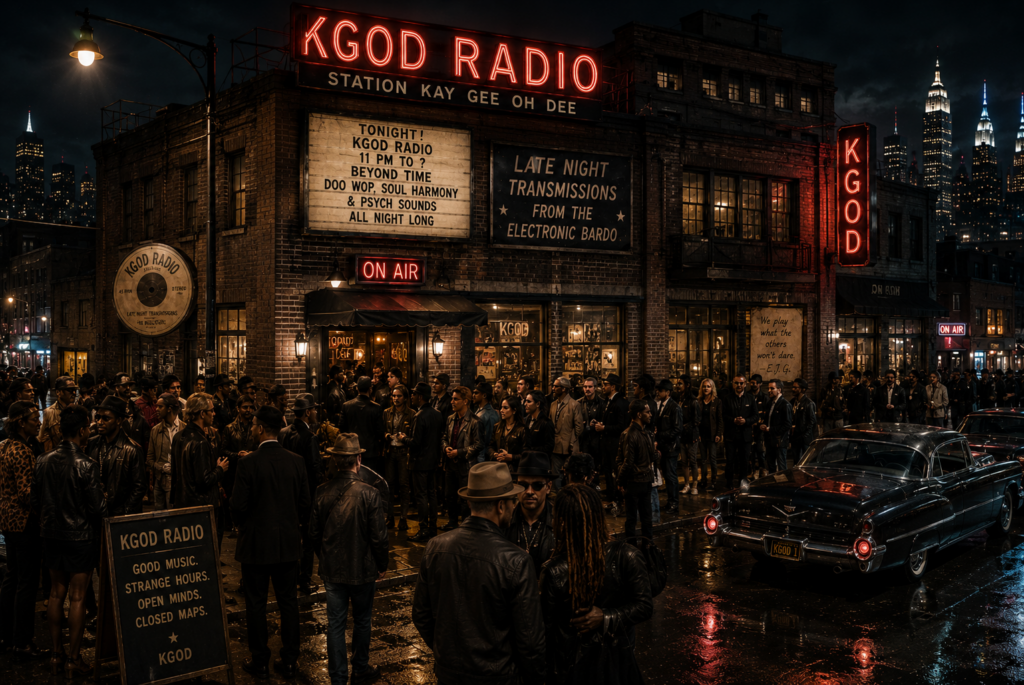
Something very interesting has started happening around the KGOD project.
At first, KGOD was simply a late-night radio atmosphere — a fictional station drifting through static somewhere between old AM radio, underground FM, dream theater, satire, jazz clubs, philosophy, and science fiction.
Then the shows started multiplying.
One became three.
Three became nine.
Now I have completed MP4 programs, with visuals, station identity, spoken intros, fake commercials, atmosphere, music segments, recurring themes, and late-night broadcast continuity. The station has started to feel real.
But then another idea appeared.
What if KGOD was not one station at all?
What if it became a network of pirate broadcasters scattered around the world?
Not a centralized corporation.
Not a giant media platform.
Not a single transmitter on a mountain.
But many small transmitters.
Many strange voices.
Many late-night operators quietly rebroadcasting pieces of the signal from wherever they happen to be.
That changes the entire nature of the project.
Suddenly KGOD stops being “a show” and starts becoming a distributed mythology.
One station might specialize in doo-wop and oldies.
Another might broadcast ambient dream material all night long.
Another becomes political satire.
Another runs jazz programs from midnight until dawn.
Another station somewhere in Europe relays mysterious spoken-word transmissions about the electronic bardo.
Another quietly loops meditation music while rain sounds drift through static.
Over time, listeners begin piecing together the larger universe themselves.
That’s where it starts becoming interesting. Because old pirate radio was never only about music. It was about freedom of atmosphere. Freedom of tone. Freedom of emotional territory.
Late-night radio once created hidden companionship for people sitting alone in cars, kitchens, truck stops, apartments, studios, diners, warehouses, and bedrooms at three in the morning.
People today are more electronically connected than ever before, yet emotionally many feel more isolated than ever.
The old feeling that “somebody else is awake with me tonight” has largely vanished from modern media.
KGOD attempts to restore that feeling.
Not through giant corporate production systems, but through small scattered creative transmitters.
The fascinating part is that modern technology now makes this possible again.
A person with a small studio, an editing system, AI music tools, visual software, and imagination can now create what once required an entire broadcast network.
In the old days, pirate radio required hidden antennas and illegal transmitters.
Today pirate broadcasting can happen through:
YouTube streams,
MP4 loops,
podcasts,
community Zoom rooms,
mirror channels,
audio relays,
small streaming stations,
and strange late-night feeds drifting through the internet after midnight.
The transmitter has changed.
The psychology has not.
And perhaps the most important part of all is the idea of continuity. A true station never entirely “ends.” Somebody is always on the air somewhere. That’s why the idea of eventually building a 24-hour KGOD schedule feels so important.
Not because it would dominate the world. But because somewhere at 2:17 AM, somebody unable to sleep might stumble across a strange broadcast filled with static, jazz, dream logic, humor, station IDs, old tube amp buzz, and mysterious voices saying:
“This is station Kay Gee Oh Dee…
Kay GOD…
the station that makes it…”
And for a few moments, they would know they are not entirely alone in the universe.
===========================================================================
Hola! Here the Bardo bus is!
===========================================================================
See You At The Top!!!
gorby