

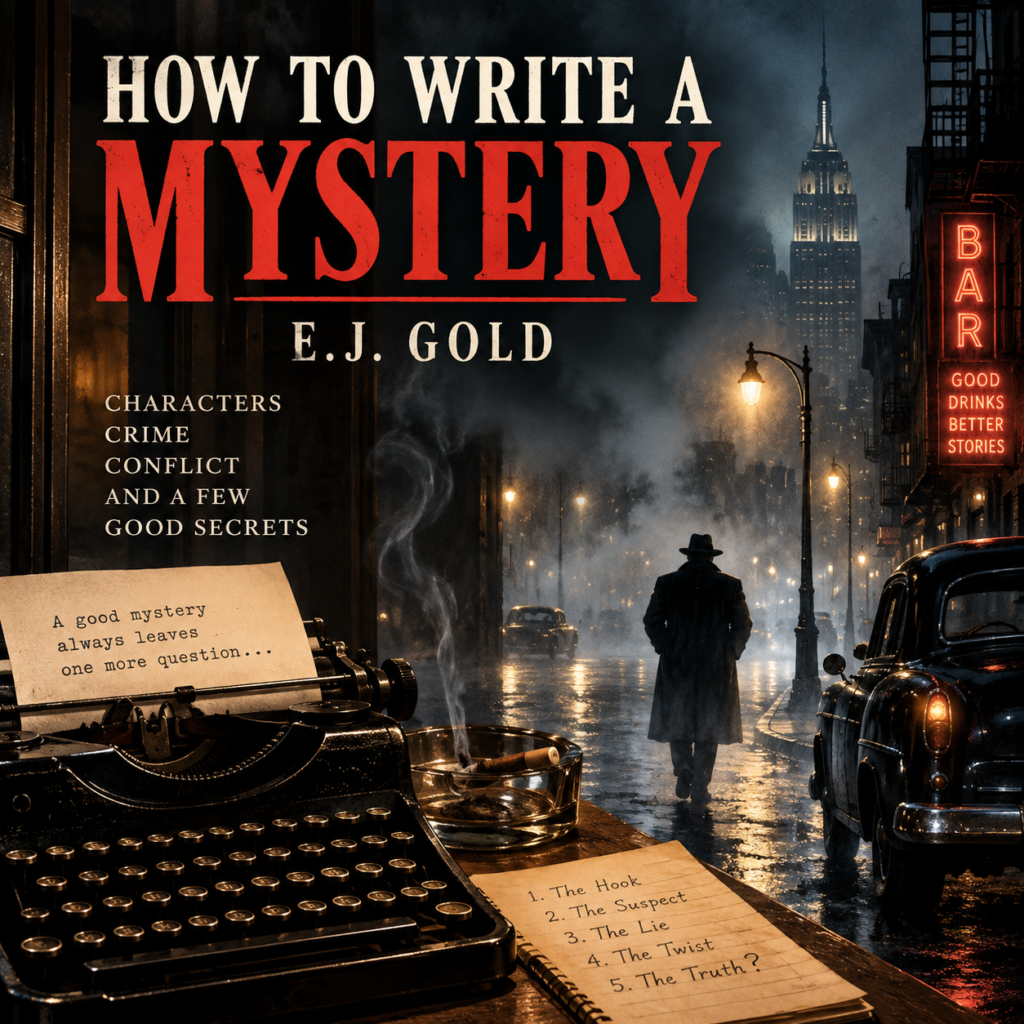
How to Write a Mystery Novel
Writing a good story isn’t just plopping people into a plot. If I’m going to write a mystery and it involves the historical figures of the five major crime families in New York City, I’d better do my homework:
The important thing about the Five Families in 1950s–60s New York is that they did not have clean geographical jurisdictions like police precincts. Several families could operate in the same borough—even the same neighborhood. Their territories were often defined more by crews, unions, industries, docks, markets, gambling operations, and particular blocks or establishments.
In broad geographical terms:
- Genovese — probably the strongest claim to Manhattan, especially Greenwich Village, the Lower/East Side, Midtown and parts of Harlem; also substantial operations in the Bronx, Brooklyn, New Jersey and elsewhere. If you were looking for the family with the deepest overall Manhattan footprint, this is it.
- Gambino — particularly powerful in Brooklyn, with major territory in Manhattan and Queens as well. Strong waterfront, trucking, construction and labor interests. Carlo Gambino’s organization became extraordinarily powerful during the 1960s.
- Lucchese — especially associated with the Bronx and East Harlem, while also very strong in Manhattan and later Queens. Their power wasn’t merely geographical: trucking, the garment district, construction and labor rackets gave them reach all over the city.
- Bonanno — strongest in Brooklyn and Queens, with Manhattan operations as well. Brooklyn neighborhoods and waterfront-related activity were important centers.
- Profaci/Colombo — overwhelmingly identified with Brooklyn, particularly South Brooklyn, although they operated elsewhere too. Of the five, this is probably the easiest one to think of as having a distinctly Brooklyn-centered base.
So if we made a deliberately oversimplified 1955–65 mental map, I’d label it: Manhattan → Genovese; Bronx → Genovese/Lucchese; Brooklyn → Gambino/Profaci-Bonanno; Queens → Bonanno/Lucchese/Gambino; Staten Island → principally Gambino, with other families present.
In the 1950s–60s New York families, the basic ladder was remarkably simple. The FBI’s organizational chart essentially gives us this structure.
BOSS / DON
↓
UNDERBOSS
↓
CAPOREGIME (CAPO / CAPTAIN)
↓
SOLDIER (SOLDATO / MADE MAN)
↓
ASSOCIATE
There’s one important wrinkle: the CONSIGLIERE doesn’t fit neatly into that vertical ladder. He was the boss’s counselor, mediator and confidant—usually regarded as part of the three-man administration with the Boss and Underboss, rather than simply another subordinate officer.
BOSS
│
┌─────────────┴─────────────┐
CONSIGLIERE UNDERBOSS
│
┌──────────────────┼─────────────────┐
CAPO CAPO CAPO
│ │ │
SOLDIERS SOLDIERS SOLDIERS
│ │ │
ASSOCIATES ASSOCIATES ASSOCIATES
A capo was quite a substantial figure. He ran his own crew or regime. The soldiers beneath him were actual initiated members of the family. Associates might work very closely with them but weren’t themselves made members.
And here’s the part that gets especially interesting for the period we’re looking at: there was no permanent “big boss of all Five Families” above the five bosses. Maranzano briefly claimed the title capo di tutti capi—”boss of bosses”—in 1931, but after Luciano had him killed, that system was replaced by the Commission. By the ’50s, therefore, the Five Family bosses were theoretically peers, with the Commission settling major inter-family questions.
In practice, of course, some bosses were considerably more powerful than others. That unofficial power structure circa 1955–60 is probably the really juicy part: who could tell whom what to do despite supposedly being equals.
=========================================================================
The Story:
He was broke, hungry, homeless, and sick. “At last,” he said to himself, “I’m getting somewhere.”
His name was Danny Vescari, and at twenty-three he had accomplished what ordinarily took a man twice his age: he had run completely out of alternatives.
It was raining on East Fourteenth Street. Not enough rain to clean anything, just enough to put a shine on the pavement and work its way through the hole in Danny’s left shoe. He stood beneath the awning of a closed furniture store with thirty-seven cents in his pocket, a fever behind his eyes, and absolutely no idea where he was going to sleep. This represented progress.
Three weeks earlier he’d had a room, a job, and a girl who occasionally permitted him to believe she was his girl. The job had gone first. The room followed. The girl had demonstrated better judgment than either of them and disappeared somewhere between the two.
Now there was nothing left to lose. Danny liked the sound of that. People were always saying it as though it were a bad thing.
Across Fourteenth Street, a black Cadillac pulled up to the curb. Danny watched it because there wasn’t much else to watch. The Cadillac was clean enough to look freshly painted, and nobody who owned a car that clean parked on Fourteenth Street at two in the morning unless he owned the street too.
A man got out. Dark overcoat. Gray fedora. Maybe fifty. He didn’t hurry through the rain.
Danny knew him. Not personally. Nobody knew Mr. Bellafonte personally unless Mr. Bellafonte wanted him to. Everybody in the neighborhood knew who he was.
Danny pushed himself farther back beneath the awning. Then the rear door of the Cadillac opened. A girl stepped out.
And Danny forgot he was sick.
She was maybe twenty-one. Dark hair, almost black, pulled back from her face. No hat. The rain caught in her hair and made it shine under the streetlight. She wore a cream-colored coat that probably cost more than Danny had earned in the last six months.
She looked up and down the street. Then she looked directly at him.
Danny stopped breathing. Not because she was beautiful, although she was. Because she was afraid.
Bellafonte said something to her. The girl shook her head. He said it again. She shook her head again. This time Bellafonte grabbed her arm.
Danny straightened. It was an involuntary movement and therefore, in retrospect, not his fault.
Bellafonte saw it.
For several seconds the two men looked at each other across Fourteenth Street. Danny considered becoming extremely interested in the furniture behind him. Instead he remained where he was.
Bellafonte released the girl’s arm. He raised one hand. Crooked a finger.
Danny looked behind himself. There was nobody there.
He looked back. Bellafonte crooked the finger again.
Danny stepped into the rain. This was probably a mistake. On the other hand, Danny’s recent experience with mistakes had been so extensive that another one hardly seemed worth worrying about.
He crossed Fourteenth Street.
Up close, Bellafonte was smaller than Danny had expected. Maybe five-eight. Beautifully dressed. Gray suit under the overcoat, white shirt, dark tie. His face was pleasant in the way certain hotel managers’ faces were pleasant when they were about to ask you to leave.
“You Danny Vescari?”
That stopped him.
“Yes.”
“Anthony Vescari’s boy?”
Danny hesitated. “Was.”
Bellafonte studied him. “Your father was a good man.”
Danny had heard this before. Usually from men his father had owed money.
“Thank you.”
“You look terrible.”
“Thank you.”
The girl made a sound. It took Danny a second to realize she was trying not to laugh.
Bellafonte turned his head toward her. The sound stopped.
“This is my niece,” he said.
Danny looked at her. She looked back.
“Elena.”
“Hello, Elena.”
Bellafonte’s eyes moved to him.
Danny corrected himself. “Miss Bellafonte.”
“Bellafonte isn’t my name,” she said.
“No?”
“No.”
Bellafonte said, “That’s enough.”
Danny decided that whatever her name was, he liked her. This was unfortunate.
Bellafonte looked him over again. “You working?”
Danny glanced at his clothes. “Does it show?”
“What happened at Delaney’s?”
“They fired me.”
“Why?”
“I hit the manager.”
The girl looked at him again. Bellafonte didn’t.
“Why’d you hit the manager?”
“He fired me.”
There was a silence.
This time the girl actually laughed.
It changed her completely. The fear vanished for half a second, and Danny saw somebody else underneath it.
Then the rear window of the Cadillac exploded.
The sound was enormous.
The girl screamed. Bellafonte dropped.
Danny didn’t. He had no idea why.
Something struck the brick wall behind him and spat pieces of mortar into his neck.
Bellafonte shouted, “DOWN!”
Danny grabbed Elena and pulled her behind the Cadillac.
Another shot.
The windshield starred.
The driver came out the other side with a pistol already in his hand. Bellafonte was on one knee. He had a gun too. Danny hadn’t seen him draw it.
Across the street, an automobile engine roared. Tires screamed on wet pavement. The driver fired twice.
Then everything stopped.
Rain.
That was all Danny could hear. Rain hitting the roof of the Cadillac.
Elena was underneath him.
He realized he was holding her. She realized it at approximately the same time.
They looked at each other.
“You can let go of me now,” she said.
“Right.”
He didn’t.
“You’re still doing it.”
“Right.”
He let go.
Bellafonte stood. The pleasant hotel-manager face had disappeared.
“Sal.”
The driver ran into the street.
Danny started to get up.
Bellafonte said, “Stay down.”
Danny stayed down. That seemed sensible.
Elena’s hand suddenly closed around his. It was trembling.
Danny looked at her. “Are you hit?”
She shook her head. “You?”
“I don’t think so.”
“You don’t know?”
“I’ve never been shot before.”
Despite herself, she smiled.
Bellafonte came around the Cadillac. He looked at Elena. Then at Danny. Then at their hands.
Elena let go.
Sal came running back.
“Gone.”
“You see who?”
“No.”
“Car?”
“Dark Buick. Jersey plates, maybe. Couldn’t get it.”
Bellafonte looked across the street.
Something had happened to him. Not fear. Danny knew fear.
This was calculation.
Bellafonte was counting. People. Possibilities. Debts. Enemies.
Then he looked at Danny.
“You still need a job?”
Danny stared at him.
A minute ago he had been broke, hungry, homeless, and sick.
Now somebody was shooting at him.
He looked at Elena. She was watching him.
Danny got to his feet.
“What are the hours?”
===========================================================================
Make it Believable:
If we’re going to make this feel like New York around 1958 rather than a generic Mafia movie, we need to build Bellafonte’s family from the inside out.
The most useful details aren’t necessarily famous historical names. They’re the everyday mechanics: who answers to whom, where everybody meets, how money travels upward, what businesses provide cover, how wives and children fit into the social world, what happens at weddings and funerals, what a capo’s crew actually does all day, and what Danny is allowed—or forbidden—to know.
For our fictional family, I’d establish something like this:
- Don Vincent Bellafonte, perhaps 58, is boss. He doesn’t personally collect gambling debts or order people around on street corners. People come to him. He has a legitimate-looking office or restaurant where very little explicit business is ever discussed.
- Underboss: Dominic “Mickey” Sarto, an old friend who came up with Vincent. He handles the machinery and passes instructions to the capos. This is potentially a wonderful murder suspect because he’s the obvious successor.
- Consigliere: Louis Ferrara, maybe 65, quiet, educated, never raises his voice. He’s the man people underestimate. He settles disputes and knows where thirty years of bodies are buried—figuratively and perhaps literally.
- Four or five capos, each with his own territory and rackets. One has gambling and bookmakers; another trucking and garment interests; another construction and unions; another loans and clubs. Each capo has perhaps half a dozen to a dozen made soldiers plus numerous associates.
- Soldiers are initiated members. They earn money largely through their own operations, kick a portion upward, and in return receive status and protection. They aren’t salaried employees.
- Associates are the enormous outer layer: bookmakers, thieves, bartenders, truckers, union people, businessmen, corrupt officials, fences, loan collectors and ambitious young guys. Danny initially belongs down here.
And one detail could make the love story much better: Elena shouldn’t be Vincent’s daughter. Niece was a good instinct. Suppose Elena’s father—Vincent’s younger brother—was killed years earlier. Vincent subsequently raised her almost as his own daughter.
That means Elena is simultaneously inside the family and outside its formal male hierarchy. She has grown up hearing conversations stop when she enters rooms. She recognizes every important man, knows who hates whom, knows which wives aren’t speaking, knows that Uncle Vincent occasionally receives visitors at 3 A.M.—but nobody has ever officially told her anything.
That gives her knowledge Danny desperately needs once the murder happens.
And I’d make one historical adjustment to our terminology. They probably wouldn’t constantly call the organization “the Mafia” among themselves. Depending on the people and context, you’d hear things such as the family, our friends, this thing, a friend of ours (an initiated member), or a friend of mine (someone connected but not made). Likewise, Danny isn’t likely to hear, “I’m a capo in the Bellafonte crime family.” He learns the structure by watching who gets up when somebody enters the room.
That’s the sort of detail that will sell the whole novel.
Next, I’d build the complete fictional Bellafonte organization circa 1958—maybe 25–30 recurring people, including wives, girlfriends, children, businesses and relationships—and secretly designate the eventual murder victim and perhaps 5 plausible suspects. Then we’ll have a world for Danny to walk into rather than inventing the mob one chapter at a time.
===========================================================================
Leave Room for a Sequel!
I think we’ve got a good engine running there. Danny’s humor gives us room to make the crime story genuinely dark without making the whole book grim, and Elena gives him an immediate reason to stay in a world any sensible man would leave.
The part I especially like is that he doesn’t enter the family because he wants to be a gangster. He’s broke, accidentally behaves courageously during an assassination attempt, and Bellafonte notices him. That’s much more interesting than the usual ambitious-young-hood setup.
And now we’ve got the lovely trap: Danny gets what he needs—food, money, a place to sleep, a job, and Elena—and every single one of those improvements makes his situation more dangerous.
That’s a mystery novel waiting to happen.
===========================================================================
Here’s the Bardo bus now!
===========================================================================
See You At The Top!!!
gorby