

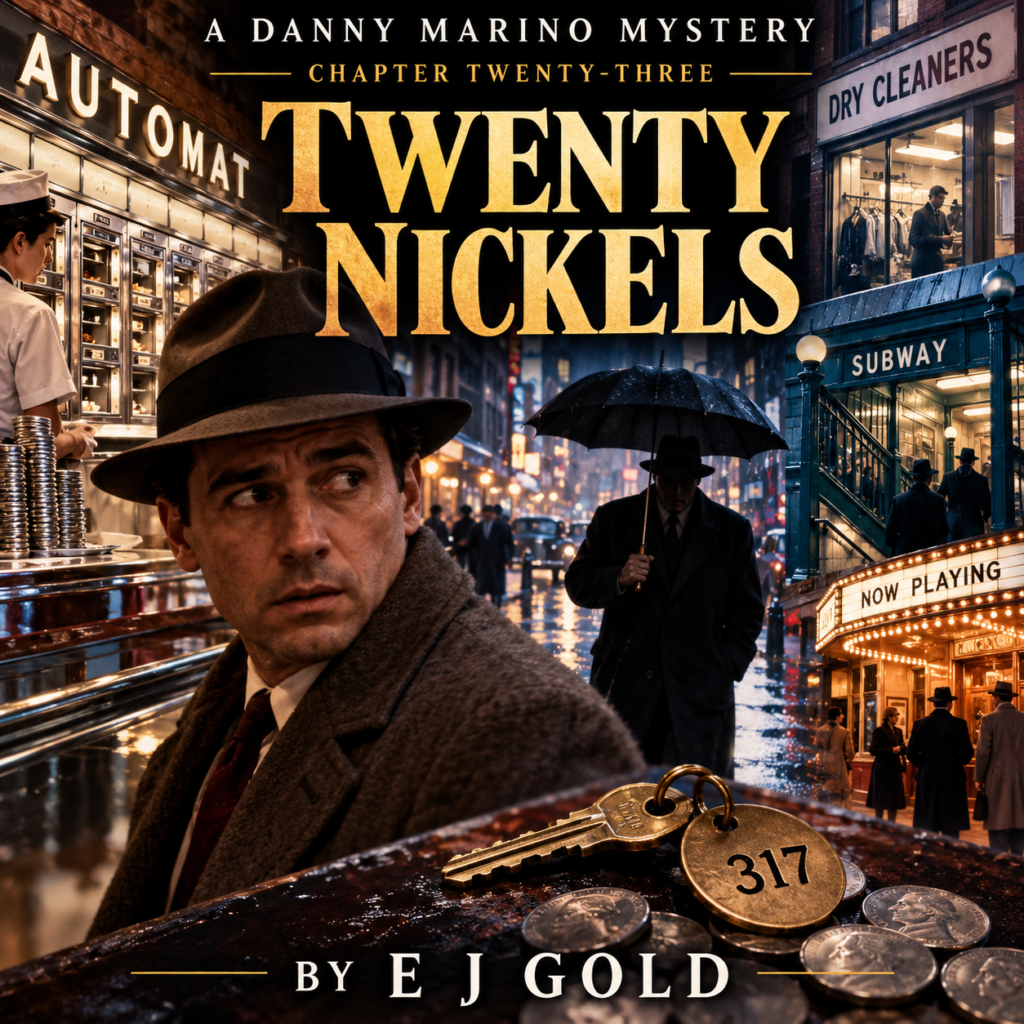
CHAPTER TWENTY-THREE
TWENTY NICKELS
Danny Marino had never thought of an umbrella as threatening. He was beginning to reconsider.
The man was half a block behind him. Danny crossed Seventh Avenue. The man crossed Seventh Avenue.
Danny stopped in front of a cigar store and looked at the racing sheets in the window. The man stopped. Danny couldn’t see what he was looking at.
He had the umbrella. That was enough.
Danny started walking again. He had no particular destination in mind, which gave him an advantage over anybody following him. It was difficult to predict where a man was going when the man himself didn’t know.
Danny went into a nearby Horn & Hardart Automat.
It was crowded, but there was always room for one more person in an Automat. People came in alone, in pairs, in groups from offices, carrying packages, newspapers, briefcases and shopping bags. They seemed to scatter as soon as they came through the door, each drawn toward a different part of the machinery.
Danny stopped just inside.
He hadn’t been in one for a while.
The place was glaringly brighter than the street. Glass, tile, brass and polished chrome caught the light and passed it around. Along one wall were rows and rows of little glass doors, each with a metal frame, a knob and a slot for nickels. That was all you could use in there was nickels.
Behind the doors was lunch.
Slices of pie waited on small plates. Sandwiches sat in neat rows. There were baked beans, macaroni, vegetables, salads and desserts. Each dish occupied its own little compartment as though it had rented an apartment.
Every few seconds a hand appeared behind the wall and replaced something somebody had taken.
Danny watched one for a moment.
A piece of lemon meringue pie disappeared through the front.
Almost immediately another piece appeared from behind.
It was a good system.
Nobody had to talk to anybody.
At the change counter a woman stood, with a trolley style coin dispenser mounted on her belt.
Danny fished in his pocket and pulled out several silver coins — two heavy silver dollars, a walking liberty half dollar and two Washington quarters. He walked over to the change lady, and put down one of the silver dollars.
“Change please.”
She took the silver dollar without looking at him.
Her fingers moved quickly, and the nickels clinked and crashed out of the coin dispenser with a cluttering sound. Sure enough, twenty nickels appeared almost instantaneously and she handed them over to him, quickly turning to the next customer.
Danny looked down at them.
Twenty nickels seemed like a lot, but most of the offerings were multi-nickel so it would go fast, which was, of course, the idea. He swept the nickels into his right-hand pants pocket. They settled there with considerable weight, but not as much as a solid silver dollar would.
Danny moved farther inside.
There was a long counter with coffee urns and hot-water dispensers, all polished metal and black handles. Steam drifted around them in little clouds. Somebody filled a cup with coffee. Somebody else drew hot water for tea. A woman dropped a tea bag into a cup and stood watching it as though something important might happen.
The coffee smelled good.
So did the pie.
There was another smell underneath everything—hot metal, steam, toast, cooked vegetables and wet wool from coats that had been outside.
Danny liked it.
For a nickel you could get something hot. For a few more nickels you could put together a meal. Nobody asked who you were or why you were there.
That last part appealed to him particularly.
He looked toward the entrance.
No umbrella.
Danny moved along the wall of little doors.
People opened them constantly.
Nickel.
Turn the knob.
Open the door.
Take the plate quickly and smartly, or lose it when the door clicked shut again.
Having secured your food plate, it’s okay to now close the door, or it will click shut on its own a few moments later. You can see immediately somebody behind the steamtable wall filling the empty compartment with the same dish you just pulled out of there.
Danny wondered what it looked like behind the wall of tiny windows. There had to be an entire restaurant hidden behind the restaurant. Cooks, dishwashers, trays, steam tables, people filling compartments as fast as New York could empty them.
But the customers never saw any of that. They saw only the little glass door.
Danny stopped. That thought bothered him for some reason. He looked through the glass at a piece of apple pie. Behind the pie he could see only darkness and movement. Then a hand appeared, moved something, and disappeared.
Danny put a nickel into a slot.
Nothing happened.
He tried another. And a third, then heard the change lady call over to him, “Three nickels for the pie”.
“Oh,” he said, fumbling for a third coin, which he dropped in. This time the knob turned and the little window clicked open.
He carefully opened the little door, and took out the pie before the door could close on him. He still had no idea why he had bought it.
He carried it toward the coffee.
The coffee arrangement was almost as mechanical as the food. Cups stood ready. Metal urns reflected faces in distorted shapes. Steam curled upward and disappeared into the light.
Danny could see the entrance reflected in one of the urns.
Or part of it.
People came through the door, their images wildly bent and stretched across the curved metal of the chrome-plated dispenser walls of the automat.
A man in a hat became a very thin man in those mirrors. A woman carrying packages became three women carrying one package.
Danny moved slightly. The reflection changed. No umbrella.
He got his coffee into the cup. Another nickel.
Now he had coffee and pie.
That at least made him look like an ordinary automat customer. He was beginning to understand that the easiest way to hide was to look as though you were doing whatever everybody else was doing.
He found a table. An elderly man was sitting there reading the Daily News.
Danny pointed at the empty chair. “Anybody sitting here?”
The old man looked at the chair. “Looks like you are.”
Danny sat down.
From there he could see the entrance reflected in the chrome trim around the food compartments.
Not all that well.
That was probably better.
He took a bite of pie.
Apple. Not bad.
Around him the Automat continued doing what it did.
Nickels dropped into slots.
Little doors opened.
Little doors closed.
Cups struck saucers.
A spoon fell on the floor.
Somebody laughed.
A busboy pushed a cart loaded with dishes.
Steam rose from the coffee urns.
A woman at the change counter turned a dollar bill into twenty nickels without interrupting a conversation with the woman beside her.
A man stood at the hot-water dispenser trying to decide whether his tea was ready.
Nobody seemed to be in a hurry, although this was New York, so actually, everybody probably was in a hurry, some of them in a desperate hurry to catch the E train uptown.
Danny drank some coffee. For the first time since Seventh Avenue he relaxed. Then — wouldn’t you know it? — a man in a gray overcoat came through the door.
Danny stopped with the cup halfway to his mouth.
The man turned.
Different man. Definitely not the umbrella man.
Danny drank the piping hot coffee.
A woman entered with two shopping bags.
Behind her came two office workers.
Then a delivery boy.
Then nobody.
Danny looked at his pie.
He took another bite.
Maybe he had imagined the whole thing.
Maybe the Umbrella Man hadn’t been following him at all.
New York contained several million people.
Some of them carried umbrellas.
Especially when it rained.
Danny considered this.
Then he saw the umbrella.
It appeared first in the reflection.
Black.
Curved handle.
The reflection moved across the polished metal of the coffee urn.
Danny didn’t turn around.
The umbrella disappeared.
Danny waited.
It appeared again in another piece of chrome.
Closer.
Danny put down his fork.
The old man lowered his newspaper.
“You through with that?”
Danny looked at the remaining pie.
“Help yourself.”
The old man pulled the plate toward him.
Danny left the coffee too.
He walked toward the side door without looking back.
As he passed the change counter, the woman was making another twenty nickels spew like rockets, out of her belt-mounted coin dispenser.
Danny put his hand into his pocket. His own nickels were still there. They made a small metallic sound as they bumped against his other change.
Behind him, somewhere among the steam, glass doors, coffee urns and reflections, was the man with the umbrella. Or somebody else.
Danny went out the side door.
He walked rapidly for half a block, turned east, crossed against the light and went into a laundry.
Steam clouded the windows.
A woman behind the counter was sorting shirts.
“Help you?”
Danny looked around.
“No.”
“You picking up?”
“No.”
“Dropping off?”
“No.”
She stared at him.
Danny looked through the window.
The umbrella went past.
Danny ducked.
The woman stopped sorting shirts.
“You hiding from somebody?”
“No.”
“You look like you’re hiding from somebody.”
“I changed my mind about the laundry.”
“Oh, did I forget to bring my laundry?” he quipped as he went through the door onto the street.
Danny was once again outside on the street. Umbrella man? No umbrella.
He walked two blocks downtown and entered a department store.
Women’s gloves. Perfume. Handbags. Cosmetics. Gift boxes.
He took the escalator to the mezzanine, notions department.
Third floor. Women’s Wear. Children’s Wear. Men’s Suits, Jackets, Coats and Hats.
He took another escalator to the fourth floor. Housewares. Danny wandered through lamps, clocks and electric toasters.
He looked over the railing.
Nobody.
He found the elevator.
“Down,” the operator said, closing the gate.
The elevator started down. At the second floor the gate opened.
Three people got in. One of them bumped Danny.
“Sorry,” the stocky gentleman apologized.
“No problem,” Danny offered.
The doors closed.
Danny looked at the man.
Short. Heavy coat. No hat.
The man looked straight ahead.
Street floor.
Everybody got out.
Danny waited until the short man went one way.
Danny went the other.
He left through a different entrance.
No umbrella.
He was beginning to feel pretty good.
That was just the kind of thing that typically worried him.
Danny went down into the subway.
He stopped at the change booth, and got two dimes and a nickel for one of his silver quarters, and dropped one of the dimes into the turnstile.
A train was already in the station. Danny quickly got on board.
The doors started to close. At the far end of the platform a man came down the stairs. Umbrella. Danny leaned forward.
The doors closed. The train moved.
Danny smiled. At the next station he got off.
He waited until the doors were almost shut and then quickly jumped back aboard.
A woman carrying groceries looked at him. Danny shrugged. “Changed my mind.” She gave him an evil look, and moved as far as possible away from him.
At Fourteenth Street, Danny got off for real. He climbed the stairs and came out on the wrong side of the avenue.
That was fine. He wasn’t sure there was a right side anymore. He walked into the lobby of a movie theater. The picture had already started. The girl at the ticket booth looked at him.
“One.” Danny paid. He went inside. The lobby was nearly empty.
Danny stood beside a cardboard display advertising a picture about people who looked much happier than anybody Danny knew.
He waited.
Nobody came in.
Danny waited another minute.
Still nobody.
He walked back to the ticket booth.
The girl looked at him.
“You just came in.”
“I know.”
“You don’t like the picture?”
“I haven’t seen it.”
She looked at Danny for a long moment.
“People are strange,” she muttered behind him.
Danny went outside. He walked another block.
No umbrella. Another block. Nothing. He slowed down. He had done it. Whatever the man wanted, he hadn’t gotten it.
Danny put his hands into his pockets. His right hand encountered the nickels.
He took all the coins out.
Seventeen nickels. Hmmmm. He counted them again. Sure enough, seventeen nickels. That didn’t seem right.
He had bought coffee and pie. That should have left—
Danny stopped walking. There was something else in his pocket. He reached inside.
A key.
Danny stared at it.
It was a small brass key with a round metal tag.
Stamped into the tag was a number.
Danny turned around.
People moved along the sidewalk behind him.
A delivery boy.
Two women talking.
A man carrying packages.
A cop at the corner.
No umbrella.
Danny looked at the key again.
He had no idea what it opened.
He had no idea who had put it in his pocket.
And then he realized something else.
He had been so busy watching the man with the umbrella that he had never once wondered who else might be following him.
===========================================================================
CHAPTER TWENTY-THREE BREAKDOWN
TWENTY NICKELS
Chapter Twenty-Three finally puts Danny Marino in motion.
After several chapters of messages, errands, dry cleaners, blue suits and apparently meaningless instructions, Danny discovers that the Umbrella Man is following him. Or at least Danny thinks he is following him.
Danny crosses Seventh Avenue. The Umbrella Man crosses Seventh Avenue. Danny stops. The man stops.
That is enough for Danny.
Instead of confronting him or running, Danny begins improvising a route through Manhattan. He has no destination, which gives him the peculiar advantage of being impossible to predict.
His first refuge is a Horn & Hardart Automat.
The Automat becomes the centerpiece of the chapter.
Danny enters a brightly lit world of tile, glass, brass, polished chrome, steam and machinery. Rows of little glass doors contain individual dishes of food. Customers put nickels into slots, turn knobs, open the doors and remove their plates. Behind the wall, unseen workers immediately replace whatever has been taken.
At the change counter, a woman wearing a belt-mounted coin dispenser turns Danny’s silver dollar into twenty nickels.
The nickels become the physical thread running through the chapter.
Danny wanders deeper into the Automat, studying the steam tables, coffee urns, hot-water dispensers, food compartments and distorted reflections in the polished metal. The ordinary workings of the place give him a way to watch the entrance without obviously looking behind him.
He also begins thinking about what must exist behind those little glass doors.
There has to be an entire restaurant hidden behind the restaurant—cooks, dishwashers, trays, steam tables and workers continually replacing the dishes that disappear through the windows.
The customers never see any of it.
They see only the little glass door.
That observation quietly reflects Danny’s position in the mystery. He sees messages, errands, umbrellas, blue suits and people coming and going. He sees what appears at the window.
He still cannot see the machinery operating behind it.
Danny buys a piece of apple pie for three nickels and coffee for another nickel. He sits with an elderly man reading the Daily News and gradually begins to relax.
Then the umbrella appears in the reflection of the polished metal.
Danny leaves through the side door.
From there the pursuit becomes a tour through ordinary Manhattan.
Danny ducks into a laundry, where his suspicious behavior immediately attracts the attention of the woman behind the counter. He has no laundry, isn’t picking anything up and isn’t dropping anything off. When she asks whether he is hiding from somebody, Danny denies it and leaves.
The Umbrella Man has passed the window.
Danny next enters a department store.
He moves through women’s gloves, perfume, handbags, cosmetics, notions, clothing and housewares, taking escalators between floors and watching for his pursuer.
In the elevator, a short, stocky man in a heavy coat bumps into Danny and apologizes.
It is an insignificant incident.
Or perhaps it isn’t.
The reader now has one obvious candidate for the person who eventually puts something into Danny’s pocket. But the chapter provides enough crowds, encounters and distractions that there is no reason to be certain.
Danny leaves through another department-store entrance.
Still no umbrella.
He goes into the subway.
Here Danny demonstrates that he is learning.
He gets onto a train just before the doors close, leaving the Umbrella Man on the platform. At the next station Danny gets off, waits until the doors are almost closed, then jumps back aboard.
It is a small but significant development.
Danny is becoming reasonably good at this.
That may be dangerous, because Danny’s growing competence is beginning to give him confidence in conclusions that may be completely wrong.
At Fourteenth Street he leaves the subway and ducks into a movie theater.
Again he behaves so strangely that an innocent bystander finds him suspicious. He buys a ticket, enters the theater, watches the lobby instead of the picture and then leaves without seeing the movie.
Finally Danny returns to the street.
No umbrella.
He walks another block.
Still nothing.
Danny concludes that he has successfully lost the man.
Whatever the Umbrella Man wanted, Danny thinks, he didn’t get it.
Then Danny puts his hand into his pocket.
He finds the nickels.
And here the arithmetic becomes important.
Danny started with twenty nickels.
He spent three on the apple pie.
He spent one on coffee.
He should have sixteen.
Danny counts them.
Seventeen.
He counts them again.
Seventeen.
There is an extra nickel.
Then Danny discovers something else in the same pocket.
A small brass key.
Attached to it is a round metal tag stamped with the number:
Danny has no idea what the key opens.
More importantly, he has no idea who put it into his pocket.
The extra nickel now becomes evidence.
Someone apparently reached into Danny’s pocket to leave the key and, in the process, left a nickel behind as well.
That means the transfer was not imaginary.
Somebody got close enough to Danny to put something into his clothing without his noticing.
The obvious suspect is the stocky man who bumped him in the department-store elevator.
But that may be exactly what the reader is supposed to think.
The transfer could have happened in the Automat, the laundry, the department store, the subway, the theater or somewhere on the street.
And there is an even larger problem.
Danny has spent the entire chapter concentrating on the Umbrella Man.
He has watched for the umbrella in windows, polished chrome, crowds and subway stations. Every decision Danny has made has been based on the assumption that the Umbrella Man is the person he needs to worry about.
Only after finding the key does Danny recognize the flaw in that assumption.
The Umbrella Man may have been the pursuer.
He may have been protecting Danny.
He may have been trying to contact him.
He may have been trying to prevent somebody else from contacting him.
Or he may have been nothing more than a deliberate distraction.
Danny has become skilled enough to recognize that he is being followed.
What he hasn’t learned yet is that there can be more than one person doing the following.
The chapter therefore ends with a change in the scale of the mystery. Danny hasn’t merely discovered a mysterious key. He has discovered the possibility of an invisible organization operating around him. Like the Automat, he can see the little doors opening and closing.
For the very first time, he realizes there is machinery behind the wall.
===========================================================================
Here’s the Bardo bus now!!!
===========================================================================
See You At The Top!!!
gorby