

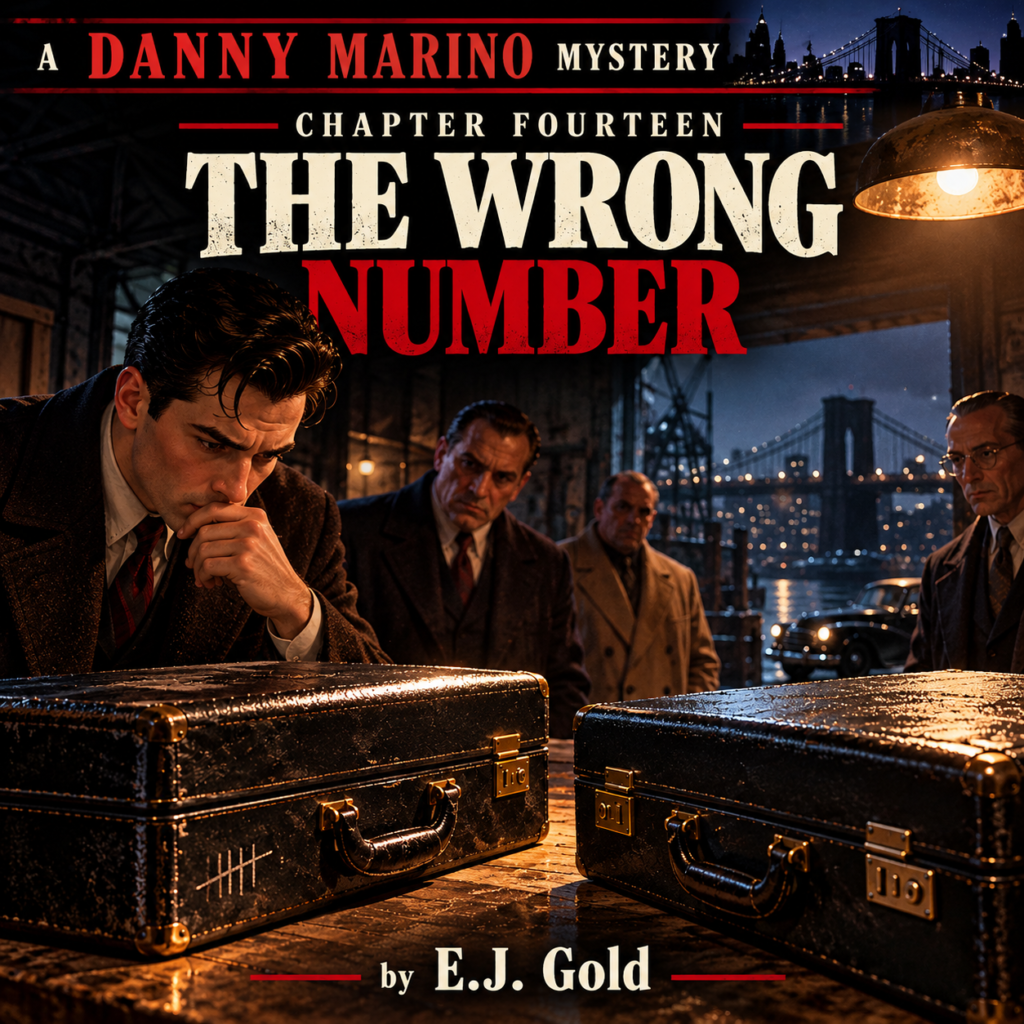
CHAPTER FOURTEEN
THE WRONG NUMBER
Charlie drove the Pontiac into Brooklyn without saying another word. Danny had discovered that Charlie could go for remarkably long periods without talking. It was one of the things Danny liked about him. The other was that Charlie seemed to know where he was going.
“You know where we’re going?” Danny hazarded.
“Yes,” Charlie responded.
“That’s comforting.”
Charlie glanced at him.
“I didn’t say I knew why.”
They turned off Atlantic Avenue and worked their way toward the waterfront.
The rain had stopped, but everything was still wet. Streetlights made long yellow streaks across the pavement. The Pontiac passed dark warehouses, loading docks and fenced lots where nothing appeared to be happening.
Danny was beginning to understand that places where nothing appeared to be happening were generally where things happened.
Charlie turned into an alley between two warehouses.
A man stepped out of a doorway.
Charlie stopped.
The man looked at Charlie, then at Danny, then at the Pontiac.
He raised two fingers, said nothing, gave no other sign. Charlie drove on.
“What was that?” asked Danny.
“Two fingers.”
“I saw that.”
“Then why did you ask?”
They stopped behind a warehouse.
Three men were waiting.
Danny recognized one of them.
Tony Spada.
Tony did not look happy.
That was unusual only because Tony normally looked as though happiness was something that happened to other people. Beside him stood a heavy man in a camel-hair coat and another man Danny had never seen before. The stranger was thin, perhaps fifty, wearing a dark suit under a raincoat. No hat. He looked like a banker. Danny had learned to distrust men who looked like bankers. Tony opened Danny’s door.
“Get out.”
Danny got out.
Charlie followed.
Tony pointed toward the warehouse.
“Inside.”
Nobody introduced anybody.
Inside, the building smelled of damp wood, machine oil and old coffee.
A bare bulb hung over a table.
On the table sat two black attaché cases.
Danny stopped.
So did Charlie.
The heavy man in the camel-hair coat said, “There they are.”
Tony said nothing.
Danny looked at the cases.
Then at Tony.
Then back at the cases.
“What?”
Tony’s eyes moved toward him.
Danny decided that perhaps “what?” had been sufficient.
The thin man spoke.
“These were picked up tonight.”
“Where?” Charlie asked.
“South of Brooklyn Heights.”
Danny looked at Charlie.
Charlie looked at Danny.
Neither said anything.
Tony walked around the table.
“Two cases.”
The heavy man nodded.
“Two.”
Tony tapped one finger against the tabletop.
“Three went to Miami.”
Nobody answered.
“Three,” Tony repeated. “Not two. Not four. Three.”
The thin man said, “We know.”
“They left Miami.”
“We know.”
“They were headed north.”
“We know that too.”
“And somebody took them.”
“Yes.”
Tony pointed at the table.
“Now two are here.”
The heavy man shrugged.
“That seems to be the situation.”
Tony stared at him.
Danny thought it was probably a bad time to shrug.
Charlie stepped closer to the cases but did not touch them.
“You open them?”
“No.”
“You sure?”
The heavy man looked offended.
Charlie nodded.
“Good.”
Danny had been watching the thin man.
The thin man wasn’t looking at the cases.
He was watching everybody else.
That bothered Danny.
Tony said, “Where’s the third one?”
“We don’t know.”
“And the fourth?”
“We don’t know.”
“So you don’t know where two of them are.”
The heavy man hesitated.
“That’s not exactly the problem.”
Tony looked at him.
“What exactly is the problem?”
The heavy man glanced at the thin man.
The thin man finally looked at the cases.
“We got a telephone call twenty minutes ago.”
Nobody moved.
“A man said he represented Miami.”
Tony’s expression didn’t change.
“He said Miami has two cases.”
Charlie looked at the table.
Then at Tony.
Then back at the table.
Tony said, “Miami has two.”
“That’s what he said.”
“And we have two.”
“Yes.”
Danny counted silently.
Tony was doing the same thing.
Charlie said, “That’s four.”
The thin man nodded.
Danny waited.
Nobody seemed relieved.
That bothered him even more.
Tony said, “Then what’s wrong?”
The thin man looked directly at him.
“Chicago called ten minutes later.”
Tony’s finger stopped tapping.
“What did Chicago say?”
“They have one.”
Nobody spoke.
Danny looked at the two cases on the table.
Two in Brooklyn.
Two in Miami.
One in Chicago.
He counted again.
It didn’t help.
Charlie said it first.
“That’s five.”
The bare bulb swung slightly overhead.
Tony stared at the cases.
Danny stared at Tony.
For the first time since Danny had met him, Tony Spada looked genuinely uncertain.
The heavy man said, “Maybe somebody’s lying.”
Tony shook his head.
“Somebody is always lying.”
The thin man said, “That’s not what worries me.”
“What worries you?”
“What if nobody is?”
Silence.
Somewhere outside, a truck changed gears.
Danny suddenly wanted very badly to be somewhere else.
Tony turned toward him.
“Marino.”
Danny straightened.
“Yeah?”
“You saw one of these before.”
Danny looked at the cases.
“Yes.”
“You remember it?”
“Yes.”
“Good.”
Tony stepped aside.
“Tell me if either one of these is it.”
Danny approached the table.
He did not touch the cases.
They looked ordinary.
Black leather. Brass fittings. Combination locks.
Businessman’s luggage.
One had a small scrape near the lower corner.
The other didn’t.
Danny bent slightly.
Then he saw it.
A tiny indentation beside the handle.
Three short marks.
One long.
Danny had seen them before.
Not on the case.
On the Saint Christopher medal.
The medal Rosie had found.
3–17–42–6.
He stood up.
“Well?”
Danny looked at Tony.
Then at Charlie.
Then at the thin man.
He suddenly understood something he wished he didn’t.
“These aren’t the same cases.”
Tony’s face became still.
“What?”
Danny pointed.
“They look the same.”
“So?”
“So somebody made more.”
Nobody moved.
Danny looked at the two black cases under the swinging light.
Four cases had been bad enough.
Now nobody knew how many there were.
And somewhere between New York, Miami and Chicago, somebody had just changed the game and the rules.
===========================================================================
CHAPTER FOURTEEN BREAKDOWN
THE WRONG NUMBER
1. START WITH MOVEMENT
The chapter begins in the Pontiac, continuing directly from the previous chapter.
Charlie knows where they’re going but not why.
That distinction keeps both Danny and the reader in the dark while getting the story moving immediately.
2. USE THE SETTING TO CREATE EXPECTATION
Wet Brooklyn streets, warehouses, loading docks and an alley near the waterfront tell us that something illicit is happening before anybody says so.
Danny’s observation establishes a useful rule of his new world:
Places where nothing appeared to be happening were generally where things happened.
Danny is learning.
3. KEEP THE HUMOR DRY
The exchange:
“You know where we’re going?”
“Yes.”
“That’s comforting.”
“I didn’t say I knew why.”
keeps the humor inside the characters. Nobody tells a joke. Charlie is simply Charlie.
The same technique appears with the two-finger signal.
4. PUT THE OBJECT IN THE ROOM
Instead of having Tony tell Danny that two cases have been recovered, we see them sitting on the table.
Objects are stronger than explanations.
Now the reader can study the cases along with Danny.
5. TURN EXPOSITION INTO ARITHMETIC
The complicated movement of the cases is reduced to a simple problem:
Two in Brooklyn.
Two in Miami.
That’s four.
Then Chicago calls.
Chicago has one.
That’s five.
The reader doesn’t need a lengthy explanation of transportation routes or mob politics. Everybody understands the problem instantly.
6. LET THE CHARACTERS REACT BEFORE EXPLAINING
The important moment isn’t merely that the arithmetic is wrong.
It is that Tony Spada doesn’t understand it either.
Until now Tony has usually seemed to know more than Danny. Seeing Tony genuinely uncertain changes the balance of the story.
The people who appeared to be running things may not be running them at all.
7. THE KEY LINE
“Maybe somebody’s lying.”
“Somebody is always lying.”
“That’s not what worries me.”
“What worries you?”
“What if nobody is?”
That’s the turn.
If everybody is telling the truth, the mystery becomes much larger.
8. MAKE DANNY USEFUL
Danny isn’t merely present while important men solve the problem.
Tony needs him.
Danny has seen one of the original cases, and his ability to notice and remember details becomes important again.
This continues something already established about him: Danny survives partly because he pays attention.
9. BRING BACK AN OLD CLUE
The markings connect the cases with the Saint Christopher medal:
3–17–42–6.
A clue planted earlier acquires new significance.
That’s an important mystery-writing technique. A good clue doesn’t necessarily explain itself when it first appears. It waits.
10. CHANGE THE QUESTION
At the beginning of the chapter the question is:
Where are the four cases?
By the end, that question is obsolete.
The new question is:
How many cases are there?
And behind that lies an even bigger question:
Who made them?
11. END BY EXPANDING THE WORLD
The chapter begins with a local problem involving New York and Miami.
By the end, Chicago is involved and the supposedly fixed number of cases has disappeared.
The geography gets bigger.
The conspiracy gets bigger.
Danny’s problem gets bigger.
That’s a good chapter ending: don’t merely leave the reader without an answer.
Make the original question inadequate.
===========================================================================
Hey! Here’s the Bardo bus now!!!
===========================================================================