

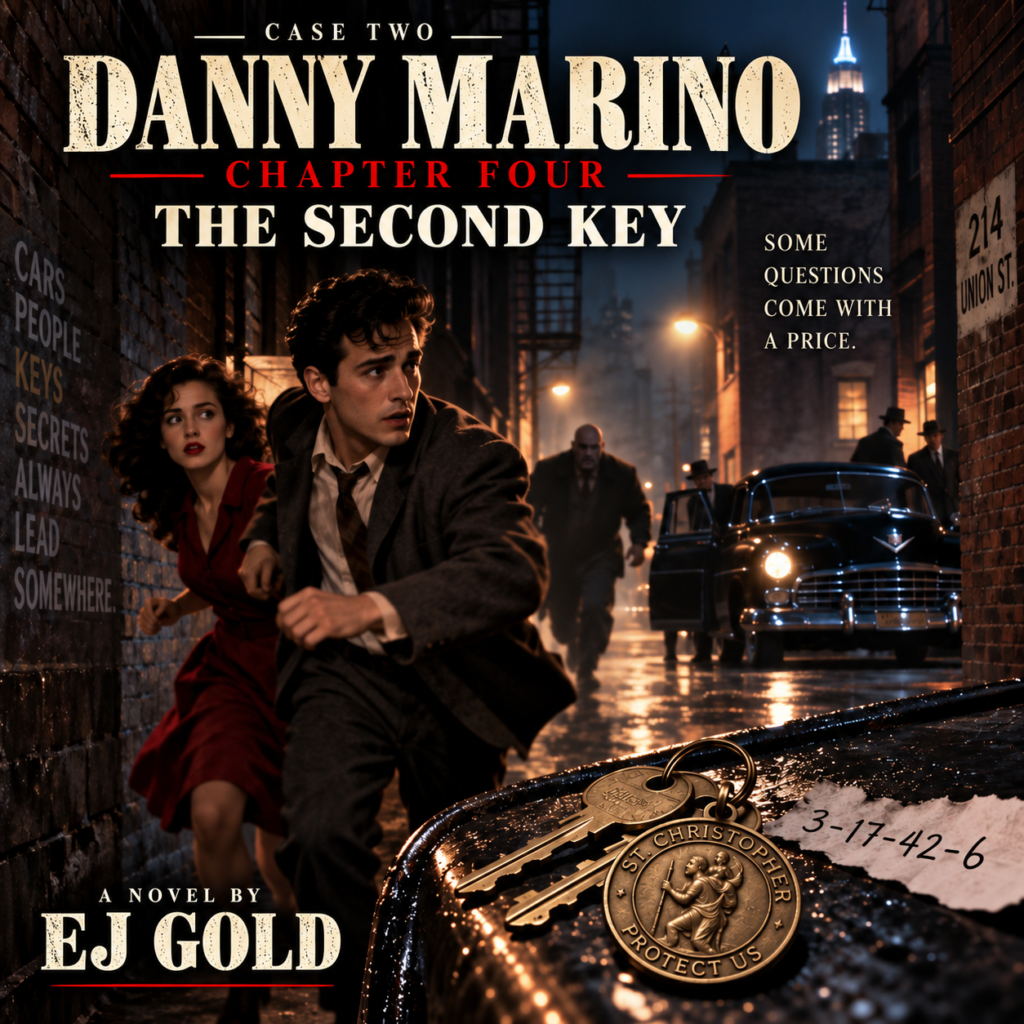
CHAPTER FOUR
THE SECOND KEY
Danny Marino had never been shot at before, and to tell you the truth, he discovered immediately that he didn’t care for it.
The bullet hit the brick wall about a foot above his head and showered the back of his neck with little pieces of Brooklyn.
“Was that necessary?” Danny yelled.
Rosie grabbed his sleeve.
“Run.”
“I was already considering it.”
They ran.
The alley behind 214 Union Street was narrow, wet and decorated with the usual municipal collection of garbage cans, broken crates and things nobody wanted badly enough to steal.
Behind them came Frankenstein.
Danny could hear him breathing.
That was encouraging.
Anybody who breathed that loud couldn’t run forever.
Unfortunately, neither could Danny.
They reached the end of the alley.
A chain-link fence blocked the way.
Rosie stopped.
“Oh, terrific.”
Danny looked left.
Brick wall.
Right.
Brick wall.
Behind them, Frankenstein.
Ahead, fence.
“This,” Danny said, “is why I generally take the subway.”
Rosie was already climbing.
Danny followed.
Another shot.
This one hit the fence.
Danny went over the top considerably faster than he had intended.
He landed on his back.
Rosie landed on her feet.
Danny looked up at her.
“You’ve done this before.”
“Get up.”
They came out on another street.
Danny didn’t know which one.
That bothered him.
He liked knowing where he was.
Rosie started toward the corner.
Danny caught her arm.
“Not that way.”
“Why?”
“The Cadillac.”
“What Cadillac?”
“The black one behind the Buick.”
Rosie looked at him.
“You noticed that?”
Danny shrugged.
“It was black.”
“That generally helps.”
They went the other way.
At the corner stood a grocery store, a laundromat and a bar with a neon sign that had lost three letters.
Danny headed for the bar.
“We don’t have time for a drink.”
“We have time for a telephone.”
Inside, three men were watching a prizefight on television.
Nobody looked at Danny.
Everybody looked at Rosie.
The bartender looked at Rosie twice.
“Phone?”
The bartender pointed toward the back.
Danny went into the booth and closed the folding door.
Rosie stood outside.
Danny put a dime in the slot.
Then he stopped.
“Who are you calling?” she asked.
Danny looked through the glass.
“That’s a very good question.”
Charlie?
No.
The police?
Definitely no.
The Roma Athletic and Social Club?
That amounted to Charlie with witnesses.
Danny hung up.
The dime came back.
Rosie stared at him.
“That was useful.”
“I saved ten cents.”
Danny stepped out of the booth.
“Now tell me something.”
“What?”
“Why did Frankenstein want that medal?”
Rosie’s expression changed.
Only slightly.
But Danny saw it.
“I don’t know.”
“Then why did you take it?”
“I didn’t.”
Danny reached into his pocket.
Sure enough, somehow, he didn’t know how, the Saint Christopher medal was still in his pocket.
On the back were the scratches:
3—17—42—6
Danny turned it over in his fingers.
Then he remembered the keys.
He reached into his other pocket.
Two keys.
Almost identical.
One belonged to the blue Buick.
The other belonged to something else.
Rosie looked down.
“That the second key?”
“You know about it?”
“I know somebody wants it.”
“Frankenstein?”
“No.”
“Charlie?”
“No.”
Danny waited.
Rosie said nothing.
“Rosie, this is the part where you tell me who.”
She looked toward the front window.
A car passed outside.
Not the Cadillac.
“There’s a garage on Third Avenue.”
“What kind of garage?”
“The kind with cars.”
“I was afraid of that.”
“Ask for Nicky.”
“And what do I tell Nicky?”
Rosie looked directly at him.
“Tell him Charlie sent you.”
Danny put the keys back in his pocket.
“Charlie didn’t send me.”
“I know.”
That was the first thing Rosie had said all night that frightened him.
Outside, brakes squealed.
The bartender glanced toward the window.
Danny didn’t.
He watched the mirror behind the bottles.
A black Cadillac had stopped at the curb.
Two men got out.
Rosie whispered:
“They found us.”
Danny looked at the back door.
Then at the telephone.
Then at the bartender.
Then at the three men watching the fight.
On television, somebody went down for the count.
Danny sighed.
“I was beginning to like this bar.”
He took Rosie’s hand.
They went through the kitchen.
Behind them, the front door opened.
A man’s voice said:
“Anybody seen a skinny kid and a girl?”
The bartender answered.
Danny couldn’t hear what he said.
But he heard everybody laugh.
Then he and Rosie were outside again.
Running.
And in Danny Marino’s pocket, the second key bounced against the Saint Christopher medal.
3—17—42—6.
For the first time, Danny wondered whether the numbers weren’t a combination.
Maybe they were an address.
Maybe they were a date.
Or maybe they were six feet of trouble written very small.
Whatever they were, somebody was willing to kill for them.
And Danny was beginning to suspect that delivering the Buick had never been the job.
The job now was finding out exactly what Danny would do next.
===========================================================================
HOW TO WRITE A MYSTERY: CHAPTER FOUR
Chapter Four, “The Second Key,” is mostly about keeping things moving while quietly adding complications.
Danny and Rosie are being chased, so there isn’t time for exposition. Instead, information arrives during the action.
We learn that Rosie can climb a fence rather better than Danny. We learn that Danny notices things, including the black Cadillac. We learn that Rosie knows about the second key but won’t say who wants it. We get a garage, somebody named Nicky, Charlie’s name used as a password, a Saint Christopher medal and the mysterious numbers:
3—17—42—6
None of these things is explained.
That’s important.
A mystery doesn’t require the writer to continually conceal information from the reader. It requires the writer to continually give the reader information whose meaning isn’t yet known.
Meanwhile, humor keeps Danny human:
“Was that necessary?”
“This is why I generally take the subway.”
“I saved ten cents.”
The jokes don’t stop the danger. They’re Danny’s way of reacting to it, and therefore they’re also character development.
Rosie develops differently. She says very little. Every time Danny asks a reasonable question, her answer creates another question. That makes her increasingly important without requiring a paragraph explaining who she is.
The chapter also changes Danny’s position in the story. At first he’s simply trying to survive something that happened to him. By the end, he has begun thinking about it.
The Buick may not matter.
The second key does.
The medal does.
The numbers probably do.
And Rosie certainly does.
That’s enough.
We don’t need to solve anything yet.
The mystery writer’s job at this stage isn’t to provide answers. It’s to make the reader unwilling to put down the book.
===========================================================================
a different subject:
Cell Phones Galore
Strolling Manhattan in an “afraz” video, I note that not only does everyone have a cellphone, but they’re walking and staring at their phone. Only a few passers-by DON’T have a phone actually in hand, actually in active use.
If you could drop somebody from 1960 onto a Manhattan sidewalk today, the phones would most certainly be far more startling than the cars, clothes or the buildings.
And it’s not merely that everyone carries a phone. It’s that the phone has captured the eyes … and ears.
People used to walk through New York looking at New York—store windows, faces, traffic, signs, somebody coming the other way. Now you can watch a whole stream of bodies moving competently through a complicated physical environment while their attention is apparently somewhere else entirely.
Which connects beautifully with my earlier question to them: “Where are you walking when you’re looking at your phone?”
The body is on Broadway.
The eyes are six inches away.
The attention may be in Tokyo, TikTok, a text from Cleveland, or nowhere in particular.
And yet something is still navigating Times Square traffic.
That’s the interesting bit. The walker avoids the lamppost, adjusts to the crowd, stops at the curb, follows the person ahead—all while the ordinary conscious attention is occupied elsewhere.
It’s almost a laboratory demonstration of sleepwalking in the everyday sense: the organism can perform a surprisingly elaborate life while the attention is absent from the place where the life is happening.
And NYC gives you the experiment with about ten thousand subjects per block.
What could possibly be so compelling that Manhattan itself loses the competition?
The answer is obvious and elusive at the same time:
Mostly it’s probably utterly ordinary stuff: texts and group chats, social feeds and short videos, maps and directions, music controls, email, news, dating apps, delivery apps, photographs—and plenty of plain old scrolling with no particular destination.
But there’s a more interesting distinction. A lot of them may not really be looking for something. They’re looking at the phone. The behavior has become automatic: a spare three seconds appears → hand reaches for phone → screen lights → thumb moves.
That’s quite different from, say, consulting a map because you’re trying to find 42nd Street. There’s no informational objective required. The phone supplies a continuously available place for attention to go.
And that makes your walking observation even better. Watch for somebody who pockets the phone. What happens next? Do they suddenly look around? Make eye contact? Notice buildings? Or, ten seconds later, does the phone mysteriously reappear?
There’s a terrific little personal experiment hiding in this:
Walk one entire city block without looking once at your phone. Then try to remember five things you actually saw.
You’ll see that the phone isn’t really the subject anymore.
Attention is.
===========================================================================
on the subject of fine art:
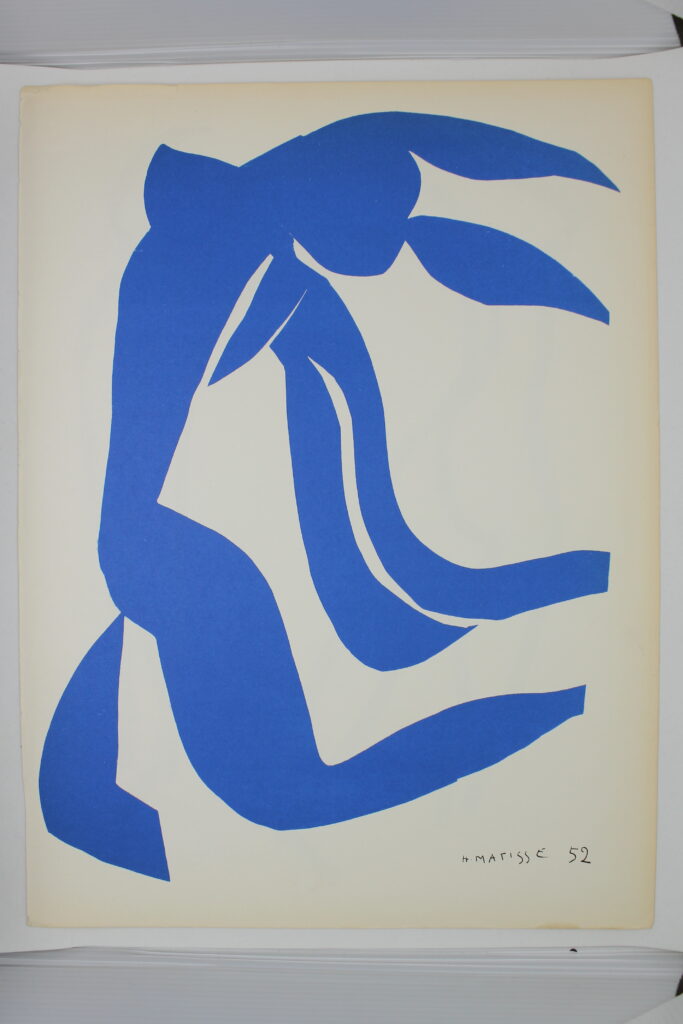
THINK YOU CAN’T AFFORD AN ORIGINAL PICASSO or MATISSE?
You might be surprised.
For many years I’ve collected and dealt in original graphics by some of the great artists of the twentieth century—Picasso, Chagall, Miró, Matisse and others.
I’m not talking about posters or photographic reproductions.
I’m talking about the real thing: original lithographs, etchings and other graphics produced by the artists and issued by important publishers in books, portfolios and publications such as Derrière le Miroir, Verve and XXe Siècle.
Many were never pencil-signed because they weren’t issued that way. That doesn’t make them reproductions. The important questions are: What is it? Who made it? Who printed it? Where was it published? And can its authenticity be documented?
That’s where knowledge matters and I have all the paperwork to prove the authenticity of any piece I sell.
I’ve been working with art, prints and rare books for decades, and I know how to find legitimate, authentic original works at prices ordinary collectors can actually consider.
You don’t have to spend a fortune just to have a famous name hanging on the wall. You can own an actual original work by the artist. A real Picasso. A real Chagall. A real Miró. A real Matisse. Properly identified. Properly documented. Honestly represented.
The real thing at a fair price.
The basic series could be “Can You Really Own an Original Picasso?” You’re on camera—or voice-over while the camera examines the print—and each video answers one question a prospective buyer is probably afraid to ask: What does “original lithograph” actually mean? Why isn’t this signed? What was Derrière le Miroir? How can a $500 or $1,000 work actually be an original by an artist whose paintings sell for millions? What’s a catalogue raisonné? How can I tell a reproduction from an original graphic? What am I actually paying for?
Then every episode ends with essentially the same very soft pitch:
I have original graphics by Picasso, Chagall, Miró, Matisse and others available from my collection. Everything is properly identified and documented. If you’ve always thought you couldn’t afford an original, you may be surprised. The real thing at a fair price.
I see an even stronger YouTube format: “What Have I Got Here?”
Put an actual print on the table. Camera close-up. Start with:
“This is an original lifetime Chagall lithograph. It’s not pencil-signed. So how do I know it’s an original?”
Now you’ve created a mystery.
Show the paper. Show where it came from. Show the original publication. Explain Maeght. Show the colophon. Explain “unsigned as issued.” Show the catalogue reference. Then reveal approximately what you’re asking for it.
That’s good YouTube because the viewer learns how to buy art while simultaneously becoming interested in the particular piece you’re selling.
And you’ve got enough inventory that you don’t need a huge audience. That’s the interesting economic part. You’re not trying to become an art influencer with 500,000 subscribers. If 2,000 genuinely interested people regularly watch, and 50 eventually become collectors, you’ve built yourself a clientele.
I’d also deliberately target the person who’s never bought serious art before. Dealers tend to speak dealer-language to people who already collect. Your opening proposition does the opposite:
“You’ve always wanted an original Picasso. You assumed that you couldn’t afford one. Let me show you something.”
That’s a hell of a YouTube opening.
And after watching ten of your videos, something else happens: they know you. They’ve watched you handle real material, explain it, point out the difference between an original and a reproduction, and occasionally say, “No, I wouldn’t buy this one.”
At that point you’re no longer an anonymous Internet seller asking them to trust a printed certificate of authenticity.
You’re their art guy. That’s what I’d use YouTube to manufacture: not traffic. Trust.
===========================================================================
Here’s the Bardo bus now!
===========================================================================
See You At The Top!!!
gorby