

There’s a wonderful vocabulary available: made man, wiseguy, associate, capo, crew, sit-down, the books, getting made, on record, tribute, kick upstairs, envelope, no-show job, shylock, vig, numbers, bookmaking, fence, hijacking, score, piece of the action, straighten out, connected, stand-up guy, rat, beef, button man. Some terms vary by period and place, which itself gives us something to teach: don’t put a 1990s mob expression into a 1957 character’s mouth.
THE MOB MYSTERY WRITER’S KIT
- The First Sentence — Make the reader unable to leave.
- Who Is This Guy? — Reveal character through behavior, not biography.
- Build the World — Research just enough New York and organized crime to make the fiction solid.
- Bring in Trouble — Something happens that the protagonist cannot ignore.
- The Woman Walks In — Introduce romance without announcing, “Here is the love interest.”
- Plant the Murder Before It Happens — Put pieces on the board innocently.
- Everybody Wants Something — Give every important character an agenda.
- The Murder — Now the story changes shape.
- Suspects, Lies and Wrong Turns — The machinery of mystery.
- The Reader Knows—but Doesn’t Know — Hide the solution in plain sight.
- The Trap Tightens — Romance, danger and investigation collide.
- The Reveal — The solution should be surprising for one second and inevitable immediately afterward.
And here’s the part I particularly like: we don’t need to know the whole story before we start.
Mob Activities, New York City, roughly 1955–1965
People & hierarchy: Boss, underboss, consigliere, capo/caporegime, soldier, associate, made man, wiseguy, crew. An associate can work closely with the family without actually being a member. “Getting made” is a major threshold. A character’s position determines whom he can order around—and whom he had better not annoy.
Useful language: connected, with us, with him, on record, straighten it out, sit-down, beef, tribute, kick up, envelope, piece of the action, score, vig, shylock, book, numbers, fence, hot goods, rat, stool pigeon, stand-up guy. And sometimes the most authentic mob language is deliberately vague: “Take care of it.” “Go see Louie.” “This isn’t your concern.” “He won’t be bothering us anymore.”
Everyday mob activity: Bookmaking, numbers, loan-sharking, fencing stolen goods, hijacking trucks, gambling rooms, union influence, construction, trucking, waterfront activity, protection/extortion and legitimate businesses used as meeting places or income sources. A great deal of mob life isn’t spectacular crime at all. It’s collecting, settling disputes, making introductions, passing envelopes and deciding who gets what.
Places: Social clubs, neighborhood bars, Italian restaurants, luncheonettes, poolrooms, barber shops, back rooms, garages, warehouses, docks, union halls and somebody’s kitchen. The location can establish rank. The boss doesn’t necessarily come to you. You come to him.
Props: Cash envelopes, racing forms, pay phones, address books, matchbooks with telephone numbers written inside, newspapers, cigarettes and cigars, pinky rings, watches, jukeboxes, restaurant checks, keys, union cards, betting slips, rolls of bills and cars with enormous trunks. No smartphones, GPS, electronic banking or instant records search. That’s wonderful for mysteries.
Transportation: Cadillacs, Buicks, Oldsmobiles, Pontiacs, Chevrolets, Fords, taxis, subway trains and shoe leather. A parked car can be an office, surveillance post, getaway vehicle—or simply where two men can talk without being overheard.
Communication: Home telephone, office telephone, pay phone, telegram, letter, messenger and face-to-face conversation. Someone saying “Don’t say that on the phone” immediately creates atmosphere.
Money: This one deserves special attention. We should build ourselves a little period price sheet: cup of coffee, restaurant dinner, cab fare, hotel room, apartment rent, weekly wages, suit, handgun, box of ammunition, automobile, $20 payoff, $100 bribe, $1,000 gambling debt. Then when somebody slides an envelope across a table, we’ll know whether it represents lunch money or catastrophe.
Violence: For good fiction, violence should be comparatively scarce. Threats, reputation and anticipation are usually more powerful. If everybody is constantly killing everybody, murder stops mattering. In a mystery, the corpse should change the temperature of the whole book.
Rules and customs: Who introduces whom matters. Rank matters. Permission matters. Territory matters. Family relationships matter. Being “made” matters. Insulting somebody can matter enormously. And there may be a vast difference between what the supposed rules are and what people actually do.
Law-enforcement side: NYPD detectives, patrolmen, precinct houses, district attorneys, grand juries, FBI agents, wiretaps, informants, surveillance and newspaper crime reporters. This is another vocabulary kit we’ll need, because our murder has to exist simultaneously in two worlds—the criminal investigation and the family’s investigation.
And then I’d add one special compartment:
THE LITTLE DETAILS DRAWER
A wet newspaper folded under somebody’s arm. Espresso cups on a Formica table. A jukebox playing while two men discuss somebody’s future. A Cadillac double-parked outside. Somebody tearing a match out of a matchbook and writing a number inside the cover. A guy who always answers the telephone but apparently has no job.
Those aren’t plot.
They’re what make the plot feel as though it actually happened.
==========================================================================
Now let’s put some of these things to work. Notice that we don’t explain them in the story. We just use them.
The Story Continues…
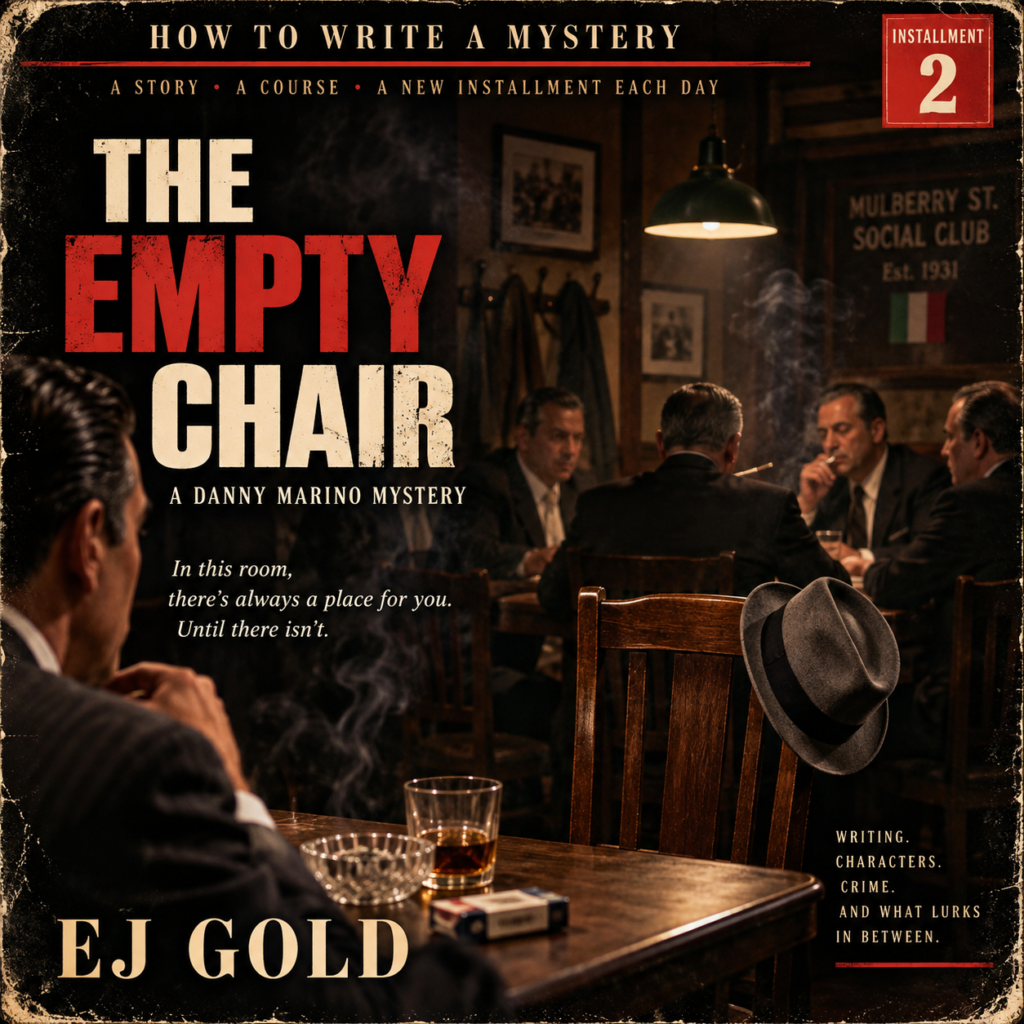
The first thing Danny learned about the mob was that an empty chair could outrank a man. He learned it at eleven-sixteen, on a Tuesday morning, in a social club on Mulberry Street, when he pulled out a chair at the card table and four men stopped talking. Nobody said anything. That was worse.
He stood there with one hand on the back of the chair. A little man in a gray suit looked up from his newspaper. “Not there.” He pushed the chair back. “Where?” The little man pointed with his chin toward a folding chair against the wall. He sat down. Conversation resumed. Lesson one.
The place was called the Roma Athletic and Social Club, although he saw nothing athletic about it. There were two card tables, six straight-backed chairs, a battered sofa, a television with the sound turned off and a coffeepot that looked as though it had been cooking the same coffee since Eisenhower’s first term. Three men were playing gin. Another was reading the Daily News. Nobody appeared to have a job. Everybody appeared to be at work.
He had been told to ask for Charlie. There were two Charlies. One was about sixty, built like a fireplug and wearing a white shirt open at the throat. The other was thirty-five, thin, beautifully dressed and had fingernails that looked professionally maintained. He made the mistake of asking which one was Charlie.
The little man behind the newspaper looked at him. “Who wants to know?”
“I do.”
“Who are you?”
He told him.
“Never heard of you.”
“That’s been happening a lot lately.”
The newspaper lowered an inch. “You trying to be funny?”
“No. It comes naturally.”
The newspaper went back up. He decided to shut up while he was ahead.
Five minutes passed. Then ten. At eleven-thirty a heavyset man entered carrying a white bakery box tied with string. He put it on the counter beside the coffeepot. “Cannoli,” he said. Nobody moved. He crossed the room, bent over the man with the newspaper and whispered something. The newspaper man nodded. The heavyset man left.
Two minutes later another man came in. This one carried an envelope. Not a business envelope. Smaller. Cream-colored. Thick. He handed it to Fireplug Charlie. Charlie didn’t open it. He weighed it in his hand.
“Short.”
The man swallowed. “I’ll have the rest Thursday.”
Charlie continued looking at him. “Thursday.”
“Yeah.”
“Thursday is Thursday.”
“I know.”
“No. I’m telling you. Thursday is Thursday. Friday isn’t Thursday.”
The man nodded. Charlie slipped the envelope into his inside jacket pocket. Nothing else happened. It was the most frightening financial transaction he had ever witnessed.
At eleven-forty, Fingernails Charlie stood up. “You.”
He looked around. “Me?”
“No, President Kennedy. Come on.”
He followed Charlie through a narrow doorway into a back room containing a desk, two chairs, a filing cabinet and a calendar from a tire company. There was a photograph of Rocky Marciano on the wall. Charlie sat behind the desk. He remained standing. Apparently chairs were going to be complicated in this business.
“Sit.”
He sat.
Charlie studied him. “You need work.”
“So I’ve been told.”
“You sick?”
“Getting better.”
“Drunk?”
“Not yet.”
“Dope?”
“No.”
“Cop?”
“No.”
“You say that pretty fast.”
“I’ve had practice not being one.”
Charlie almost smiled. Almost.
“Lou says you’re all right.”
“I don’t know Lou.”
“That doesn’t matter.”
“It seems like it ought to.”
“It doesn’t.”
Another lesson.
Charlie opened a drawer and took out a pack of cigarettes. He offered one. He shook his head. Charlie lit his own.
“You drive?”
“Yes.”
“License?”
“Yes.”
“Car?”
“No.”
“Family?”
“No.”
“Girlfriend?”
“No.”
Charlie stopped. “Nothing?”
“I’ve got a room.”
“I heard you’re homeless.”
“I’ve got a room until Friday.”
“So you’re homeless Saturday.”
“That’s the current arrangement.”
Charlie leaned back. “You talk too much.”
“I’ve been told that too.”
“I got a job. Couple hours. You drive a car from here to Brooklyn. You leave it where you’re told. You come home.”
“What’s in the car?”
Charlie looked at him for a long moment. “That question is why you’re broke.”
He nodded. “When do I start?”
“Now.”
Charlie opened the desk drawer again and tossed him a set of keys. There was a little brass Saint Christopher medal on the ring. “Blue Buick. Across the street.”
“Where in Brooklyn?”
“There’s an address in the glove compartment.”
“And when I get there?”
“Park it.”
“Then what?”
“Get out.”
“And?”
Charlie sighed. “You really need the whole thing explained?”
“I’m new.”
“Park the car. Lock the car. Put the keys under the driver’s mat. Walk away. Take the subway back. Don’t stop anywhere. Don’t open anything. Don’t look in the trunk.”
“Especially the trunk?”
Charlie stared at him. “See? That’s the problem with you.”
He put the keys in his pocket. As he reached the door Charlie said, “One more thing.”
He turned.
“If anybody stops you, the car belongs to your cousin.”
“What’s my cousin’s name?”
“Jesus Christ.”
“That’s going to be hard to sell.”
This time Charlie did smile. It vanished immediately. “Anthony Russo. Your cousin is Anthony Russo. He lent you the car because you’re looking for work.”
“Where does Anthony Russo live?”
Charlie pointed toward the front room. “Get out.”
He did. As he crossed the club, the front door opened. And she walked in.
Twenty-five, maybe twenty-six. Dark hair pulled back, camel-colored coat, no hat. She wasn’t glamorous in the way women in magazines were glamorous. She was worse. She looked real.
She carried a brown paper bag under one arm. Every man in the room changed slightly when she entered. Not much. Just enough. Fireplug Charlie stood. The man with the newspaper lowered it completely. One of the card players removed the cigarette from his mouth. She belonged here. He didn’t.
She noticed him immediately. Noticed the keys in his hand. Then looked at Fingernails Charlie standing in the doorway behind him. Something passed across her face. It lasted less than a second.
“Who’s this?”
Charlie said, “Nobody.”
She kept looking at him. “Does Nobody have a name?”
He told her.
She shifted the paper bag to her other arm. “I’m Anna.”
Charlie interrupted. “Anna.”
One word.
She looked at Charlie. “What?”
“Leave it.”
“I said hello.”
“Good. You said it.”
She rolled her eyes and walked toward the back. As she passed, she said quietly, “Check the gas.”
Then she was gone.
He looked at Charlie. Charlie was no longer smiling.
“Go.”
He went.
The Buick was exactly where Charlie said it would be. Blue. Four-door. Clean enough to be respectable and dirty enough not to be remembered. He unlocked it and got behind the wheel. The gas gauge showed three-quarters full.
He smiled. Then he remembered what Anna had said. Check the gas. He started the engine. Three-quarters. He nearly pulled away. Instead he switched off the engine and sat there. Something was bothering him. He didn’t know what.
Then he saw it.
The ignition key had a Saint Christopher medal. But the key he had used to open the door did not fit the ignition. There were two nearly identical keys on the ring.
He looked at them. Then at the club across the street. Fireplug Charlie stood inside the window watching him. He selected the second key. The engine started. Charlie disappeared from the window.
He drove south. He didn’t look in the trunk. He didn’t open the glove compartment until he reached Canal Street. Inside was the address. Nothing else. He read it twice.
214 Union Street, Brooklyn.
He put the paper back. At the next light he became aware of a black Cadillac two cars behind him. It stayed there through the next light. And the next.
He made a right. The Cadillac made a right.
He made a left. The Cadillac made a left.
He began to feel considerably less unemployed.
At the next intersection he turned right without signaling. A horn screamed behind him. The Cadillac continued straight.
He laughed. “Idiot.”
He drove another block. Then he stopped laughing. Because in the rearview mirror he saw the Cadillac backing up. Fast.
And somebody was sitting beside the driver. Somebody wearing a gray hat.
He had seen that hat before.
It had been hanging on the back of the empty chair.
===========================================================================
Oy, what a place to leave the story! Tune in tomorrow for further study.
===========================================================================
Here’s the Bardo bus now!!!
===========================================================================
See You At The Top!!!
gorby