

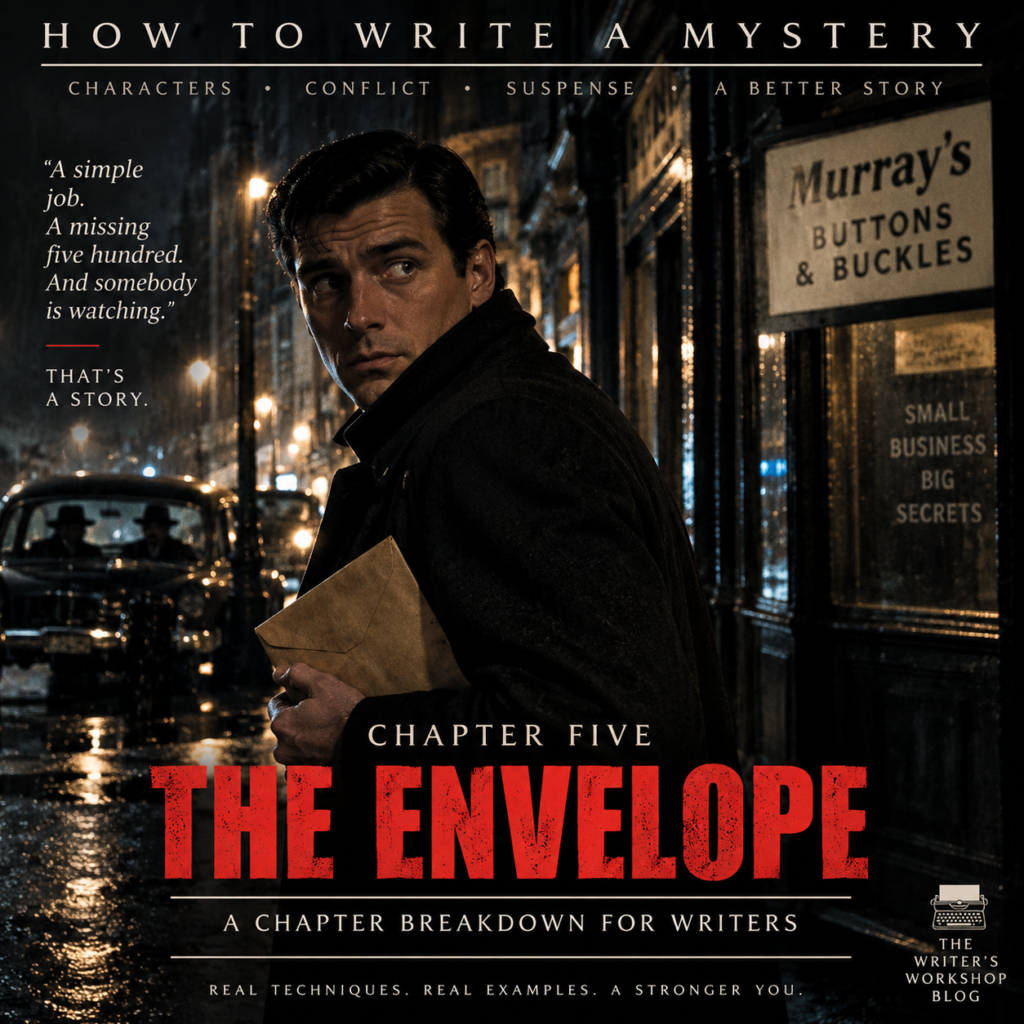
CHAPTER FIVE
THE ENVELOPE
Danny Marino learned something important about organized crime on a Wednesday afternoon.
He learned that nobody was actually organized. It was chaotic and wild, yet subtle and dangerous.
He was sitting in the back room of the Café Roma with Frankie Bell, Louie Carbone, a bookmaker named Chickie Ross and an elderly man everybody called Uncle Pete, although Danny had been reliably informed that Uncle Pete had no living relatives.
Four men were arguing about seventeen dollars.
“I’m telling you, he gave me forty.”
“He gave you twenty.”
“I saw two twenties.”
“You saw one twenty twice.”
Uncle Pete raised a finger.
Everybody stopped talking.
“He gave him forty.”
Frankie smiled triumphantly. “Thank you.”
“And you owe him twenty-three.”
Frankie’s smile disappeared. “How do you figure?”
“I don’t know. But I’m old, so everybody assumes I know what I’m talking about.”
Nobody challenged this. The door opened. Salvatore Rizzo came in carrying a small brown envelope. The room changed.
Danny had noticed this before. Nobody announced rank. Nobody had to. You could tell who mattered by watching who stopped talking when they entered.
Rizzo looked around.
“Marino.”
Danny stood.
“Yeah?”
Rizzo handed him the envelope.
“Take this to Murray’s.”
“Who’s Murray?”
“Murray.”
“Where?”
“Forty-seventh Street.”
“Where on Forty-seventh?”
Rizzo stared at him.
Danny waited.
“Between Ninth and Tenth.”
“What’s the address?”
“You’ll see Murray.”
That appeared to conclude the briefing.
Danny slipped the envelope into his inside coat pocket.
Frankie said, “Don’t lose it.”
“I wasn’t planning to.”
“Don’t open it.”
“I wasn’t planning that either.”
“Don’t get hit by a bus.”
Danny looked at him.
“I’ll put that on the list.”
He left.
Forty-seventh Street was wet from a rain that had stopped half an hour earlier. Cars hissed through puddles. A delivery truck blocked half the street while its driver argued with a cop who had clearly been arguing with delivery drivers since breakfast.
Danny walked west.
He found Murray’s between a tailor shop and a place selling electrical fixtures.
There was no sign.
There was, however, a man standing in the doorway.
“You Marino?”
Danny stopped.
“Who’s asking?”
“Murray.”
“You don’t look like a Murray.”
“You don’t look like a Marino.”
They considered each other.
Murray was perhaps fifty, short, beautifully dressed and completely bald except for two determined patches of gray hair above his ears.
Danny handed him the envelope.
Murray didn’t take it.
“Come inside.”
The shop was narrow and deep. Shelves lined the walls from floor to ceiling, stacked with cardboard boxes.
“What do you sell?” Danny asked.
“Buttons.”
Danny looked around.
Thousands of boxes.
“All buttons?”
“Some buckles.”
Murray went behind a counter.
“Give me the envelope.”
Danny handed it over.
Murray opened it.
There was money inside.
Danny couldn’t tell how much.
Murray counted it.
Then counted it again.
Then looked at Danny.
“Short.”
“How short?”
“Five hundred.”
Danny said nothing.
Murray put the money back into the envelope.
“You count it?”
“No.”
“Rizzo count it?”
“I don’t know.”
“Frankie?”
“I don’t know.”
“You know anything?”
“I know you sell buttons.”
Murray almost smiled.
Almost.
Then the front door opened.
Two men entered.
Danny recognized one of them.
Tony Spada.
He’d seen Spada twice at the Café Roma. Both times, people had made room for him without being asked.
Spada saw Danny.
“What’re you doing here?”
“Delivering an envelope.”
“To Murray?”
Danny looked around at the buttons.
“No. To Macy’s.”
Spada stared at him.
Then laughed.
The second man didn’t.
He was younger than Spada, maybe thirty-five, with a narrow face and the kind of eyes that seemed to arrive at a place several seconds before the rest of him.
Spada nodded toward him.
“This is Nicky Vella.”
Danny offered his hand.
Vella looked at it.
Danny put it back in his pocket.
Murray said, “We’re short five.”
Spada stopped smiling.
“Five what?”
“Hundred.”
“Impossible.”
“Count it.”
Spada counted it.
The room became very quiet.
Danny watched the street through the front window.
A woman passed carrying groceries.
A cab stopped.
Somebody across the street was sweeping rainwater away from his doorway.
Ordinary Wednesday afternoon.
Behind him, five hundred dollars had apparently become a matter of national importance.
Spada said, “Who gave you this?”
Danny turned.
“Rizzo.”
“Directly?”
“Yes.”
“Anybody touch it?”
“No.”
“You sure?”
“Yes.”
Vella spoke for the first time.
“How sure?”
Danny looked at him.
“Sure enough.”
Vella stepped closer.
“That’s not an answer.”
“It’ll have to do.”
Spada raised one hand.
“Easy.”
Nobody moved.
Then Murray said something Danny didn’t expect.
“It isn’t Marino.”
Vella looked at him.
“How do you know?”
“Because if Marino took five hundred dollars, he wouldn’t come in here and stand around while I counted what’s left.”
Danny nodded.
“That would’ve been my thinking.”
Nobody laughed.
Murray reached beneath the counter and brought out another envelope.
He handed it to Spada.
“That’s yours.”
Spada put it inside his jacket.
“What about the five?”
“That’s Rizzo’s problem.”
Spada looked at Danny.
“Come on.”
“Where?”
“Back.”
Danny followed him outside.
Vella came with them.
They walked east.
Nobody spoke for half a block.
Then Spada said, “You didn’t count it?”
“No.”
“Why not?”
“Rizzo told me not to open it.”
Spada glanced at him.
“Good answer.”
“It happens occasionally.”
They reached Ninth Avenue.
Vella suddenly stopped.
“Wait.”
Danny stopped.
Spada stopped.
Vella was staring across the street.
A black Buick was parked beside a hydrant.
There were two men inside.
Danny looked at the Buick.
Then at Vella.
“What?”
“You know them?”
“No.”
Spada said, “Keep walking.”
They kept walking.
Danny resisted the temptation to look back.
At the next corner Spada turned into a drugstore.
They followed.
Spada went directly to the pay phone.
He dropped in a dime and dialed.
“It’s me.”
Pause.
“Yeah.”
Another pause.
“We got company.”
He listened.
“Okay.”
He hung up.
Danny said, “Who are they?”
Spada looked through the drugstore window.
“Maybe nobody.”
“That’s a lot of trouble for nobody.”
Vella finally smiled. It was the same smile you see on a crocodile.
Danny decided he liked him better when he didn’t smile.
Spada said, “Marino.”
“Yeah?”
“You’re going back alone.”
“To Roma?”
“No.”
He gave Danny an address.
“Go there. Ask for Charlie.”
“Then what?”
“Tell Charlie the rain came early.”
Danny waited.
“That it?”
“That’s it.”
Danny looked outside.
The black Buick rolled slowly past the drugstore.
Neither man inside looked toward them.
Danny memorized the license plate without appearing to.
Then he walked out into the street.
He had been sent out to deliver an envelope.
Now five hundred dollars was missing, two strangers were following them, and he was carrying a message about weather to a man named Charlie.
Danny smiled.
At last, he thought, the job was beginning to make sense.
===========================================================================
This one has quite a bit of writing technique hidden inside the action, so it makes a good lesson.
HOW TO WRITE A MYSTERY — CHAPTER FIVE
Chapter Five, “The Envelope,” is about escalation.
Danny starts with the smallest possible assignment: deliver an envelope. That’s useful mystery construction. Don’t announce that something important is about to happen. Start with something ordinary and let it become important.
The opening scene also establishes the world through comedy. Four supposedly organized criminals are arguing over seventeen dollars. The joke tells us something: organized crime is made up of ordinary human beings—petty, confused, funny and more than occasionally, dangerous.
Then Rizzo enters and everybody stops talking. We don’t say, Rizzo is powerful. We demonstrate his power by showing what everybody else does when he walks into the room.
The envelope creates the central problem. Danny delivers it unopened. Murray counts the money.
Five hundred dollars is missing.
Now a simple errand has become dangerous.
Notice that Danny doesn’t panic or explain himself excessively. Murray eventually concludes that Danny probably didn’t steal it because a thief wouldn’t calmly stand there while the money was counted. Character is being established through behavior rather than description.
Then another complication arrives: Tony Spada and Nicky Vella.
Nicky immediately creates tension. Almost nothing is said about him. He simply refuses Danny’s handshake and starts asking questions. That’s enough.
Then comes the Buick.
Two unidentified men are sitting across the street.
We don’t explain who they are.
That’s important.
A mystery writer doesn’t have to answer every question. In fact, the unanswered question is one of the principal engines that pulls the reader forward.
By the end of the chapter we have several unresolved elements:
Who took the $500? Who are the men in the Buick? Who is Charlie? What does “the rain came early” mean? Why is Danny so good at noticing details?
None of these questions has to be answered in the very next chapter. That’s the trick.
A mystery isn’t merely a sequence of answers. It’s a controlled accumulation of questions. And Danny began the afternoon delivering an envelope. By the end, he’s being followed.
That’s escalation.
===========================================================================
…and on another subject:
WHY BUY ART NOW?
Why are you waiting to own an original?
People spend thousands of dollars every year on things that vanish, like restaurants, travel, electronics, cars, subscriptions and entertainment. Nothing wrong with any of that. But art is different.
You use it and still have it.
An original work of art may be a unique painting or drawing. It may also be an original lithograph, etching or engraving—one of a recognized number of impressions produced from the artist’s original matrix.
That is very different from buying a modern photographic reproduction of an artwork.
Many important original prints are documented and identified in the artist’s catalogue raisonné, the scholarly reference used to establish exactly what the work is, including information about editions, states and impressions where applicable.
So when we say original, we do mean original.
Some works are unique. Others belong to very limited and fully documented editions. Either way, you’re acquiring an actual work of art produced directly by the artist, not merely a photographic image of one.
And there is another remarkable thing about art:
You can use it every day without using it up.
Live with an artwork for twenty or thirty years and it hasn’t been consumed. You can give it to your children. They can give it to theirs.
Art also has a centuries-old secondary market. Paintings, drawings, lithographs, etchings, engravings and sculpture have long been collected, inherited, bought, sold and auctioned.
Does that mean an artwork you buy today will increase in value?
Nobody can promise that. Neither can I.
Art prices rise and fall. Markets and tastes change. Art should never be sold with a guaranteed financial return. But personally, I’ve made some good guesses. There is no guarantee that anything will come of it. You buy the art because you like it, not because someone expects it to magically appreciate in value.
Don’t think it’s a good thing for the art to appreciate in value. There’s nothing worse than having something you really like living with become so valuable that you have to sell it.
What I can offer is something much simpler:
The real thing at a fair price.
An authentic work of art, accurately described, with the legitimate documentation and provenance available for that particular work.
You don’t have to be a millionaire to become an art collector.
You become an art collector when you acquire your first real work of art.
Buy something because it speaks to you. Buy it because you want to live with it. Buy it because owning the real thing is fundamentally different from owning a reproduction.
And perhaps, fifty years from now, somebody will turn it over, look at the name, the catalogue reference or the provenance and ask:
“Who had the sense to buy this?”
That could be you.
The art is real.
It’s available now.
And you can own it.
===========================================================================
Here’s a way YOU can sell art!
Worthless ART phone pitch:
We’ve all experienced that terrible moment when a work of art we love suddenly becomes so valuable that we have no choice but to sell it.
It’s heartbreaking.
Fortunately, there’s now a way to avoid that problem.
Guaranteed Worthless Art.
Every artwork we sell is guaranteed to be worthless. Hang it on your wall, enjoy it every day, and never worry about appreciation again.
Each piece comes with an official Certificate of Guaranteed Worthlessness.
And we stand behind our guarantee. If your artwork should unexpectedly acquire significant market value, simply return it and we’ll exchange it for another piece that is still satisfactorily worthless.
Guaranteed Worthless Art.
Because you should never have to choose between the art you love and an outrageous amount of money.
===========================================================================
Here’s the Bardo bus now!!!
===========================================================================
See You At The Top!!!
gorby