

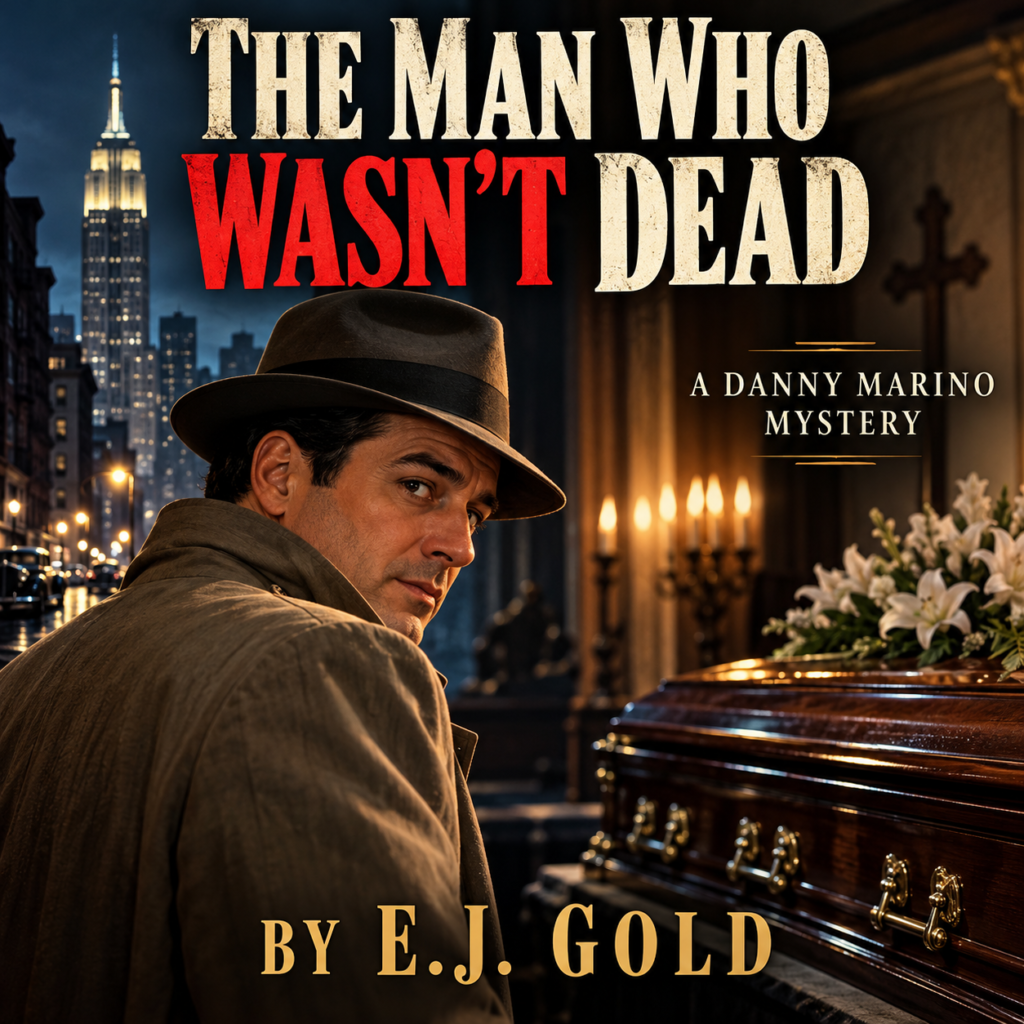
THE MAN WHO WASN’T DEAD
A Danny Marino Mystery
By E.J. Gold
Danny Marino was sitting in his office on a Wednesday afternoon, trying to decide whether he could afford lunch, when a man walked in and offered him fifty dollars. The man was about sixty, well dressed, with a narrow face and the sort of carefully maintained mustache that suggested he had plenty of time in the mornings. His suit was dark gray, his shoes were polished, and he carried a black umbrella despite the clear weather.
“My name is Vincent Rinaldi,” he said, walking toward where Danny was sitting.
“Yes?”
The man took a chair without being invited.
“I’d like you to attend a funeral tomorrow.”
“Whose funeral?”
“Mine.”
Danny looked at him.
“You’re looking pretty healthy for a dead man.”
“Thank you.”
“Thursday?”
“At two o’clock.”
“Where?”
“Angelotti and Sons. On the Lower East Side.”
Danny knew the place. He also knew Charlie Angelotti, whose father had started the business and whose grandfather had buried half the neighborhood.
“Why me?”
“Because you’re a private investigator.”
“That’s what it says on the door.”
“And because you have no connection with my family.”
“That’s also true.”
Rinaldi took five ten-dollar bills from his wallet and placed them on the desk with his left hand.
“There’s one other thing.”
“Usually is.”
“Whatever happens, don’t let them open the coffin.”
Danny looked at the money.
“Why would anybody want to open the coffin?”
“That’s what I’m paying you to find out.”
“Suppose somebody insists?”
“Then find out who insists.”
He stood.
Danny picked up one of the bills and examined it.
“Mr. Rinaldi.”
The man turned.
“Suppose somebody asks me why I’m attending your funeral.”
“Tell them you were a friend.”
“Are we?”
“We are now.”
And he left.
Danny watched him through the window. Rinaldi walked east, turned at the corner, and disappeared.
Danny counted the money.
Fifty dollars was fifty dollars.
He went to lunch, then he went just a few blocks, over to the Heavenly Home Mortuary, Inc.
THE FUNERAL PARLOR
Angelotti and Sons Heavenly Home Mortuary occupied all three floors of a narrow brick building between a wholesale hosiery supplier and a store selling glass saints candle holders, beads and other religious articles. There were two brass plaques beside the entrance, one announcing the business, and the other announcing that the building had been built in 1896, and it looked every bit its age.
The hallway into the foyer smelled of furniture polish, lilies, and something Danny wasn’t able to identify.
Charlie Angelotti met him in the vestibule.
“I’m Danny Marino,” he announced himself. “Who died?”
“Vincent Rinaldi.”
Angelotti nodded toward Danny. “You knew Vincent?”
“Yep. Met him yesterday.”
“That’s impossible.”
“Why?”
“He died Tuesday night.”
Danny considered this.
“Maybe I got the days mixed up.”
Charlie shook his head.
“Vincent Rinaldi was pronounced dead Tuesday at eleven forty-five. Heart attack. Doctor signed the certificate.”
“Where’s the body?”
“Upstairs.”
“Can I see him?”
“Closed coffin.”
“Why?”
“His own instructions.”
“His own?”
Charlie nodded.
“He arranged the whole thing three weeks ago. Paid in advance. Picked the coffin. Even chose the flowers.”
“That’s planning ahead.”
“Vincent was an accountant.”
“That explains it.”
Charlie lowered his voice.
“There’s something else.”
“What?”
“Two different undertakers telephoned yesterday, both claiming they had authority to collect the body. Neither one had any paperwork.”
“Who sent them?”
“Wouldn’t say.”
“Anything else?”
“A woman came in claiming to be his widow.”
“Was she?”
“Far as I know, Vincent wasn’t married.”
Danny looked toward the stairs.
“Can I see the coffin?”
Charlie sighed.
“You’re going to make trouble.”
“Probably.”
“Come on.”
The viewing room was on the second floor. Heavy curtains covered the windows, and the furniture was arranged to discourage conversation.
A polished mahogany coffin stood on a low platform surrounded by flowers.
Danny walked around it.
“Nice box.”
“Top of the line.”
“Expensive?”
“Very.”
“Who picked it?”
“Vincent.”
“Anything unusual about it?”
“Extra padding. He said he wanted to be comfortable.”
Danny looked at Charlie.
“That’s a strange thing for a dead man to worry about.”
“Vincent was particular.”
Danny examined the flowers. There were wreaths from organizations he’d never heard of, including the Metropolitan Importers Association and the Brotherhood of Independent Produce Merchants.
There was also a large arrangement from the Downtown Athletic & Bridge Club.
That interested him.
Tony Spada was not a man who sent flowers without a reason.
Danny examined the card.
WITH DEEPEST REGRETS.
No signature.
“Charlie, did Tony Spada order these?”
“Somebody from the club.”
“Who?”
“Didn’t say.”
“Did they pay?”
“Cash.”
“Everybody pays cash around here?”
“It’s a funeral parlor, Danny. We don’t give credit to dead people.”
Danny was about to answer when the door opened.
A woman entered.
She was about forty-five, wearing a black dress, black gloves, and a small hat with a veil. Her face was handsome in a tired, determined way.
She looked at Danny.
“Who are you?”
“Danny Marino.”
“Are you a relative?”
“Friend of the deceased.”
She turned to Charlie.
“I specifically requested a private service.”
Charlie spread his hands.
“Mrs. Rinaldi, I can’t keep out every friend your husband ever had.”
“Then I’ll have to speak to the manager.”
“I’m the manager.”
“Then I’ll speak to the owner.”
“I’m the owner.”
She looked at Danny again.
“Did Vincent send you?”
That was an interesting question.
Danny said, “Wouldn’t that be difficult?”
She didn’t answer.
Instead, she walked to the coffin and placed one gloved hand on the lid.
“Poor Vincent.”
Danny watched her carefully.
She wasn’t crying.
TONY SPADA
At eleven-thirty, Danny went to the Downtown Athletic & Bridge Club.
Tony Spada was in the back room reading a racing form. Nicky Bellomo was sitting at the card table, predictably eating a large bologna and cheese sandwich with mustard and sauerkraut, and two sides of fries.
Nicky looked up.
“Marino. You bring anything?”
“No.”
“Why not?”
“You didn’t ask me to.”
“That’s never stopped anybody else.”
Tony lowered the racing form.
“What do you want?”
“Vincent Rinaldi.”
Tony looked at him for several seconds.
“What about him?”
“He’s dead.”
“People die.”
“He’s having a funeral.”
“Dead people do that.”
“You sent flowers.”
Tony put down the racing form.
“Who told you?”
“Charlie Angelotti.”
Tony looked annoyed.
“Charlie talks too much.”
“Who’s Rinaldi?”
“An accountant.”
“For whom?”
“Different people.”
“What kind of accounting?”
“The kind where you add numbers.”
Danny sat down.
“Tony, yesterday afternoon Vincent Rinaldi walked into my office and paid me fifty dollars to attend his funeral.”
Nicky stopped chewing.
Tony stared at Danny.
“Yesterday?”
“Wednesday.”
“Vincent died Tuesday.”
“That’s what Charlie says.”
Nicky swallowed.
“Maybe he didn’t know.”
Tony turned toward him.
“Didn’t know what?”
“That he was dead.”
Tony closed his eyes briefly.
Danny said, “He also told me not to let anybody open the coffin.”
Tony opened his eyes.
“Then don’t.”
“Why?”
“Because he told you not to.”
“Tony, who was Vincent Rinaldi working for?”
Tony studied him.
“Marino, sometimes you ask questions you don’t need answers to.”
“That’s what makes me what I am.”
“Yeah. That’s what makes you a nuisance.”
Nicky returned to his sandwich.
Tony picked up the racing form.
“Go to the funeral. Do what you were paid to do. Then forget about Vincent Rinaldi.”
Danny stood.
“One more thing.”
Tony looked up.
“Did you know he was married?”
Tony frowned.
“Vincent?”
“Yeah.”
“Vincent wasn’t married.”
THE OTHER VINCENT
Danny spent the afternoon finding people who knew Vincent Rinaldi.
At a restaurant on Mulberry Street, an elderly waiter remembered serving him Wednesday at lunchtime.
“Spaghetti with clams,” the waiter said. “White sauce.”
“Alone?”
“With a younger fellow. Dark hair, nice suit, big green ring.”
“Did Vincent have a mustache?”
“Yesterday he did.”
“Usually?”
“Never before.”
“Did he finish his spaghetti?”
“No.”
“That unusual?”
“Very. He always finished.”
“What did he drink?”
“Water.”
“Usually?”
“Red wine. Always.”
Danny wrote it down.
Then he went back to Angelotti and Sons.
Charlie confirmed that the dead Vincent had never worn a mustache. He also supplied the name of the cousin who had identified the body.
Frank Rinaldi.
Long Island City.
Danny found Frank working beneath the hood of a Buick in a repair shop on Twenty-first Street.
“Your cousin Vincent,” Danny said.
“He’s dead.”
“So I’ve heard. Did he have any brothers?”
Frank straightened.
“One.”
“Name?”
“Anthony.”
“Where is he?”
“Don’t know.”
“When did you last see him?”
“Ten years ago.”
“What did he look like?”
“Like Vincent.”
“How much like Vincent?”
“Twins.”
“Identical?”
“That’s what they called them.”
Danny took out his notebook.
“Was Anthony left-handed?”
Frank looked surprised.
“Yeah.”
“Vincent?”
“Right.”
Danny remembered the man in his office, placing the money on the desk with his left hand.
“Did Anthony have a mustache?”
“Last time I saw him.”
“Why doesn’t anybody talk about him?”
Frank looked down at the engine.
“Because Anthony’s trouble.”
“What kind?”
“The kind that gets people killed.”
Danny leaned against the Buick.
“Frank, somebody who looked like Vincent hired me yesterday.”
Frank said nothing.
“Vincent was already dead.”
Still nothing.
“Was Anthony involved with his brother’s business?”
Frank shook his head.
“Vincent kept books. Anthony stole things. Vincent was the smart one.”
“And Anthony?”
“Anthony was smart enough to get other people into trouble.”
THE ACCOUNTANT’S APARTMENT
Vincent Rinaldi had lived in a respectable brownstone on East Fifty-first Street.
The landlady, Mrs. Kaplan, was a stout woman with gray hair and a suspicious expression.
“Mr. Rinaldi is dead.”
“I know.”
“Then what do you want?”
“I’m investigating his death.”
She looked him over.
“You a policeman?”
“No.”
“Then why should I talk to you?”
“Because somebody may have murdered him.”
That got her attention.
She let him in.
Vincent’s apartment was on the third floor.
It was neat, modest, and furnished with old-fashioned pieces that had probably belonged to his parents.
There were books everywhere.
Not account books.
Real books.
Dickens, Balzac, Dumas, a complete Shakespeare, and several volumes of Italian poetry.
Danny looked around.
“Did he have visitors Tuesday night?”
“A woman and a younger man.”
“Together?”
“No. The woman came first.”
“What time?”
“About eight.”
“And the man?”
“Nine, maybe.”
“Did they leave?”
“The woman did.”
“When?”
“About nine-thirty.”
“The man?”
“I didn’t see him leave.”
“Did anybody else go upstairs?”
“Not until the doctor came.”
Danny looked at the desk.
There was a blotter, a brass lamp, a fountain pen, and a small leather appointment book.
“Mind if I look?”
Mrs. Kaplan shrugged.
“Everybody else has.”
“Who?”
“That young man with the ring. He came back Wednesday.”
Danny opened the appointment book.
Tuesday’s page contained two entries.
8:00 — E.R.
9:00 — L.C.
Below them, in Vincent’s precise handwriting, was a third entry.
THE SECOND COPY.
Danny examined the desk.
There was a rectangular clean patch in the dust.
“Typewriter?”
“Yes.”
“Where is it?”
“I don’t know.”
“Was it here Tuesday?”
“Certainly.”
“Wednesday?”
“Not when the young man left.”
Danny looked at her.
“You saw him carrying it?”
“Yes. He said it was his.”
“Did you believe him?”
“Why shouldn’t I?”
Danny made a note.
“Did Vincent keep his account books here?”
“Sometimes.”
“Where?”
“In the desk.”
The drawers were empty.
Danny examined the blotter.
A word had been written heavily enough to leave an impression on the sheet beneath.
ANGEL.
Danny looked at it.
Angelotti?
Perhaps.
He slipped the sheet into his notebook.
“Mrs. Kaplan, who called the doctor?”
“I did.”
“When?”
“About eleven.”
“Why?”
“Mr. Rinaldi was ill.”
“How did you know?”
“He rang for me.”
“Did you go upstairs?”
“Of course.”
“What did you find?”
“He was sitting in his chair. He could hardly breathe.”
“Did he say anything?”
“Not much.”
“Did you give him anything?”
“Water.”
“Anything else?”
“No.”
Danny looked toward the bathroom.
“Did he take medicine?”
“Heart medicine. He kept it in the cabinet.”
“Did you get it for him?”
“No. He already had it.”
“Where?”
“On the table beside him.”
Danny nodded.
That was useful.
He thanked her and left.
THE DOCTOR
Dr. Samuel Weiss occupied a small office on East Seventy-second Street.
He was a thin man with a white beard and tired eyes.
“Mr. Marino, I’m very busy.”
“I’ll be quick.”
“You’re investigating Vincent Rinaldi?”
“That’s right.”
“I signed the death certificate.”
“Heart attack?”
“Coronary thrombosis, as I believed at the time.”
“Did you examine him?”
“Yes.”
“Where?”
“At his apartment.”
“Who called you?”
“His landlady.”
“Did you know Vincent?”
“I’d treated him for several years.”
“Did he have a heart condition?”
“Yes. An irregular heartbeat. He was taking digitalis.”
“Could too much digitalis kill him?”
“Certainly.”
“Could it look like a heart attack?”
“An overdose can produce fatal disturbances of the heart rhythm. Without laboratory testing, it might be mistaken for a natural cardiac death.”
“Did you perform an autopsy?”
“No. There was no indication of foul play.”
“Did Vincent have a scar on his left wrist?”
Dr. Weiss looked surprised.
“Yes. A small white scar. Old injury.”
“Was anybody else present when you arrived?”
“Mrs. Kaplan.”
“Anyone else?”
“No.”
“Did you see his medicine?”
“Yes. A bottle on the side table.”
“Was there anything else?”
“A glass of water.”
Danny wrote that down.
“Thank you, Doctor.”
“Mr. Marino, is there something wrong?”
“I don’t know yet.”
He left.
THE MAN WITH THE GREEN RING
The Metropolitan Importers Association occupied the second floor of a warehouse on Broome Street.
Danny climbed a narrow staircase that smelled of garlic, tobacco, and wet cardboard.
A young man sat behind a desk.
“Can I help you?”
“Lou Carbone.”
“He’s busy.”
“I’ll wait.”
“What’s your name?”
“Marino.”
The young man disappeared through a door.
A minute later, Lou Carbone appeared.
He was about thirty-five, broad-shouldered, with slick black hair and a gold ring bearing a large green stone.
“Marino?”
“That’s right.”
“What do you want?”
“Vincent Rinaldi.”
Carbone smiled.
“He’s dead.”
“That’s what everybody tells me.”
“Then maybe you should believe them.”
Danny looked at the ring.
“Nice emerald.”
“Thanks.”
“You had lunch with Vincent yesterday.”
Carbone’s smile disappeared.
“No.”
“Spaghetti with clams. White sauce.”
“I don’t know what you’re talking about.”
“Vincent didn’t finish his.”
Carbone moved closer.
“Listen, pal. You’re in the wrong place.”
Danny glanced around the room.
“Could be.”
“Then get out.”
“One question.”
Carbone stared at him.
“Was it Anthony?”
For a moment, Carbone’s expression changed.
Not much.
Just enough.
Then he said, “Get out.”
Danny went.
Outside, he stopped at a newsstand and bought a newspaper.
He wasn’t interested in the news.
He wanted to think.
He stood beside a fruit cart and reconstructed the sequence.
Tuesday night, Vincent Rinaldi had died.
Wednesday morning, Frank Rinaldi had identified the body.
Wednesday afternoon, Anthony Rinaldi had hired Danny to attend the funeral.
That same afternoon, Anthony had eaten spaghetti with Lou Carbone.
Thursday afternoon, the coffin was scheduled to be buried.
And somebody was trying very hard to keep it closed.
Danny remembered something else.
Anthony had told him not to let anybody open the coffin.
But he hadn’t told him why.
Danny wondered whether Anthony knew what was inside.
Or whether he was afraid to find out.
THE FUNERAL
At one-thirty Thursday afternoon, Danny arrived at Angelotti and Sons.
The viewing room was filling with mourners.
Some were genuinely sad.
Others looked like they had come to make sure the deceased stayed deceased.
Tony Spada was there, wearing a dark suit and a narrow black tie.
Nicky Bellomo stood beside him holding a paper bag.
Danny looked at the bag.
“What’s that?”
“Sandwich.”
“At a funeral?”
“I might get hungry.”
Tony said, “Put it away.”
Nicky folded the top of the bag.
Mrs. Rinaldi sat in the front row.
Lou Carbone stood near the door.
Danny recognized two men from Empire Mortuary Transport. Charlie had identified them as the men who had delivered the body.
Charlie approached.
“Everything’s ready.”
“Good.”
“Any trouble?”
“Not yet.”
“Let’s keep it that way.”
Danny looked at the coffin.
“Charlie, I need a favor.”
Charlie sighed.
“What now?”
“I want you to delay the service.”
“Why?”
“Because somebody’s going to open that coffin.”
Charlie’s face went pale.
“You promised you wouldn’t.”
“No. Vincent told me not to. I never promised.”
“Marino—”
“Five minutes.”
Charlie looked toward the mourners.
Then he looked at Tony Spada.
Tony was watching them.
Charlie said, “Five minutes.”
Danny went downstairs and telephoned Detective Sergeant Harry Sullivan.
Sullivan was not pleased.
“Marino, what is it this time?”
“Possible homicide.”
“Whose?”
“Vincent Rinaldi.”
“He’s dead already.”
“That’s the part I’m sure about.”
“Where are you?”
“Angelotti and Sons.”
“Stay there.”
Danny hung up.
The service began at two-fifteen.
A priest said a few words.
Mrs. Rinaldi dabbed at her eyes.
Lou Carbone stood motionless beside the door.
Tony Spada looked bored.
Nicky Bellomo quietly opened his paper bag.
At two-thirty, the priest finished.
Charlie stepped forward.
“Friends and family, we will now proceed—”
“Just a moment.”
Danny stood.
Every head turned.
Charlie closed his eyes.
Danny walked toward the coffin.
“Before we go any further, I’d like to ask a question.”
Nobody answered.
“Who here knew Vincent Rinaldi?”
Several hands went up.
“Who knew Anthony Rinaldi?”
Nobody moved.
Danny looked at Mrs. Rinaldi.
“Did you?”
She stared at him.
“Who?”
“Anthony. Vincent’s twin brother.”
Lou Carbone moved toward the door.
Danny said, “Mr. Carbone, I’d appreciate it if you’d stay.”
Carbone stopped.
Tony Spada leaned forward.
Danny continued.
“Tuesday night, Vincent Rinaldi died. Wednesday afternoon, his brother Anthony hired me to attend this funeral. He told me not to let anybody open the coffin.”
Mrs. Rinaldi stood.
“This is outrageous.”
“Probably.”
Danny turned toward her.
“Your name isn’t Rinaldi, is it?”
She said nothing.
“Your initials are E.R. You visited Vincent Tuesday evening. Eight o’clock.”
She looked toward Carbone.
Danny noticed.
“You’re Evelyn Russo.”
Her face changed.
“How do you know that?”
“Vincent’s appointment book.”
“That’s no crime.”
“No. Neither is pretending to be somebody’s widow. But it makes people curious.”
Charlie looked horrified.
“She’s not his wife?”
“Apparently not.”
Danny turned to Carbone.
“You visited Vincent at nine.”
Carbone folded his arms.
“So?”
“Dr. Weiss found him dead later that night.”
“Heart attack.”
“Maybe.”
Danny looked at the coffin.
“There’s something in there that several people want.”
Tony Spada stood.
“Marino.”
Danny looked at him.
Tony spoke quietly.
“Be careful.”
“I am.”
“No. You’re not.”
At that moment, Sergeant Sullivan entered with two uniformed officers.
“What’s going on?”
Danny pointed to the coffin.
“I’d like you to open that.”
Sullivan stared at him.
“Why?”
“Because I think there’s something inside besides Vincent Rinaldi.”
Sullivan examined the funeral paperwork Danny had gathered and listened to Charlie’s account of the rival claims to the body. Then he instructed Charlie to suspend the burial while the matter was investigated.
The mourners protested.
Mrs. Russo protested.
Lou Carbone protested most of all.
Tony Spada said nothing.
Sullivan asked Charlie to open the coffin in the presence of the officers.
Two attendants removed the screws.
The lid rose slowly.
Vincent Rinaldi lay inside, wearing a dark suit, his hands folded over his chest.
He had no mustache.
Danny stepped closer.
The dead man’s left wrist was visible.
There was a small white scar.
Dr. Weiss had been right.
Danny looked at the body.
Then at the coffin lining.
“Charlie, is this the coffin Vincent ordered?”
“Yes.”
“Exactly?”
“Of course.”
“Did he specify anything unusual?”
“Extra padding.”
“Where?”
“Underneath.”
“Why?”
“He said he wanted to be comfortable.”
Nicky Bellomo, standing in the back, said, “That’s funny.”
Nobody laughed.
Danny looked at Sullivan.
“Sergeant, I think you should get a warrant to examine the coffin. Especially underneath the lining.”
Sullivan studied the coffin.
Then he looked at Charlie.
“Nobody touches it until I get back.”
The coffin remained at Angelotti and Sons under police guard.
Later that afternoon, Sullivan returned with the necessary authority to search it.
Beneath the padded lining, the officers found a shallow compartment.
Inside was a thick brown envelope.
The envelope contained typewritten pages.
Hundreds of them.
Names.
Dates.
Amounts.
Payments.
Receipts.
And several entries that caused Tony Spada, when Sullivan described the discovery, to become suddenly interested.
Danny smiled.
“The second copy.”
THE TYPEWRITER
Danny returned to Vincent’s apartment.
Mrs. Kaplan let him in.
“Again?”
“Again.”
He went straight to the desk.
The appointment book was still there.
He examined the Tuesday entries.
E.R.
L.C.
THE SECOND COPY.
Then he looked at the blotter.
ANGEL.
He lifted it.
Underneath was a folded piece of paper.
It was a receipt from Angelotti and Sons.
Three weeks old.
Paid in full.
Danny turned it over.
On the back, in Vincent’s handwriting, were four words.
IF NECESSARY, ASK ANTHONY.
Danny stared at the message.
Anthony had known.
He had known about the coffin.
He had known about the papers.
And he had hired Danny to keep the coffin closed.
Why?
Danny thought about the man who had come to his office.
He had not asked Danny to protect the papers.
He had asked him to attend the funeral.
And not let anyone open the coffin.
There was a difference.
Danny looked again at the receipt.
Vincent had written IF NECESSARY.
Necessary for what?
He examined the desk.
Then the empty space where the typewriter had stood.
The machine had been taken.
Why steal a typewriter?
Perhaps because something had been typed on it.
Danny opened the desk drawers again.
In the bottom drawer was a box of typewriter ribbons.
Three new ribbons.
One used.
Danny examined the used ribbon.
The inked fabric carried traces of repeated typing.
He had heard of specialists who could sometimes recover portions of the most recent writing from a ribbon.
He put it in his pocket.
The next morning, Danny visited a typewriter repair shop on West Twenty-third Street.
The proprietor was an elderly man named Mr. Feldman.
Danny placed the ribbon on the counter.
“Can you read what’s been typed on this?”
Feldman examined it.
“Some of it, maybe. These cloth ribbons get used over and over. Letters print on top of letters.”
“How much?”
“Depends.”
“On what?”
“How much you pay me.”
Danny sighed.
“Everybody’s a businessman.”
“That’s why we have businesses.”
Feldman spent an hour examining the ribbon with a magnifying glass.
He could recover only fragments.
But one passage was clear enough.
IF I REFUSE, MY BROTHER WILL BE KILLED.
Another fragment contained the name CARBONE.
Danny read it twice.
Then he folded the paper.
“Mr. Feldman, how much?”
“Ten dollars.”
Danny paid him.
He was beginning to think that being a detective was a very expensive way to earn fifty dollars.
ANTHONY
Danny found Anthony Rinaldi that afternoon.
It wasn’t difficult.
Anthony was sitting in the same restaurant on Mulberry Street, eating spaghetti with clams.
White sauce.
Danny sat opposite him.
“Hello, Vincent.”
Anthony looked up.
“Marino.”
“How’s the spaghetti?”
“Good.”
“You finish it this time?”
Anthony put down his fork.
“What do you want?”
“The truth.”
Anthony looked around the restaurant.
“That’s expensive.”
“Everybody keeps telling me.”
Danny placed the ribbon transcription on the table.
Anthony read it.
His face changed.
“Where did you get this?”
“Vincent’s apartment.”
Anthony closed his eyes.
“Poor Vincent.”
“Did Carbone kill him?”
Anthony looked at Danny.
“I don’t know.”
“Did you?”
“No.”
“Then why did you hire me?”
Anthony looked at the paper again.
“Because Vincent asked me to.”
“When?”
“Tuesday afternoon.”
“Before he died?”
“Yes.”
“Exactly what did he tell you?”
Anthony pushed his plate away.
“He said Carbone was threatening him. He said he’d hidden a copy of the books somewhere safe. If anything happened to him before Thursday, I was to find a private investigator, pay him fifty dollars, and tell him to attend the funeral.”
“And keep the coffin closed?”
“Yes.”
“Did Vincent tell you the books were in the coffin?”
“No. I didn’t know that until the police found them.”
“Then why keep it closed?”
“Vincent said somebody would try to get at whatever he’d hidden. He wanted the funeral to go ahead without interference.”
“Why didn’t he go to the police?”
Anthony laughed bitterly.
“Vincent kept books for people who don’t like records. Some of those people have friends in the police department.”
“Why not give me the whole story?”
“Because Vincent told me not to. He wanted you to notice who tried to interfere.”
Danny considered this.
“Then why did you have lunch with Carbone Wednesday?”
Anthony looked embarrassed.
“Carbone wanted to know where the records were. He thought Vincent had told me. I met him in a public place because I was afraid not to.”
“Did you tell him?”
“I told him I didn’t know.”
“Did he believe you?”
“No.”
Danny leaned forward.
“Anthony, who killed your brother?”
Anthony stared at the table.
“I think Lou Carbone did.”
“Why?”
“Because Vincent wouldn’t give him the records.”
“How?”
“I don’t know.”
Danny watched him.
Anthony looked genuinely miserable.
“Vincent was the good one,” he said quietly. “He kept books. I stole things. He tried to keep me out of trouble.”
“Did he?”
“No.”
Anthony picked up his fork.
“That’s the trouble with good people. They keep trying.”
THE MEDICINE
Danny went back to Dr. Weiss.
This time he brought Sergeant Sullivan.
The doctor listened carefully.
“You’re suggesting murder?”
“Yes.”
“With what?”
“That’s what we’d like to know.”
Dr. Weiss reviewed his notes.
“Vincent complained of chest pain. He was pale, sweating, and short of breath. His pulse was irregular.”
“Could poison do that?”
“Some poisons could.”
“Could you have mistaken poisoning for a heart attack?”
The doctor looked uncomfortable.
“It’s possible.”
Sullivan said, “We’ll need an autopsy.”
Dr. Weiss nodded.
“Of course.”
The medical examiner subsequently found a fatal concentration of digitalis in Vincent’s body.
It was consistent with an overdose of his heart medicine.
Sullivan called Danny.
“You were right.”
“About what?”
“Poison.”
“Good.”
“Good?”
“Not for Vincent.”
Sullivan said, “Now we have to prove who gave it to him.”
Danny looked at his notebook.
There were three people with opportunity.
Evelyn Russo.
Lou Carbone.
And Mrs. Kaplan.
All three had been in the building Tuesday night.
But the landlady had been the last person known to have given Vincent anything to drink.
Danny went back to the apartment.
This time Sullivan came with him.
Mrs. Kaplan looked worried.
“Again?”
“Again,” Danny said.
He asked about the water.
She said she had brought it upstairs after Vincent rang for her.
“Where did you get it?”
“From my kitchen.”
“Why not his?”
“He asked me for cold water. My refrigerator was downstairs.”
“Did you put anything in it?”
“Of course not.”
“Did anybody else handle it?”
“No.”
“Did Mr. Carbone ask you to do anything Tuesday?”
She shook her head.
“No.”
Danny looked at Sullivan.
There was something wrong.
He could feel it.
But he couldn’t prove it.
They left.
THE WRONG SUSPECT
Danny met Evelyn Russo at a coffee shop near Grand Central.
She arrived wearing a blue suit and a hat with a small feather.
“Mr. Marino, I don’t appreciate being summoned.”
“Nobody does.”
“What do you want?”
“To know why you pretended to be Vincent Rinaldi’s widow.”
She stared at him.
Then she sighed.
“Lou told me to.”
“Why?”
“He said Vincent had made arrangements and that the family wouldn’t interfere if I was there.”
“Did Lou tell you Vincent was going to die?”
She looked down.
“He said Vincent wouldn’t be a problem much longer.”
“When?”
“Tuesday afternoon.”
“Before you went to the apartment?”
“Yes.”
“What did he ask you to do there?”
“Get Vincent to sign over the records.”
“Did he?”
“No.”
“What happened?”
“We argued.”
“Then?”
“I left.”
“At nine-thirty?”
“About that.”
“Did Lou arrive before you left?”
She nodded.
“Yes.”
“Did you see him?”
“He was coming up the stairs.”
“Did you speak?”
“Just hello.”
Danny sat back.
“Did you touch Vincent’s medicine?”
“No.”
“Did you see Lou touch it?”
“No.”
“Then why did you tell Charlie you were Vincent’s wife?”
She looked embarrassed.
“Because Lou told me to. He said the funeral arrangements had to go ahead exactly as planned.”
Danny watched her.
“Mrs. Russo, I think Lou Carbone used you.”
She looked at him.
“That’s what I was afraid of.”
Danny believed her.
Not because she was convincing.
Because she had no reason to know where the second copy was hidden.
Carbone had been searching for it.
Evelyn had been sent to make sure the funeral proceeded.
And Mrs. Kaplan had been paid to keep quiet about something.
He still needed proof.
THE SECOND VISIT
Danny returned to the Downtown Athletic & Bridge Club.
Tony Spada was playing solitaire.
Nicky Bellomo was eating a piece of pie.
“Tony.”
“Marino.”
“Vincent was murdered.”
Tony looked up.
“Who?”
“Lou Carbone arranged it.”
“Can you prove it?”
“Not yet.”
“Then don’t say it.”
Danny sat down.
“I need to find out where Carbone keeps his records.”
Tony looked at him.
“What records?”
“The originals.”
Tony shook his head.
“Marino, you have no idea what you’re getting into.”
“Probably.”
“Those papers involve people who don’t like being involved.”
“Then they shouldn’t have written things down.”
Tony almost smiled.
Almost.
“Carbone has an office on Broome Street.”
“I know.”
“There’s a back room.”
“I figured.”
“There’s a safe.”
“Where?”
“Behind a painting.”
“What painting?”
Tony thought.
“Some woman with a horse.”
“Lady Godiva?”
“Maybe.”
“Was she naked?”
Tony looked offended.
“How should I know? I don’t look at paintings.”
Nicky said, “If she was naked, you’d know.”
Tony turned toward him.
Nicky returned to his pie.
Danny stood.
“Thanks, Tony.”
“Marino.”
Danny stopped.
“Don’t go there alone.”
“Why?”
“Because I don’t want to send flowers twice.”
Danny went to Sergeant Sullivan.
Sullivan listened.
Then he made several telephone calls.
The discovery of Vincent’s records, the missing typewriter, and the testimony concerning Carbone’s threats gave the police enough to seek a search warrant.
By six o’clock, they had one.
By seven, they were at the warehouse on Broome Street.
Carbone wasn’t there.
The young man at the desk tried to stop them.
Sullivan showed him the warrant.
They went upstairs.
The back room contained a desk, two chairs, a liquor cabinet, and a painting of a woman riding a white horse.
She was wearing a long dress.
Danny looked at it.
“Not Lady Godiva.”
Sullivan said, “What?”
“Never mind.”
They removed the painting.
Behind it was a wall safe.
A locksmith opened it.
Inside were several bundles of cash, a pistol, and three leather-bound account books.
There was also a small cardboard box.
Inside the box was a typewriter.
Danny recognized the make and model from Vincent’s apartment.
A serial number recorded on Vincent’s insurance inventory later confirmed it was his.
The machine was taken into evidence.
Carbone was arrested the next morning.
He denied everything.
He denied threatening Vincent.
He denied visiting his apartment.
He denied taking the typewriter.
He denied owning the safe.
He even denied that the emerald ring was an emerald.
Sullivan put the evidence in front of him.
Carbone looked at it.
Then he asked for a lawyer.
THE GLASS OF WATER
Three days later, Sullivan called Danny.
“Marino, we have a problem.”
“What?”
“Carbone’s lawyer says we can’t prove he poisoned Vincent.”
“What about the medicine?”
“Carbone’s fingerprints aren’t on the bottle.”
“Could have worn gloves.”
“Could have. But we need evidence.”
“What about Evelyn?”
“She says she didn’t touch it.”
“Maybe she’s lying.”
“Maybe.”
Danny thought for a moment.
“Sergeant, who prescribed the medicine?”
“Dr. Weiss.”
“Where was it filled?”
“Pharmacy on Lexington.”
“Get the prescription records.”
“Why?”
“I want to know when Vincent last refilled it.”
Sullivan sighed.
“All right.”
Later, he called back.
“Tuesday afternoon. Thirty tablets.”
“How many were left?”
“Twenty-eight.”
Danny considered that.
“Then he took two.”
“Apparently.”
“Would two ordinary doses account for the amount in his body?”
“The medical examiner says no.”
“Then somebody gave him more.”
“That’s what we’re trying to prove.”
Danny thought about the glass of water.
Mrs. Kaplan had washed it.
But why had she washed it?
She was the landlady, not the maid.
Danny opened his notebook.
Mrs. Kaplan had said that she gave Vincent water from her own kitchen.
She had also said that she washed the glass afterward.
But Vincent had died before midnight.
The doctor had arrived at eleven forty-five.
Danny had seen the glass in the doctor’s notes.
It had still been beside Vincent when the doctor arrived.
So when had Mrs. Kaplan washed it?
After the doctor left.
After Vincent was dead.
Danny picked up the telephone.
“Sergeant, I think we’ve been asking the wrong question.”
“What question?”
“Who put poison in Vincent’s medicine?”
“What’s the right question?”
“Why did Mrs. Kaplan wash a glass that was evidence in a sudden death?”
MRS. KAPLAN
Mrs. Kaplan was surprised to see them.
“Again?”
Sullivan showed his badge.
“We have some questions.”
She let them in.
Danny looked around the kitchen.
There was a small medicine cabinet above the sink.
A glass stood beside a bottle of seltzer.
“Mrs. Kaplan, did you give Vincent anything to drink Tuesday night?”
“Of course.”
“What?”
“Water.”
“When?”
“After the woman left.”
“Why?”
“He asked for it.”
“Did you take it upstairs?”
“Yes.”
“Did he drink it?”
“Yes.”
“Did you wash the glass afterward?”
“Yes.”
“Why?”
She looked puzzled.
“What do you mean, why?”
“Why wash it after a man has died?”
“It was dirty.”
“Most people leave things alone when a doctor has just pronounced somebody dead.”
She looked away.
Danny continued.
“Dr. Weiss told us the glass was still beside Vincent when he arrived. You washed it after he left. Before the body was removed.”
She said nothing.
“Did Lou Carbone pay you?”
Her face changed.
Sullivan stepped forward.
“Mrs. Kaplan, you don’t have to answer that without a lawyer.”
She sat down heavily.
For a long moment, nobody spoke.
Then she began to cry.
She admitted that Carbone had given her two hundred dollars.
He had told her Vincent needed a sedative, that the doctor had approved it, and that she should put the contents of a small packet into his water.
She said she had believed him.
Carbone had also told her to wash the glass afterward.
She had done so.
She insisted she had never intended to kill anyone.
Sullivan listened.
Then he asked where the packet had come from.
Mrs. Kaplan said Carbone had given it to her Tuesday afternoon, several hours before Vincent’s death.
That was important.
She described the packet, the meeting, and the instructions.
The police checked her account.
A bank teller confirmed that Mrs. Kaplan had deposited two hundred dollars in cash Wednesday morning.
A shopkeeper on the block remembered Carbone entering the building Tuesday afternoon.
And the medical examiner confirmed that the quantity of digitalis found in Vincent’s body was consistent with the contents of the packet Mrs. Kaplan described.
The landlady’s confession was not the only evidence.
It was the missing piece.
Carbone had arranged the murder.
Mrs. Kaplan had administered the poison.
And Vincent Rinaldi had known enough about Carbone to prepare for the possibility.
THE LAST INSTRUCTIONS
Danny spent the next hour with Anthony Rinaldi.
They sat in a small coffee shop on Second Avenue.
Anthony looked exhausted.
“Vincent knew somebody was going to kill him,” he said.
“He knew it was possible,” Danny answered. “That’s different.”
“He arranged everything.”
“Yes.”
“The funeral. The coffin. The records.”
“Yes.”
“And he told me what to do.”
Danny stirred his coffee.
“Anthony, there’s one thing I still don’t understand.”
“What’s that?”
“Why didn’t Vincent simply give the second copy to somebody he trusted?”
Anthony looked at him.
“Because he didn’t trust anybody.”
“Not even you?”
“Especially me.”
Danny considered this.
“Then why ask you to hire me?”
“Because he knew I’d do that much.”
“Why?”
Anthony smiled sadly.
“Because he gave me the fifty dollars.”
Danny looked at him.
“Tuesday afternoon?”
“Yes.”
“And the instructions?”
“Written down.”
“Where are they?”
Anthony reached into his pocket and took out a folded sheet of paper.
Danny opened it.
The handwriting matched the notes in Vincent’s appointment book.
It read:
ANTHONY —
IF ANYTHING HAPPENS TO ME BEFORE THURSDAY, FIND A PRIVATE INVESTIGATOR WHO DOESN’T KNOW EITHER OF US.
PAY HIM FIFTY DOLLARS.
TELL HIM TO ATTEND THE FUNERAL AND PREVENT ANYONE FROM OPENING THE COFFIN.
DO NOT TELL HIM ABOUT THE RECORDS.
IF THE FUNERAL GOES FORWARD WITHOUT INTERFERENCE, THE RECORDS WILL REMAIN SAFE UNTIL THE TIME COMES TO USE THEM.
IF SOMEBODY TRIES TO INTERFERE, THE INVESTIGATOR WILL KNOW WHERE TO BEGIN.
VINCENT.
Danny read it twice.
Then he looked at Anthony.
“Why didn’t you show me this before?”
“Because he told me not to.”
Danny smiled.
“Vincent really didn’t trust anybody.”
Anthony nodded.
“That’s right.”
Danny folded the paper and handed it back.
“Well, he was right about one thing.”
“What’s that?”
“Somebody tried to interfere.”
Anthony looked at him.
“Who?”
“Everybody.”
THE PEN
A week later, Anthony came to Danny’s office.
He placed an envelope on the desk.
“There’s another fifty dollars.”
Danny looked at it.
“For what?”
“For solving the case.”
Danny considered the money.
Then he took it.
“Thank you.”
Anthony stood.
“One more thing.”
“What’s that?”
“Vincent left you something.”
He placed a small package on the desk.
Danny opened it.
Inside was a fountain pen.
A fine one.
Gold nib.
There was a note.
FOR MR. MARINO, WHO MAY SOMEDAY NEED TO WRITE SOMETHING IMPORTANT.
Danny looked at the pen.
“That’s nice.”
Anthony nodded.
“Vincent liked good pens.”
He went to the door.
Then he stopped.
“Mr. Marino?”
“Yeah?”
“Do you think he knew?”
“Knew what?”
“That he was going to die?”
Danny thought about the funeral arrangements, the coffin, the records, the instructions.
“I think he suspected.”
Anthony nodded slowly.
“That’s what I thought.”
He left.
THE FINAL ACCOUNT
That evening, Danny went to the Downtown Athletic & Bridge Club.
Tony Spada was reading the racing form.
Nicky Bellomo was eating a plate of spaghetti.
Danny sat down.
Tony looked up.
“Well?”
“Carbone’s arrested.”
“I heard.”
“Mrs. Kaplan too.”
“I heard.”
“Vincent’s records are with the district attorney.”
Tony put down the racing form.
“I heard.”
Danny waited.
Tony looked at him.
“Anything else?”
“Anthony paid me another fifty dollars.”
Tony considered that.
“Good.”
“Vincent left me a pen.”
“Good.”
Danny leaned back.
“Tony, you know what bothers me?”
“Everything bothers you.”
“Vincent planned his own funeral. He arranged the coffin, hid the records, paid the undertaker, and hired me through his brother.”
Tony nodded.
“Smart man.”
“He did all that because he thought somebody might kill him.”
“Apparently.”
“And then somebody did.”
Tony looked at Danny.
“What’s your point?”
Danny thought for a moment.
“Maybe there isn’t one.”
Nicky Bellomo looked up from his spaghetti.
“I got a point.”
Tony sighed.
“What?”
Nicky pointed his fork at Danny.
“If you’re gonna plan your own funeral, you oughta make sure you get a good turnout.”
Danny laughed.
Tony didn’t.
Nicky continued.
“Otherwise, what’s the point of going?”
Tony picked up the racing form.
Danny stood.
“Well, I guess I’ll be going.”
Tony nodded.
“Marino.”
Danny stopped.
“Next time a dead man hires you, get paid in advance.”
Danny smiled.
“He did.”
Tony looked up.
“Then what’s the problem?”
Danny took the fountain pen from his pocket.
“Nothing, I guess.”
He walked toward the door.
Nicky called after him.
“Hey, Marino!”
Danny turned.
“What?”
“Did you ever find out who was in the coffin?”
Danny looked at him.
“Yeah.”
“Who?”
“Vincent Rinaldi.”
Nicky considered this.
Then he nodded.
“Good. At least somebody showed up.”
Danny went out into the street.
It was raining.
He had forgotten his umbrella.
He stood under the awning for a moment, watching the traffic.
Then he remembered something.
Vincent Rinaldi had paid him fifty dollars to attend his funeral.
Anthony had paid him another fifty dollars for solving the case.
And Vincent had left him a fountain pen.
A hundred dollars and a fountain pen.
Not bad for a week’s work.
He stepped into the rain.
Then he stopped.
He had never actually attended the burial.
He had been too busy solving the murder.
Danny looked up at the dark sky.
“Well, Vincent,” he said, “I guess I owe you a funeral.”
He took out the fountain pen and examined it.
There was a small inscription on the barrel.
V.R. — ALWAYS KEEP A SECOND COPY.
Danny smiled.
Then he put the pen away and headed for the subway.
He had a sudden thought.
If Vincent Rinaldi could arrange his own funeral three weeks before he died, perhaps Danny Marino ought to make a few arrangements of his own.
He considered the possibilities.
A nice coffin.
A respectable service.
A few flowers.
Maybe even a brass band.
Then he remembered the prices Charlie Angelotti charged.
Danny shook his head. In the language of his underworld acquaintances, Fuhgetaboutit.
At those prices, he couldn’t afford to die.
===========================================================================
THE MAN WHO WASN’T DEAD
A Danny Marino Mystery — Story Breakdown
By E.J. Gold
The Premise
A well-dressed gentleman walks into private investigator Danny Marino’s office and offers him fifty dollars to attend his funeral the following afternoon.
The gentleman, Vincent Rinaldi, has one unusual instruction: Whatever happens, Danny must not allow anyone to open the coffin.
Danny soon discovers that Vincent Rinaldi died the night before their meeting.
The Mystery
Vincent Rinaldi was an accountant who maintained confidential financial records for several powerful and dangerous clients.
Knowing that his life might be in danger, Vincent arranged his own funeral three weeks in advance, concealing a second set of account books beneath the padding of his coffin.
He also prepared instructions for his identical twin brother, Anthony, to hire a private investigator if anything happened to him.
When Vincent dies under suspicious circumstances, Anthony impersonates his brother and hires Danny.
But several people are determined to control the funeral, recover the records, or prevent the truth from emerging.
The Investigation
Danny follows a series of clues through 1958 Manhattan, including a restaurant on Mulberry Street, a Long Island City garage, Vincent’s East Side apartment, a funeral parlor, and the offices of a mysterious import business on Broome Street.
He discovers:
- Vincent had an identical twin brother, Anthony, who was left-handed and wore a mustache.
- A supposed widow, Evelyn Russo, had visited Vincent shortly before his death.
- Lou Carbone, a businessman with criminal connections, had threatened Vincent and attempted to obtain his records.
- Vincent’s typewriter had disappeared, but a discarded ribbon retained fragments of a warning.
- The coffin contained a concealed compartment holding incriminating financial records.
- Vincent’s apparent heart attack may not have been natural.
The Solution
Medical examination reveals that Vincent died from a fatal overdose of digitalis, a medication he took for his heart condition.
Danny recognizes the significance of a seemingly ordinary detail: Mrs. Kaplan, Vincent’s landlady, washed the glass of water she had given him after his death.
Confronted with the evidence, she admits that Carbone paid her to administer a substance he described as a sedative.
Her account, supported by other evidence, establishes how the murder was carried out.
Carbone is arrested, and Vincent’s hidden records become evidence.
The crucial distinction is that Vincent did not know he would be murdered. He anticipated the possibility and prepared accordingly.
The Characters
Danny Marino: A private investigator whose persistence, observation, and willingness to ask inconvenient questions turn a peculiar funeral assignment into a murder investigation.
Vincent Rinaldi: A cautious accountant who attempts to protect his records, his brother, and ultimately the truth, even after his own death.
Anthony Rinaldi: Vincent’s identical twin, a petty thief who reluctantly carries out his brother’s final instructions.
Lou Carbone: A criminal businessman determined to recover the financial records that threaten him.
Evelyn Russo: A woman recruited to impersonate Vincent’s widow and influence the funeral arrangements.
Mrs. Kaplan: Vincent’s landlady, whose involvement in the poisoning provides the final breakthrough.
Tony Spada: A familiar underworld figure who knows more than he is willing to say.
Nicky Bellomo: Tony’s perpetually hungry associate, whose observations provide comic relief.
Charlie Angelotti: The funeral director caught in the middle of an increasingly peculiar burial.
Sergeant Harry Sullivan: The police detective who helps turn Danny’s discoveries into a criminal case.
The Setting
New York City, 1958.
The story moves through the funeral parlors, neighborhood restaurants, garages, brownstones, social clubs, and warehouses of mid-century Manhattan and Queens.
The atmosphere combines old-fashioned detective fiction, New York street life, organized crime, and the everyday absurdities of people trying to conduct business while somebody is being murdered.
The Central Idea
Vincent Rinaldi understands that knowledge can be dangerous, particularly when it concerns powerful men who prefer their financial dealings to remain secret.
His solution is to arrange matters so that his death will not necessarily mean the disappearance of the evidence.
Danny’s task is to discover what Vincent knew, why he was killed, and how the dead accountant managed to set an investigation in motion.
The Ending
Danny receives a second fifty-dollar payment and a fine fountain pen inscribed with Vincent’s personal motto:
ALWAYS KEEP A SECOND COPY.
Having solved the murder, Danny realizes that he has spent so much time investigating the funeral that he never actually attended the burial.
He considers making advance arrangements for his own eventual departure.
Then he remembers the funeral director’s prices.
At those prices, he couldn’t afford to die. Couldn’t resist the comedy punchline to a very old joke.
Congratulations! You’ve qualified for the Danny Marino Detective Agency — No salary, no badge, and you buy your own lunch.
===========================================================================
GET TO THE NEXT LEVEL
Become an Operating Overmind
Most of your life is spent asleep, with the body-mind running on automatic.
But your Essential Self can awaken and become an Active Soul, capable of conscious, self-directed operation.
Conscious operation earns merit. Merit opens the way to higher levels of being.
The larger intelligence is already within reach.
Wake up. Become an Operating Overmind. Get to the next level.
===========================================================================
Here’s the Bardo bus now!!!
===========================================================================
See You At The Top!!!
gorby