

For some time now, people have been arguing about artificial intelligence, synthetic media, cloned voices, and all the rest of the new technological landscape that has suddenly appeared around us. Most of the conversation tends to drift immediately into fear, paranoia, suspicion, or warnings about deception. That’s understandable. Every major communications technology in history has produced a similar reaction.
When photography first appeared, painters worried that painting itself might die. When recorded music emerged, many musicians believed live performance would vanish. Radio was feared. Television was feared. Synthesizers were feared. Multitrack recording was feared. Drum machines were feared. Sampling was feared. The earliest electric guitars, when they were introduced by Les Paul, were immediately regarded as vulgar mechanical intrusions into “real” music. Drum machines have always been held in high disregard.
Yet somehow, in spite of all the resistance to change, civilization staggered onward.
What usually happens is that the technology itself eventually settles into the role of an instrument — neither angelic nor demonic by nature, but simply another extension of human creativity and intention — but you’ll never convince an ape-descendant of that.
I see modern voice synthesis technology as an extension of my creative workplace.
Barbara and I have now completed a fully authorized and verified clone of my actual speaking voice using ElevenLabs technology and housed on her machine. Nobody else can use or duplicate that clone.
It requires a live sample of my own voice in real present time, to verify that I made and authorized the clone.
I want to be very open about this process, because I think openness is the healthiest and most intelligent approach. I’m not trying to hide the fact that certain readings, narrations, or spoken passages may use a synthetic rendering of my own voice. Quite the opposite. I’m inclined to announce it proudly and prominently.
In fact, I absolutely enjoy the paradoxical absurdity, don’t you?
The warning label would read something like:
“Genuine Authorized Official Certified Authentic Synthetic Voice of E.J. Gold”, which is my favorite, although it’s somewhat wordy…
or maybe something like:
“Verified Authentic Approved Cloned Reading Voice of the Real E.J. Gold”
There’s something wonderfully strange about combining words like “authentic” and “synthetic” and “real” in the same sentence, but that’s exactly where we now find ourselves culturally and technologically.
One important detail that many people don’t understand is that this was not simply generated from random old recordings. The system required a professionally recorded live reading, at least an hour and a half hour’s worth, beautifully recorded and mastered by Oz Fritz.
Without this, the rest of it would have been impossible, but there’s a catch:
Then it required of me personally a live authentication procedure. I had to read an unknown text generated in real time — text which could not possibly have been known beforehand. The live reading was then compared against the known characteristics and behavioral markers of my speaking voice.
Sort of the equivalent of “I Am Not a Robot” authentication procedures online.
That’s very very significant.
In other words, this was not somebody assembling fragments from archives and pretending to be me. The originating speaker participated directly in authenticating the voice model itself. Nobody else can generate a reading using my clone.
To me, that changes the entire character of the enterprise. This is not identity theft. It’s clearly a simple identity extension.
At eighty-four years old, with more than one hundred books in print, decades of blogs, lectures, workshops, Zoom meetings, radio-style broadcasts, text talks, poems, scripts, and recordings behind me, there is simply no realistic way for me to sit in a recording booth and personally narrate every piece of written material that exists under my name. The body of work is too large. The hours required would be overwhelming.
Yet people still want access to the material, and most of them want audio books, not paperbacks.
Many people absorb information more effectively through listening than through reading. Others are visually impaired. Some simply enjoy hearing spoken presentations while driving, walking, working, or resting.
The problem is not lack of material. The problem is biological bandwidth. Technology now provides a solution — the reading clone.
Books can become audio books in my own voice. Blog posts can become spoken broadcasts. Text talks can become podcasts. Archived writings can once again become living spoken transmissions.
And because the model is based on my actual voice patterns, phrasing, cadence, timing, emphasis, and delivery style, listeners familiar with my voice and my work experience a continuity that would likely be impossible using random hired narrators.
That was never a good solution.
In some ways, this may actually preserve authenticity more effectively than traditional outsourcing. The voice follows my speech patterns and rhythms almost perfectly. I say “almost”, in hopes of silencing some critics.
People often forget that artists and performers have always used technology to extend themselves.
A guitarist plugs into amplifiers and effects pedals — I happen to have about a dozen for my beautiful Fender Stratocaster. And I have voice splitters that use AI to create harmony voices when I do happen to sing and need backup.
Singers double-track vocals. Films use ADR replacement dialogue — almost every movie made now uses voice replacement.
Radio announcers use compression and processing. Producers use equalization, reverbs, delays, harmonizers, pitch correction, echo — all sorts of sound altering devices, and everybody uses layering systems anymore.
Musicians use thousands of different kinds of synthesizers to imitate orchestras and orchestras imitate synthesizers — I’ve been using my DX7, the earliest multivoice synth, ever since it came out. My unit is a very low serial number. As soon as they became available, I got one through my friend Skip — his music store had the very first to land them from Japan.
I attended lectures on the DX7 by Bo Tomlin. Nobody has ever really plumbed the depth of that FM synthesizer.
Entire genres of music are built from electronically manipulated sound. Nobody accuses a Hammond B-3 with twin Leslie speakers of “fraudulent organ sounds” just because electricity was involved, but at first, they did slam anyone who played an electric piano, like Herbie Hancock’s New York City apartment-sized Fender Rhodes.
Technology becomes part of the instrument. That’s exactly how I view synthetic voice systems. Not as deception. As instrumentation.
There is also another dimension to this that interests me deeply: continuity of transmission.
Much of my work over the decades has involved ideas, stories, instructions, observations, humor, paradoxes, and experiments communicated orally through talks, workshops, broadcasts, and informal exchanges. Voice carries personality in ways text alone sometimes cannot.
Timing matters. Cadence matters. Pauses matter. Tone matters. The clone manages to capture at least some of that feeling.
A phrase spoken with dry amusement conveys something entirely different from the same sentence printed flatly on paper. The voice itself becomes part of the teaching mechanism. Modern voice synthesis technology allows some of that continuity to survive.
Instead of pretending the new technology does not exist, I would rather make it part of the artwork itself. I find it amusing to openly acknowledge the synthetic nature of the system almost like an old laboratory certification label or radio engineering stamp from the future.
Some of the descriptive phrases we’re considering include:
“Authorized Official Certified Synthetic Voice of E.J. Gold”
“Verified Authentic E.J. Gold Voice Clone”
“Identity-Verified Synthetic Voice of E.J. Gold”
“Officially Authenticated E.J. Gold Cloned Voice”
“Authorized and Live-Authenticated E.J. Gold Voice Replica”
“Official E.J. Gold Voice Model — Authenticated from Live Verification”
“Real E.J. Gold. Synthetic Delivery System.”
“The Voice is Artificial. The Signal is Real.”
That last one may be closest to the heart of the matter. Because ultimately, every medium is artificial. Books are artificial memory systems. Radio is artificial telepresence.
Recordings are frozen time. Photography captures dead light from vanished moments. Film manufactures motion from still images.
Digital communication transforms thought into electrical patterns moving through invisible networks. Human civilization itself is built from layered systems of symbolic transmission. The question has never really been whether a medium is artificial.
The real question is whether meaning survives the journey. Whether the signal gets through. And perhaps that is where this new technology becomes most interesting of all.
A counterfeit can become more valuable than the original when the counterfeit itself acquires:
- history,
- authorship,
- rarity,
- influence,
- notoriety,
- craftsmanship,
- or mythological weight.
A genuine ancient coin may simply be an ancient coin.
But a famous counterfeit becomes:
a story.
A Becker forgery, for example, is not merely “a fake Greek coin.” It is:
- a documented artifact of 19th-century numismatic history,
- evidence of extraordinary engraving skill,
- a famous deception,
- a known hand,
- an object with provenance and scholarship attached to it.
At that point the counterfeit stops being merely imitation and becomes an original artifact in its own right.
That’s the paradox.
The fake develops authenticity.
Very much like:
- prepared piano,
- musique concrète,
- tape loops,
- synthesizers,
- Warhol silkscreens,
- Duchamp readymades,
- or forged ancient coins that became museum pieces themselves.
The modern world is increasingly about authenticated simulation.
And oddly enough, once authenticity is verified openly, the audience relaxes. The anxiety comes mostly from hidden manipulation.
Once declared openly, the synthetic process itself becomes part of the art form.
===========================================================================
Some bands are assembled.
Others seem to arrive already carrying a legend.
Nobody remembers exactly where Jim Marzipan & The Perceptions first appeared. Depending on who tells the story, they emerged from a warehouse district in Los Angeles, a crumbling rehearsal loft in San Francisco, a Venice beach party gone out of control, or a late-night psychedelic showcase somewhere between the Whisky and the Fillmore.
What everyone agrees on is that the group seemed to materialize fully formed.
By the time most people first heard them, the mythology was already in motion.
Jim Marzipan himself quickly became one of those impossible-to-classify figures that the late sixties specialized in producing. Part poet, part street philosopher, part dangerous romantic, he carried the strange stillness of someone watching the world from slightly outside ordinary reality. Interviews rarely clarified anything. One night he would speak in cryptic fragments about perception, memory, dreams, and parallel realities; the next night he’d joke with reporters about pizza, cheap amplifiers, and broken motel televisions.
The name of the band itself became part of the mythology.
Asked repeatedly whether “The Perceptions” was inspired by The Doors of Perception by Aldous Huxley, Jim usually answered with a grin:
“Well, The Doors already took the doors, so we took the perceptions.”
That line rapidly entered underground rock folklore and is alive today.
Depending on the interview, he would elaborate further:
“Everybody talks about opening the doors of perception. We figured somebody ought to check what was actually coming through.”
Or:
“The doors are easy. The hard part is what you do with your perceptions once the doors open.”
Nobody was ever quite certain how serious he was being.
The Perceptions themselves were equally enigmatic. Tight enough to sound telepathic, loose enough to feel permanently on the verge of collapse, the band developed a reputation for performances that changed radically from night to night. Some audiences described the concerts as hypnotic experiences. Others said the group sounded like a garage band discovering religion in real time. Certain listeners swore the music itself seemed to slow down or accelerate the sensation of time.
Naturally, this only increased the rumors.
Stories circulated constantly:
that the band rehearsed in total darkness,
that they once played six straight hours without repeating a song,
that mysterious tapes existed from private after-hours sessions,
that audience members occasionally walked out in tears without understanding why,
that one famous concert supposedly ended with the house lights failing while the band continued playing in complete darkness.
None of these stories were ever confirmed.
That hardly mattered.
The music itself lived somewhere between psychedelic rock, late-night blues, poetic theater, trance-induction, and urban dreamlife. One moment the sound could feel intimate and fragile, almost whispered directly into the listener’s ear; the next moment it would erupt into walls of electric tension and shimmering rhythm.
People argued constantly about what the group “really meant.”
Some critics called them philosophers disguised as a rock band.
Others insisted they were simply the greatest underground party band of their generation.
A few dismissed the whole thing as carefully staged mythmaking.
But even the skeptics kept listening.
The surviving photographs only deepened the atmosphere:
grainy backstage images,
smoky rehearsals,
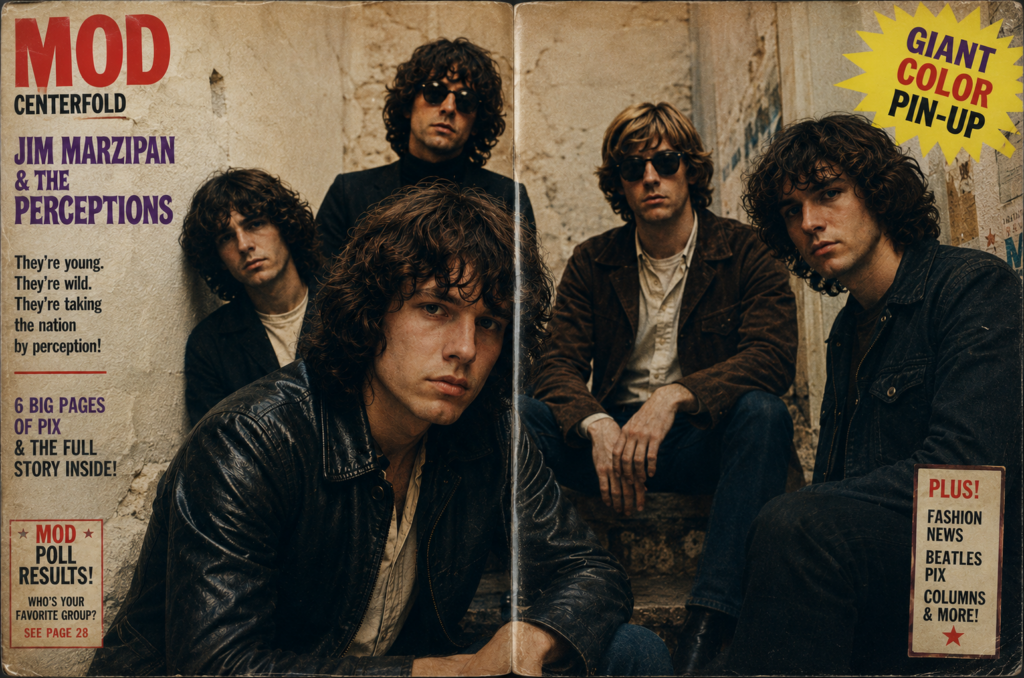
mod magazine centerfolds,
late-night apartment snapshots with pizza boxes and scattered records,
psychedelic Fillmore posters,
television appearances,
and live shots captured from the edge of the stage while crowds surged below.
Looking back now, it becomes difficult to separate the actual band from the dream people projected onto them.
Maybe that was always the point.
Jim Marzipan & The Perceptions never claimed to explain reality.
They merely adjusted the lighting.
===========================================================================
The Bardo bus is here. Jump on!
===========================================================================
See You At The Top!!!
gorby