

What Survives Endgame?
Everyone knows the old Las Vegas saying:
“What happens here, stays here.”
It’s a clever advertising slogan, but it also describes something much deeper.
Think about a computer game.
While you’re inside the game, everything matters. You worry about your resources, your enemies, your score, your victories and defeats. Your avatar may become rich, famous, feared, or utterly destroyed.
Then someone clicks Save & Quit.
Instantly, the entire world disappears.
The cities vanish.
The monsters vanish.
The treasure vanishes.
The wars vanish.
The avatar itself no longer exists as an active being.
From outside the game, it all seems strangely insubstantial.
Organic life may work much the same way.
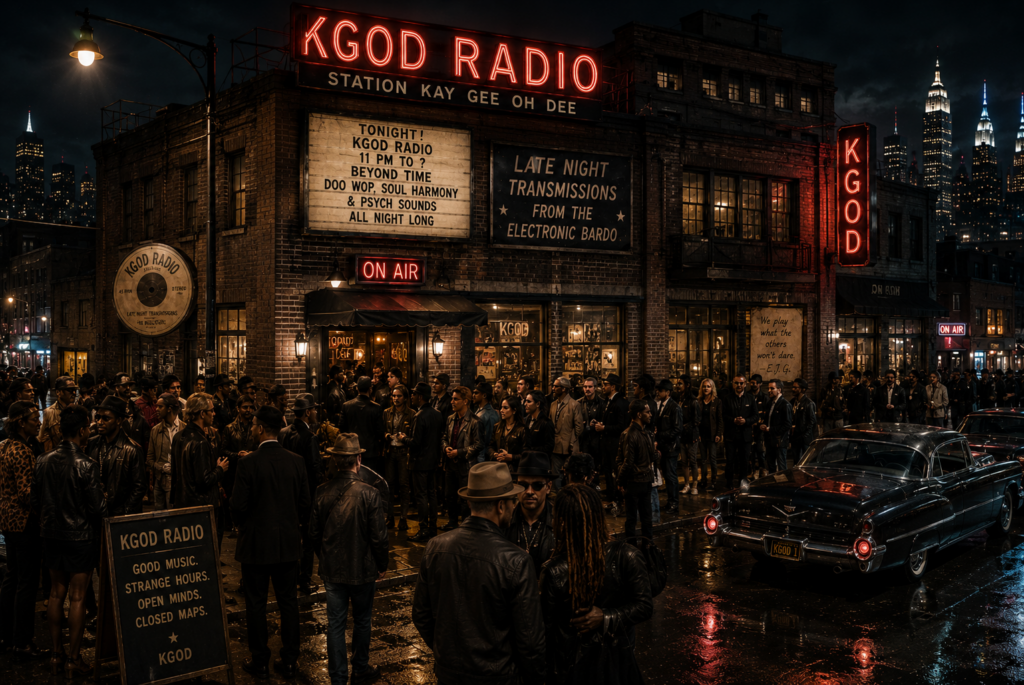
“You’re listening to Kay GOD… the station that makes it. Tonight’s question: What survives endgame? The score? Probably not. The player? Well… that’s tonight’s mystery.”
While we’re immersed in it, every event feels overwhelmingly real. We become identified with the character we’re playing. Success and failure, pleasure and pain, reputation and possessions all seem enormously important.
But suppose physical life is only one level of a much larger reality.
What survives when we leave?
Certainly not the bank account.
Not the automobile.
Not the house.
Probably not even the personality we’ve spent decades carefully constructing.
Yet something appears to remain.
Anyone who has worked extensively with computers knows that even after a program closes, traces often linger behind. Temporary files remain. Memory isn’t always completely erased. A few processes continue running in the background. The operating system remembers things.
Perhaps consciousness behaves in much the same way.
The game ends, but not without leaving vestigial effects.
Not the experiences themselves, but the traces they leave behind.
Perhaps what survives is memory—not memory of events, but memory of understanding.
Perhaps it is skill: the capacities we’ve developed through repeated experience.
Perhaps it is intention: the direction we’ve gradually chosen for ourselves.
Perhaps it is attention: what we’ve learned to notice, and what we’ve learned to ignore.
Perhaps compassion survives, because every encounter has quietly reshaped the heart.
Perhaps humor survives, because somewhere along the way we discovered that even the most impossible situations can be met with laughter.
And perhaps the greatest surviving trace of all is the ability to recognize the next game when it begins.
If that’s true, then life isn’t really about accumulating possessions inside the game.
It’s about developing qualities that continue to exist after the screen goes dark.
Maybe that’s why so many ancient traditions speak less about rewards and punishments than about awakening.
The score doesn’t survive.
The player might.
And perhaps the only question worth asking at the end of any game is this:
Who have you become by playing it?
The phrase “the ability to recognize the next game when it begins” is the gem in this essay. It hints at reincarnation, recurring opportunities, awakening, simulation theory, and spiritual development—all without committing to any one interpretation. It lets each reader supply their own meaning, which is one of the reasons I think it lands so well.
===========================================================================
Here’s the Bardo bus now.
===========================================================================
See You At The Top!!!
gorby