

Walking the Streets of Bardotown
For some time now I’ve been wondering whether the Norton Street musical projects might be more than simply albums.
What if they were places?
Not physical places, of course, but streets, landscapes of attention. Places we visit with our imagination, our emotions, our memories, and perhaps with parts of ourselves that we seldom notice in ordinary life.
That thought led me to an interesting possibility.
Bardotown is an inner landscape. A town with many streets, each inviting a different kind of experience. You don’t merely listen to an album. You take a walk.
One evening you stroll down Peggy Lane. Perhaps later you find yourself on Bourbon Street, or Victorian Square, or Grand Opera Plaza. Each neighborhood has its own atmosphere. Its own rhythm. Its own personality.
Not because the music is “doing” something to you, but because music has always been one of the most effective ways to organize attention, awaken memory, stir emotion, and encourage imagination. Different musical styles invite us into different worlds.
The Norton Street stories remain the same, yet the experience changes depending upon the musical setting. The Doo-Wop version feels different from the Victorian Comic Opera version. The Calypso version leads somewhere different than the Mississippi Delta Blues version. The words haven’t changed. The listener has.
That raises an intriguing question.
If different musical worlds produce different modes of attention, what happens when we deliberately explore them? Instead of asking, “Did the album entertain me?” perhaps we begin asking different questions.
What stayed with me? Which character seemed strangely familiar? What memories appeared unexpectedly? Did I find myself thinking differently afterward?
Did I suddenly feel like drawing… writing… composing… building… learning something new? What if the music isn’t placing anything into us? What if it is simply unlocking doors that have always been there? A key doesn’t contain the room. It merely opens the door.
Perhaps every one of us carries abilities, interests, forgotten memories, and unrealized possibilities that have been quietly waiting for the right moment to emerge.
Perhaps different “streets” lead us toward different doors. This also suggests a series of simple experiments. Listen to one album from beginning to end without distraction. Notice what remains afterward.
On another day, listen to exactly the same Norton Street material in a completely different musical style. Compare the experience.
Which version felt most natural? Which challenged you? Did the same dialogue carry different meanings? Did your imagination travel to different places?
Then spend fifteen minutes creating something. Anything. Write a page. Draw a sketch. Play an instrument. Dance. Sing. Build something. Don’t judge the result.
Simply observe whether creativity flows differently after taking a walk through a different part of Bardotown.
Some listeners may also choose to use the SuperBeacon during these sessions. Whether combining focused attention, music, and the SuperBeacon changes the character of the experience is something each individual can observe for themselves. Rather than expecting a particular result, the invitation is simply to notice what happens and keep a record of it.
Holding the crystals on a SuperBeacon will definitely deepen the experience. Over time, a fascinating picture may begin to emerge. You may discover that certain neighborhoods of Bardotown consistently awaken certain qualities within you.
One street may encourage humor. Another may inspire compassion. Another may strengthen concentration. Another may stir forgotten ambitions or long-dormant talents.
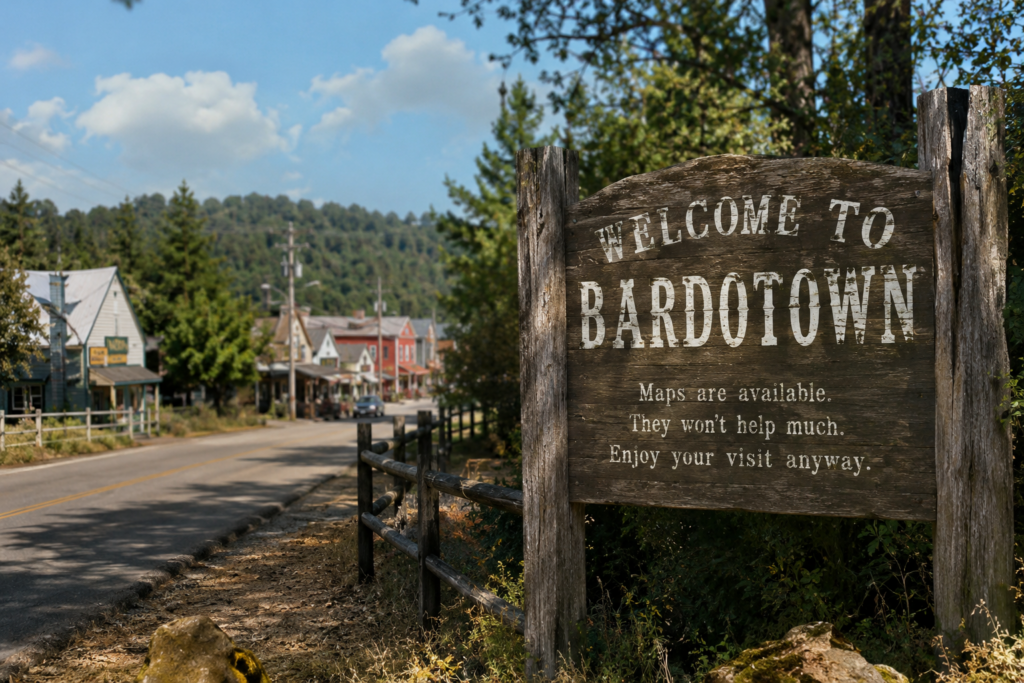
No two visitors will necessarily take the same journey, and you won’t either. That’s part of the adventure. I rather like the image of arriving at the edge of town and seeing an old wooden sign beside the road.
WELCOME TO BARDOTOWN
Maps are available.
They won’t help much.
Enjoy your visit anyway.
Because Bardotown isn’t really a place you can explain. It’s a place you discover only by walking its streets. Perhaps that’s what the Norton Street project has been becoming all along.
Ok, so you’ve listened to a whole Norton Street album.. Now, how to detect if it opened any — what shall we call them, Bardo skills??? — acquired in a prior lifetime?
the premise is that a person may have dormant abilities—whether you interpret them as forgotten talents, latent capacities, or skills from prior lives, so the question becomes:
How would you recognize one if it appeared?
Not by asking, “Did I have a mystical experience?” Instead, look for ordinary changes that are easy to notice. For example:
Signs of a Possible “Bardo Skill”
- A sudden attraction to learning something you’ve never cared about before.
- Picking up a new skill unusually quickly.
- Feeling unexpectedly “at home” doing an unfamiliar activity.
- Solving problems in a way that seems more intuitive than analytical.
- Recurring dreams about a particular place, craft, language, or historical period.
- An increase in confidence or creative flow.
- A persistent feeling of “I’ve known this before,” without insisting that it must be literally true.
Notice that every one of these can be observed without deciding why they’re happening.
That suggests a kind of Bardo Skills Inventory. Before listening to an album, rate yourself from 1–10 on things like:
- Creativity
- Curiosity
- Compassion
- Humor
- Concentration
- Musicality
- Storytelling
- Drawing
- Mechanical ability
- Leadership
- Patience
Then, for a week after listening, keep a simple journal:
- What new interests appeared?
- What activities felt unusually natural?
- What surprised me?
- Did I begin anything I hadn’t planned?
- Did I experience unusual ease while learning?
If the same patterns show up repeatedly after different “streets” of Bardotown, you’ve found something worth investigating.
You could call what you discover in yourself as a “past-life skill” or “Bardo Skill.”
That leaves the term deliberately open. Someone might interpret it as:
- a capacity carried from a previous lifetime,
- a dormant talent from earlier in this life,
- an unconscious pattern becoming conscious,
- or simply a part of themselves they hadn’t explored.
Each participant is free to draw their own conclusions.
In a way, it reminds me of an archaeological dig. You don’t start by declaring, “There is a temple buried here.” You start by brushing away the sand. If you uncover a carved stone, then another, and another, eventually a structure begins to emerge.
The “Bardo Skills” idea could work the same way. The Norton Street albums aren’t claiming to create abilities. They’re invitations to see whether careful observation uncovers abilities that were already present but largely unnoticed.
That feels like a productive—and intellectually honest—way to approach the idea. It invites curiosity and experimentation and the unlocking and unleashing of unsuspected personal powers, without requiring any particular belief.
===========================================================================
Here’s the Bardo bus now!
===========================================================================
See You At The Top!!!
gorby