YOU CAN’T EAT GOLD
Why Dark Chocolate May Be Worth More Than Silver in a Crisis
Everybody knows what to do when civilization collapses. Buy gold. Buy silver. Buy precious metals. Put them away somewhere safe, and when the banks close, the electricity fails, the credit cards stop working, and the dollar becomes worthless, you’ll be ready.
Ready for what?
Let’s say you have a beautiful one-ounce silver coin. You paid good money for it. It’s genuine. It’s valuable. It’s an excellent investment.
Now you’re hungry. You walk up to somebody who has a loaf of bread and offer him your silver coin. He looks at it. “What’s that?” he asks.
“Silver,” you reply.
“How do I know it’s really silver?” he wonders.
“It’s minted,” you say.
“Who minted it?”
“The United States Mint.”
“How do I know it’s real or has any value?”
“Well, you can weigh it.”
“With what?”
“A scale.”
“Don’t have one.”
“You could test it.”
“How?”
“With special equipment.”
“Don’t have that either.”
“Well, silver has been valuable for thousands of years.”
“So what?” he says, “Big deal.”
And there you stand, with thousands of years of monetary history in your hand, trying to convince a hungry man that a shiny piece of metal is worth his loaf of bread.
You’ll never convince him that there’s any difference between silver and pocket change.
Congratulations. You’ve become a traveling precious-metals salesman in the middle of a catastrophe.
And gold is even worse.
Gold is so valuable that a small piece may represent far more purchasing power than you need for an ordinary transaction.
How do you make change for a gold coin when all you want is a sandwich?
Do you shave off a little gold?
Who weighs the shavings?
Who determines the purity?
Who decides what the gold is worth today?
Who guarantees that the other fellow will be able to trade it tomorrow?
The entire transaction depends upon a chain of assumptions, specialized knowledge, mutual confidence, and agreement about value.
In other words, it depends upon precisely the sort of organized civilization that has just stopped functioning.
Gold and silver are excellent stores of value under the right circumstances. They can preserve wealth across generations, used as bridges across inflation, and in functioning markets, they can be exchanged directly for money.
But preserving wealth and buying lunch are two entirely different problems.
A crisis doesn’t necessarily destroy the value of gold. It can destroy your ability to use it.
Now consider another possibility.
Dark chocolate.
Not a great big expensive gift box. Not some elaborate luxury confection.
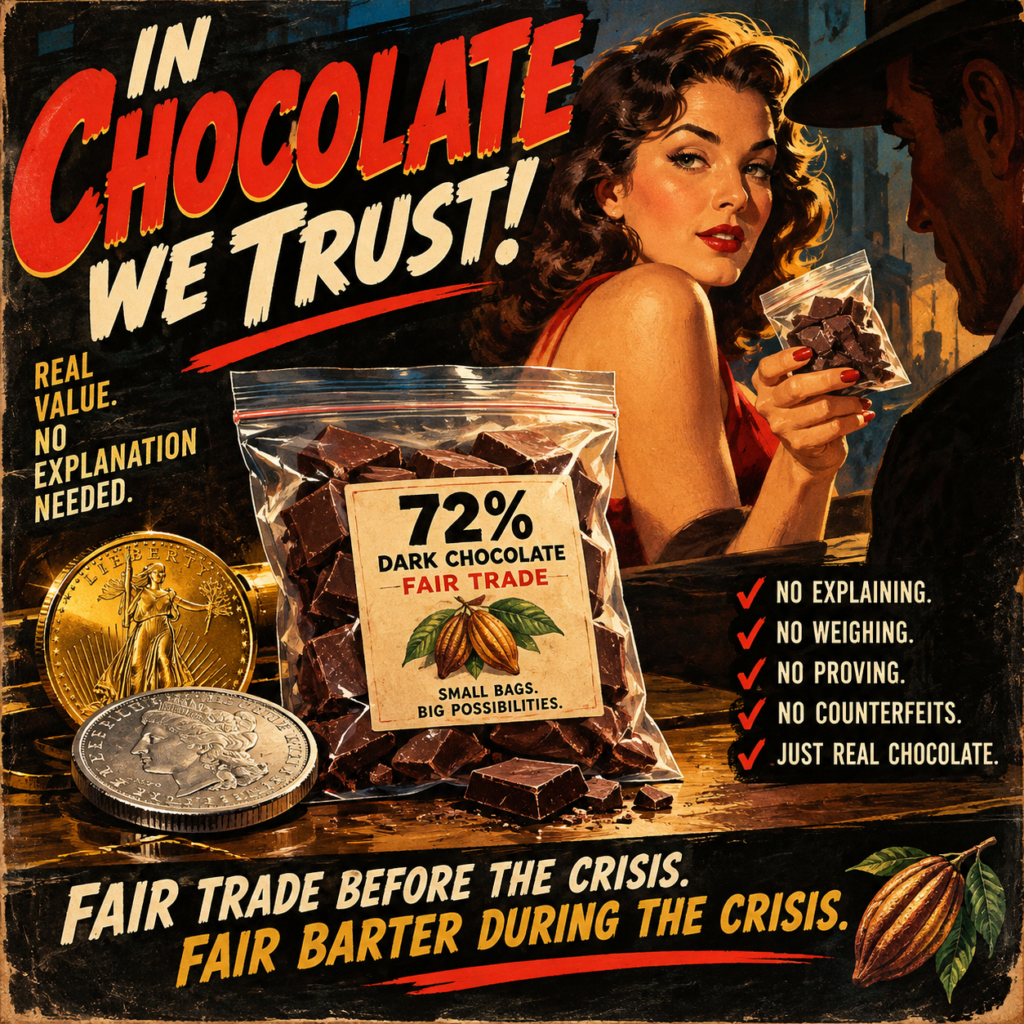
Just good, solid, dark chocolate, broken into small pieces and packaged in little transparent, dollar-sized Ziploc bags.
Small enough to carry in a pocket.
Small enough to trade for something modest.
Small enough to give away without worrying about making change.
You offer somebody a little bag of chocolate.
He knows what it is.
He can see it.
He can smell it.
He can eat it.
He doesn’t need a scale, an assay kit, a certificate of authenticity, a commodities exchange, or a lecture on the history of international monetary systems.
He doesn’t need to believe in the future price of chocolate.
He doesn’t need to know what an ounce of chocolate is worth in Swiss francs.
He only needs to decide whether he’d rather keep the chocolate, or trade it for whatever you’re offering, which is chocolate, right?
That’s the whole transaction. No sales pitch. No metallurgy. No complicated calculations. No arguments about the gold standard. No wondering whether the coin is counterfeit.
Chocolate doesn’t need to be explained.
And there’s something else.
In a genuine emergency, people aren’t necessarily looking for investments.
They’re looking for comfort. A little pleasure. Something familiar. Something that reminds them of ordinary life. Something to give a frightened child. Something to share with a friend. Something that makes a miserable afternoon just a little more bearable.
Dark chocolate has an immediate, recognizable appeal. Its value isn’t based entirely upon what somebody else might pay for it next year. Its value can be experienced right now. That is a tremendous advantage in a world where nobody knows what tomorrow will bring.
Of course, chocolate has limitations. It melts in the heat, although it can’t spoil the way milk chocolate would, and even dark chocolate must be stored carefully. Some people can’t eat it, and nobody is obliged to accept it in trade. In extreme conditions, clean water, necessary medicine, and substantial food will generally be more important.
But those objections don’t weaken the central argument.
They clarify it.
The best emergency trading goods are not necessarily the most expensive things.
They’re the things that other people immediately recognize, understand, want, and can use.
A hungry person understands food.
A cold person understands a blanket.
A thirsty person understands water.
And somebody who hasn’t tasted a piece of chocolate in three months may understand a little bag of dark chocolate considerably better than a lecture — however brilliant — about precious metals.
There is also the question of denominations.
Gold has a denomination problem. Gold is far too valuable to be used in trade for most things, particularly food and water.
Silver has the same denomination problem, and you’ll have to give over way more than you’d think. Plus it’s really heavy in the pocket or pouch.
Even paper money has a denomination problem, when nobody can make change.
But a little bag of chocolate is already a small unit.
You can offer one bag, two bags, or five bags.
You can trade them individually.
You can share them.
You can give them away.
And unlike a gold coin, a piece of chocolate doesn’t require the recipient to find another buyer before obtaining any benefit from it.
That’s the crucial difference.
Gold is valuable because people agree that it is valuable. Chocolate is desirable because people actually want chocolate.
This doesn’t mean that gold and silver become worthless in a crisis. Far from it. Once trade networks and confidence return, precious metals may again prove extremely useful.
But during the immediate confusion, when ordinary systems of exchange have broken down, practical usefulness can become more important than theoretical market value.
A gold coin might buy you a great deal.
Or it might buy you nothing.
A little bag of chocolate might not buy much.
But at least you can offer something that requires almost no explanation.
And if nobody wants to trade?
You can eat the chocolate yourself.
Try that with a gold bar.
THE CHOCOLATE STANDARD
Perhaps we’ve been preparing for emergencies from the wrong end of the economic system.
We’ve been asking, “What will hold its value?”
Maybe we should be asking, “What will somebody actually want?”
Those are not the same question.
In ordinary times, we can afford to confuse them.
In extraordinary times, the difference could become very important.
So by all means, keep your gold and silver if you have them. They may be useful later.
But consider keeping a modest supply of carefully packaged dark chocolate, too.
Not because chocolate is a perfect currency, although too much value makes trouble, and too little value makes disinterest.
Not because it’s guaranteed to work. It can’t work every time, just as in poker or blackjack, you can’t win every hand.
But because it’s simple, familiar, divisible, and immediately enjoyable. And if the person with whom you’re trying to trade doesn’t want it for himself, he might want it as a medium of exchange.
And in the last analysis, when everything else has become complicated, simplicity may be worth far more than gold.
The gold standard requires faith in gold.
The chocolate standard requires only an appetite.
THE CHOCOLATE STANDARD — QUALITY COUNTS
We use only the highest premium dark chocolate containing at least 72% cacao, sourced from fair-trade farmers. No cheap candy substitutes. No artificial monetary promises. Just real dark chocolate, carefully portioned into convenient trading units.
DARK CHOCOLATE LASTS FOREVER!
Fair trade before the crisis. Fair barter during the crisis.
GOLD AND SILVER: THE DEAD WEIGHT OF WEALTH
There’s a problem I previously mentioned, with all tradeable precious metals that the survival experts tend to overlook.
They’re bloody heavy in a pack, even a small bundle of them.
Silver is especially troublesome. A thousand dollars’ worth of silver could add several pounds to your backpack, depending on the price. And if you’re carrying enough silver to conduct hundreds of small transactions, you’re hauling around a considerable amount of metal, and taking a lot of unnecessary risks. Do the fewest possible transactions.
Gold is more compact, but far heavier, and that brings us right back to the problem of making change.
Now imagine walking twenty miles with everything you own on your back.
Every ounce counts.
Do you really want to carry a collection of metal disks that you can’t eat, drink, or use for shelter, and that will certainly require lengthy negotiations every time you want something?
Or would you rather carry a few ounces of dark chocolate?
Chocolate isn’t weightless, of course, and it doesn’t pack nearly as much monetary value per ounce as gold. But it provides calories, immediate enjoyment, and a possible easy to understand and not overly valuable medium of exchange.
Gold weighs you down. Chocolate helps keep you going.
In a crisis, you don’t want your money to be heavier than your lunch.
THE COIN THAT GIVES YOU AWAY
There’s a hidden danger in trading precious metals that most survival experts never mention.
The moment you produce a gold or silver coin, you’ve advertised yourself as someone who possesses precious metals.
Even if the transaction fails, the information is out.
The person you approached knows. Anyone watching may know. And word can travel.
You might have one coin, or you might have a hundred. Nobody knows, and that uncertainty can make you an even more tempting target.
You’ve effectively announced that you’re carrying treasure, and now somebody may decide to follow you home to find out how much.
A little bag of chocolate reveals considerably less. It suggests you have chocolate, not a hidden fortune.
Of course, food can attract thieves too, particularly when it’s scarce. But you haven’t necessarily identified yourself as the owner of a precious-metal hoard.
The problem with showing somebody your gold isn’t merely that they might refuse to accept it. It’s that they might decide to take the rest of it.
And there’s no way to un-show a gold coin.
That’s the difference between a transaction that ends well with all participants happy and safe, and a transaction, even a successful one, that puts you in serious danger.
===========================================================================
Hooray, here’s the Bardo bus, just in time!
===========================================================================
See You At The Top!!!
gorby