

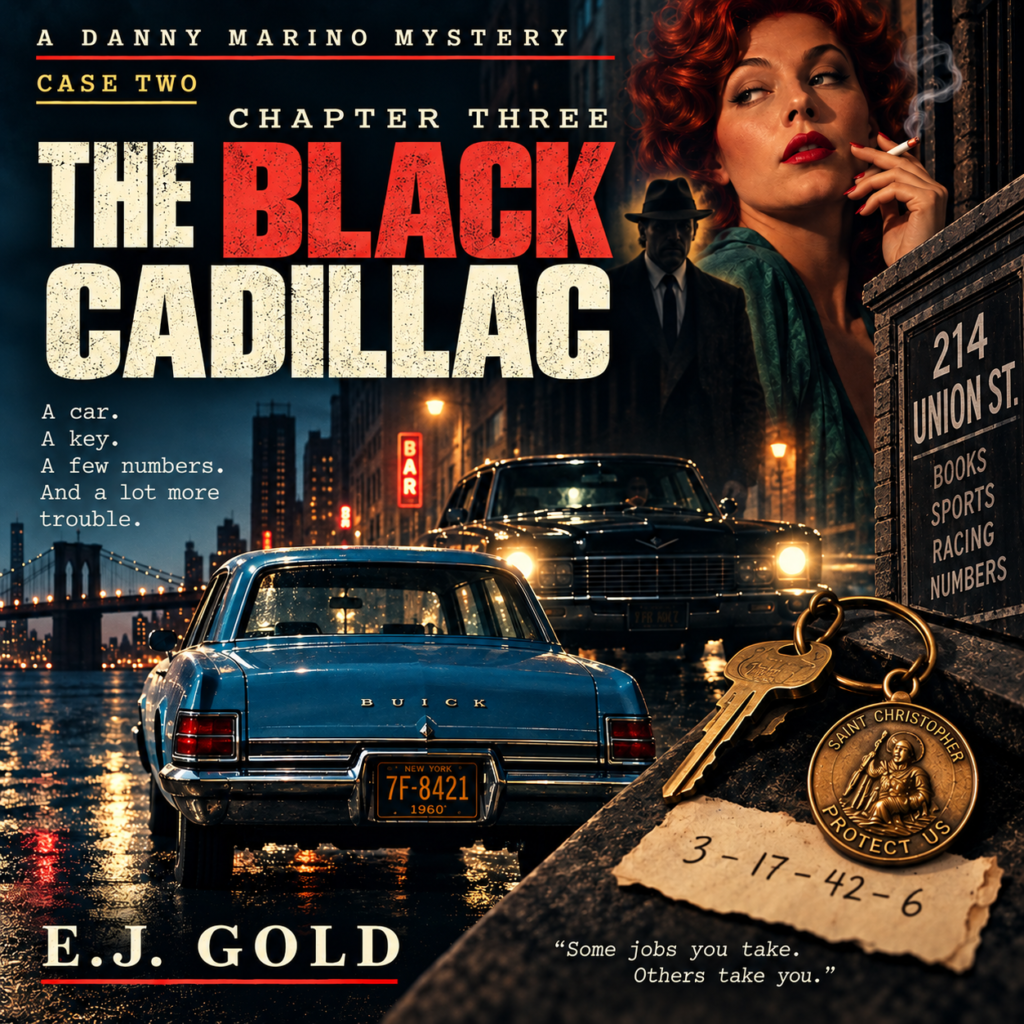
CHAPTER THREE
THE BLACK CADILLAC
Danny had been followed before, but never by a car nicer than his apartment.
The black Cadillac was half a block behind him when he turned onto Atlantic Avenue. He saw it in the Buick’s rearview mirror: big, polished, patient.
He turned right.
The Cadillac turned right.
He turned left.
The Cadillac turned left.
“Maybe we’re both lost,” Danny said.
He turned right again.
So did the Cadillac.
“Together.”
The gas gauge was sitting on empty.
Anna had told him to check the gas. Naturally, he hadn’t. Danny had always considered gasoline one of those details best handled by people who owned cars.
He spotted a Gulf station ahead and pulled in.
A kid in gray coveralls came running out.
“Fill it?”
Danny looked at the gauge, then at the three dollars in his pocket.
“Let’s not get hysterical. Give me two dollars’ worth.”
The kid unscrewed the cap.
The Cadillac went past.
Danny watched it disappear.
“Friend of yours?” the kid asked.
“What?”
“Black Caddy. Been behind you since Flatbush.”
Danny looked at him.
“You noticed?”
“Hard not to. Guy driving it looks like Frankenstein.”
“You know him?”
“Nope.”
“How do you know he looks like Frankenstein?”
“He got gas here yesterday.”
Danny gave the kid a quarter.
“What’s your name?”
“Eddie.”
“Eddie what?”
“What’s the quarter for?”
“Information.”
“Then my name’s Eddie Quarter.”
Danny liked him immediately.
“Did Frankenstein say anything?”
“Yeah. He said fill it.”
“Anything else?”
“He said check the oil.”
Danny took back the quarter.
“Hey.”
“You’re overcharging.”
The Cadillac was gone, but Danny waited another minute before pulling out.
214 Union Street turned out to be a narrow brick building between a butcher shop and a place called LOMBARDI’S SOCIAL CLUB. Three old men sat in folding chairs outside the club, watching the street with the professional attention of men who had absolutely nothing to do.
Danny parked.
One of the old men said, “You can’t park there.”
“Why not?”
“Joey parks there.”
“Who’s Joey?”
The three men looked at one another.
The oldest shrugged.
“Nobody.”
Danny moved the Buick.
There was another empty space twenty feet away.
“You can’t park there either.”
“Joey?”
“Lou.”
“Who’s Lou?”
“Nobody.”
Danny drove around the block.
When he came back, one of the old men had moved a garbage can into the first space.
Danny parked in front of a fire hydrant.
Nobody objected.
214 Union had four buzzers. None had names.
Danny pressed the second.
Nothing.
He pressed the third.
A woman’s voice came through the intercom.
“Yeah?”
“I’m looking for Charlie.”
There was a long silence.
Then:
“Everybody’s looking for Charlie.”
The buzzer sounded.
Danny pushed through the door.
The hallway smelled of cabbage, cigars and something sweet he couldn’t identify. He climbed one flight.
A door opened before he knocked.
The woman standing there was perhaps thirty, perhaps forty, with red hair, a green silk robe and a cigarette in a long black holder.
She looked at Danny.
Then past him.
Then at Danny again.
“You alone?”
“I think so.”
“That isn’t an answer.”
“It’s the best one I’ve got.”
She stepped aside.
The apartment wasn’t an apartment.
There was no bed, no sofa, no kitchen table. There were two desks, six telephones, a chalkboard and three men wearing headsets.
Numbers covered the board.
YANKEES -6
DODGERS 8-5
BELMONT 3RD
BOSTON +2
One of the telephones rang.
A man picked it up.
“Yeah.”
He listened.
“Twenty on Boston. Ten on the Yankees. Got it.”
He hung up.
Another phone rang.
The woman closed the door.
“I’m Rosie.”
“Danny.”
“I know.”
That bothered him.
“How?”
“Charlie said Danny would come.”
“With the Buick?”
Rosie stared at him.
“What Buick?”
Danny didn’t answer.
Rosie walked to the window and looked down.
“You brought a car?”
“Apparently.”
“What kind?”
“Blue Buick.”
Rosie turned around very slowly.
“Charlie told you to bring a blue Buick here?”
“He told me to drive it here.”
“Those aren’t the same thing.”
“They sounded the same when he said them.”
Rosie crushed out her cigarette.
“Where is it?”
“Outside.”
“Where outside?”
“Hydrant.”
One of the headset men looked up.
“That’s Joey’s hydrant.”
Danny looked at him.
“Of course it is.”
Rosie was already putting on shoes.
“Keys.”
Danny handed her the ignition key.
She looked at it.
“Other one.”
Danny took the second key from his pocket.
The little Saint Christopher medal came with it.
Rosie stopped.
For the first time since Danny had entered the room, nobody spoke.
Even the telephones seemed quieter.
Rosie took the key but not the medal.
“Where’d you get that?”
“It was with the keys.”
“No, it wasn’t.”
Danny felt something cold settle behind his ribs.
“It was when Charlie gave them to me.”
Rosie looked toward the three men.
One of them took off his headset.
Another quietly locked the door.
Danny said, “I have the feeling I’ve missed something.”
Rosie held up the second key.
“This doesn’t belong to the Buick.”
“I figured that much out.”
“Do you know what it belongs to?”
“No.”
“Good.”
“Why is that good?”
“Because if you knew, I’d have to wonder why you’re still alive.”
A telephone rang.
Nobody answered it.
It rang again.
Rosie looked through the window.
Her face changed.
“Danny.”
“What?”
“Did anybody follow you?”
“I was hoping you wouldn’t ask that.”
“What kind of car?”
“Black Cadillac.”
Rosie closed her eyes.
“Big fellow driving?”
“Eddie says he looks like Frankenstein.”
“Who’s Eddie?”
“Eddie Quarter.”
“Who’s Eddie Quarter?”
“I don’t know. We only just met.”
Rosie grabbed Danny by the sleeve.
“Downstairs. Now.”
“What about the Buick?”
“Forget the Buick.”
“That was my entire assignment.”
“You’ve been promoted.”
“To what?”
“Running.”
They went down the back stairs.
Danny heard a car door slam in the street.
Then another.
Rosie stopped on the landing.
“Give me the medal.”
Danny handed it to her.
She turned it over.
On the back, scratched so lightly that Danny hadn’t noticed it, were four numbers.
3 — 17 — 42 — 6
“What are they?”
Rosie slipped the medal into her bra.
“I don’t know.”
“You’re lying.”
“Of course I’m lying.”
“About what?”
“Everything.”
Somebody knocked on the front door upstairs.
Three slow knocks.
Nobody moved.
Then a man’s voice called through the door.
“Rosie.”
She grabbed Danny’s hand.
They ran.
Behind them the man called again.
This time he sounded almost friendly.
“Rosie. Open the door.”
They reached the alley.
Danny looked back toward Union Street.
The blue Buick was still sitting at the hydrant.
The black Cadillac was parked directly behind it.
A very large man stood beside the Buick.
He was looking straight at Danny.
Eddie had been right.
Frankenstein.
The man smiled.
Danny smiled back.
“Friend of yours?” Rosie whispered.
“No.”
“Then why are you smiling?”
“My mother taught me manners.”
Frankenstein started toward them.
Rosie ran.
Danny followed.
It occurred to him, somewhere between Union Street and the next corner, that yesterday morning he had been broke, hungry, homeless and sick.
Things were definitely improving.
===========================================================================
HOW TO WRITE A MYSTERY
Breaking Down Chapter Three
Chapter Three opens:
“Danny had been followed before, but never by a car nicer than his apartment.”
That sentence has several jobs. It establishes danger—the black Cadillac is following him. It tells us Danny has been followed before. It reminds us he’s broke. And it gets a laugh. Four pieces of information in one sentence.
That’s compression.
From there, the chapter keeps moving. Danny tests the Cadillac by making several turns. It follows. Instead of explaining that Danny is suspicious, we show him doing something about his suspicion.
Then we stop for gasoline.
Why interrupt a chase for gasoline?
Because the stop introduces Eddie Quarter, gives us information about the Cadillac driver, adds humor, and makes the world larger. A minor practical problem becomes a character scene.
Next we arrive at 214 Union Street.
The three old men guarding imaginary parking spaces don’t advance the mystery very much—but they make the neighborhood real. They also give the reader a moment to relax before the next piece of trouble.
Upstairs, Danny discovers the bookmaking operation and meets Rosie. Again, instead of explaining organized crime, we walk into a room and see it operating. Telephones, headsets, chalkboard, odds. The reader learns by looking.
Then comes the reversal:
“What Buick?”
Danny thought his assignment was to deliver the car. Suddenly neither Danny nor the reader understands the assignment anymore.
That’s when the second key becomes important.
Then the Saint Christopher medal.
Then the numbers scratched on its back.
Each answer produces another question.
That’s one of the basic engines of mystery writing:
Don’t merely conceal information. Reveal information that creates a larger mystery.
Finally, the black Cadillac returns and Frankenstein gets out.
Now all the separate pieces of the chapter—the Cadillac, Eddie’s warning, Rosie, the Buick, the key and the medal—collide at once.
Rosie and Danny run.
And the chapter ends by returning to Danny’s original condition: broke, hungry, homeless and sick.
Except now he’s also being chased by Frankenstein.
Things are definitely improving.
That’s structure: danger, humor, discovery, reversal, greater danger—and out.
The reader gets information constantly, but never quite enough to become comfortable.
That’s how you keep the pages turning.
===========================================================================
Here’s the Bardo bus now!
===========================================================================
See You At The Top!!!
gorby