

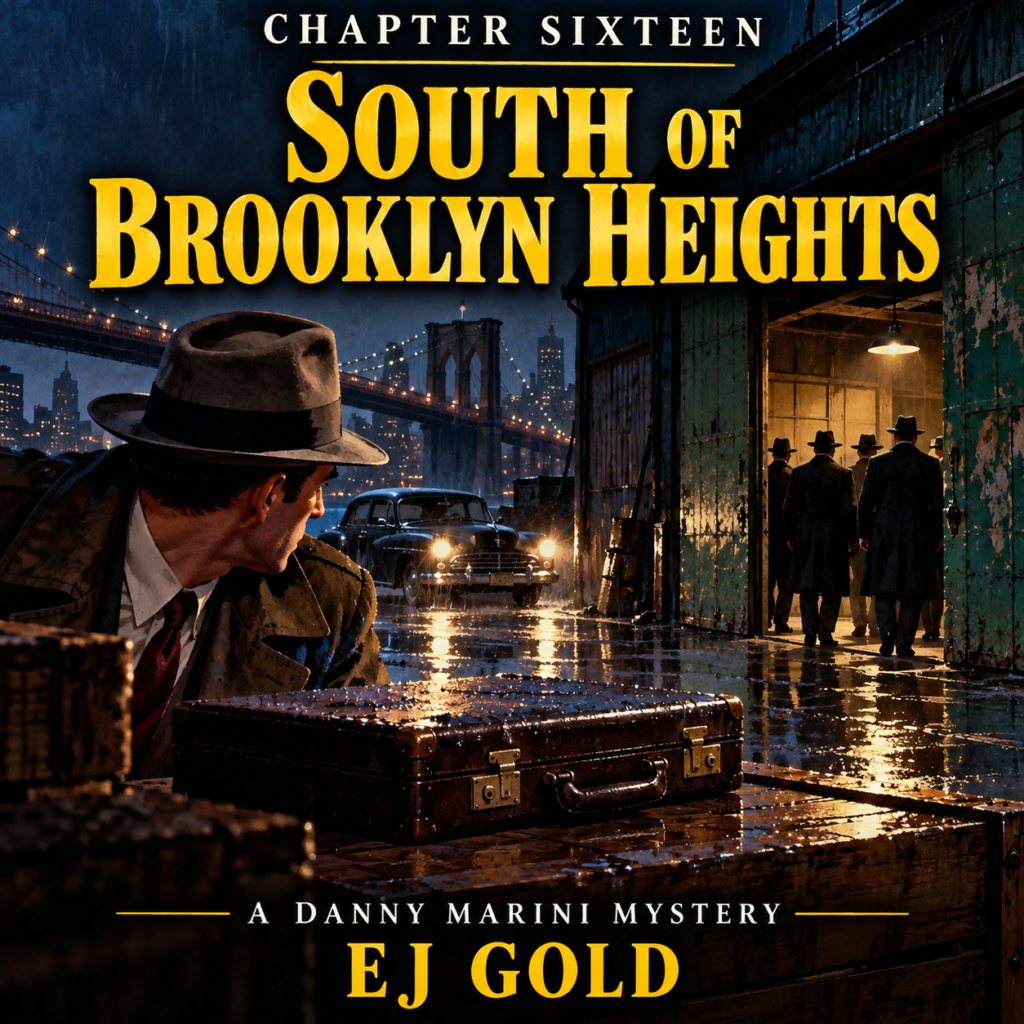
CHAPTER SIXTEEN
SOUTH OF BROOKLYN HEIGHTS
The Pontiac sedan had seen better days.
So had Danny Marino.
The Pontiac was parked half on the curb outside a warehouse near the waterfront, somewhere south of Brooklyn Heights. Danny wasn’t entirely sure where. The streets had changed names twice since Tony Spada had given him directions, and the directions hadn’t been very good to begin with.
“Look for the warehouse with the green door.”
There were six warehouses.
Four had green doors.
Danny sat behind the wheel and watched the rain.
He had been told there was an attaché case inside one of those buildings. He had not been told who had put it there, who had found it, or why somebody hadn’t simply picked it up and brought it back.
Those omissions bothered him. Lately, omissions bothered him more than information.
He got out of the Pontiac. A truck rolled past toward the docks, throwing water across his shoes.
“Perfect. Just perfect,” he muttered grimly, glancing down at his mud-splattered shoes and pant legs. “Just what I needed.”
The correct warehouse turned out to be the one with the least green door. Most of the paint had peeled away.
Danny knocked.
Nothing happened.
He knocked again.
A small panel opened at eye level.
Two eyes looked at him.
“The rain came early,” Danny said.
The panel closed.
Danny waited.
Thirty seconds later the door opened.
A man in shirtsleeves stood there. He was about fifty, built like somebody who had spent thirty years lifting things other people preferred not to lift.
“You Danny?”
“No.” He immediately thought better of it. The man stared at him. “Yes,” he nodded.
“Come in,” the man said, opening the door a little wider. The warehouse smelled of rope, damp cardboard and coffee. There were three men inside. One Danny knew by sight from the Downtown Athletic & Bridge Club. The other two he had never seen before.
That made four men guarding one attaché case.
The case sat on a wooden table.
Danny looked at it.
Nobody spoke.
Finally Danny said, “Pajamas?”
The man in shirtsleeves didn’t smile.
“We didn’t open it.”
“Good.”
“You want to?”
“No.”
That answer seemed to surprise everybody.
Danny walked around the table.
The case looked ordinary. Dark leather. Brass locks. Scuffed corners. The sort of thing an accountant might carry to work. Or somebody who wanted half of New York frightened out of its mind, in an evacuation panic.
“How did it get here?”
Nobody answered.
Danny looked at the man in shirtsleeves.
“You found it?”
“No.”
“Who did?”
“A kid.”
“What kid?”
“A kid.”
“That narrows it down.”
The man leaned against the table.
“Delivery boy. Sixteen, seventeen. He saw somebody put it behind some crates in an alley two blocks over. Kid thought maybe there was something worth stealing inside.”
“There was?”
“We don’t know.”
“Because you didn’t open it.”
“Right.”
Danny looked again at the case.
“What happened to the kid?”
“He went home.”
Danny waited.
The man added, “We think.”
Danny didn’t like the addition.
“Who left the case?”
“Kid says a man.”
Danny waited again.
“A man wearing a dark suit.”
That changed the room.
Danny didn’t show it.
There had been a lot of dark suits lately.
“What kind of man?”
“Tall.”
“That helps.”
“Hat.”
“Now we’ve got him.”
“One other thing.”
Danny looked at him.
“He wasn’t alone.”
“How many?”
“Two cars. Maybe five men.”
Danny stopped joking.
Five men did not accidentally lose an attaché case.
“Then they left it deliberately.”
“That’s what I said,” offered Danny.
One of the other men spoke for the first time.
“No. You said they dumped it.”
“Same thing.”
“No, it isn’t.”
Danny looked from one to the other.
The second man was right.
Dumping something meant you wanted to get rid of it.
Leaving something meant you might expect somebody to find it.
“Who knew we were looking for these cases?” Danny asked.
Nobody answered.
That was becoming a habit.
A telephone rang in the office at the back of the warehouse.
Nobody moved.
It rang again.
The man in shirtsleeves went to answer it.
Danny stayed beside the table.
The attaché case was less than three feet away.
For several seconds he had the ridiculous feeling that it was watching him.
The man returned.
His face had changed.
“That was Tony.”
“What does he want?”
“He says don’t bring the case.”
Danny looked at the case.
“Fine with me.”
“He says don’t touch it.”
“Even better.”
“He says everybody gets out.”
That was different.
The three men moved immediately.
Danny didn’t.
“Why?”
The man was already putting on his coat.
“Tony didn’t say.”
Danny looked at the attaché case.
“Did Tony say anything else?”
The man hesitated.
“He asked if it was open.”
“And?”
“I told him no.”
“What did he say?”
The man looked at Danny.
“He said keep it that way.”
They walked outside.
The rain had become heavier.
Nobody ran. Men like these didn’t run unless somebody was shooting at them.
But they walked very quickly.
Danny climbed into the Pontiac.
The man in shirtsleeves leaned through the open window.
“You coming?”
“In a minute.”
“Tony said everybody.”
“I heard you.”
The man looked toward the warehouse.
“You know something I don’t?”
“Usually.”
The man left.
Danny sat alone.
Across the street, rain ran down the warehouse windows.
Nothing happened.
Thirty seconds.
A minute.
Two minutes.
Then headlights appeared at the end of the block.
A black sedan came slowly through the rain.
It stopped in front of the warehouse.
Four men got out.
Dark suits.
Dark hats.
None of them hurried.
One went to the green door.
It opened before he knocked.
Danny sat very still.
Somebody had remained inside.
The four men entered.
The door closed.
Danny started the Pontiac.
He was halfway down the block when another car turned the corner.
He recognized the driver.
Charlie.
The undertaker.
Danny stopped.
Charlie pulled alongside and lowered his window.
“What are you doing here?”
Danny looked back toward the warehouse.
“Apparently leaving.”
Charlie didn’t laugh.
“Where’s the case?”
“Inside.”
“You opened it?”
“No.”
Charlie seemed relieved.
Then Danny noticed something.
Charlie wasn’t alone. A man sat beside him. Thin. Well dressed. Danny had seen him before. The coffee shop. The man who had known about the Buick. The man looked at Danny through the rain. Neither of them acknowledged the other.
Charlie said, “Go back to Second Avenue.”
“Tony sent me here.”
“Tony changed his mind.”
“So I’ve heard.”
Charlie began rolling up his window.
Danny said, “Charlie.”
The window stopped.
“Who are the guys in the warehouse?”
Charlie looked straight ahead.
“I don’t know.”
“Miami?”
“No.”
“Chicago?”
“No.”
“One of the families?”
Charlie looked at him.
“I said I don’t know.”
That was the first time Danny had heard fear in Charlie’s voice.
The window went up.
Charlie’s car pulled away.
Danny watched it disappear into the rain.
Then he looked back at the warehouse.
Four dark-suited men had gone inside.
Somebody had been waiting for them.
Charlie didn’t know who they were.
Tony didn’t want the case touched.
And somebody had left it where a sixteen-year-old delivery boy was almost certain to find it.
Danny put the Pontiac in gear.
He had been thinking about the whole thing wrong.
Everybody had.
They had been asking who had the four cases.
Maybe that wasn’t the question.
Maybe the question was:
Who wanted them found?
===========================================================================
CHAPTER SIXTEEN BREAKDOWN
SOUTH OF BROOKLYN HEIGHTS
1. START WITH THE ORDINARY
Danny drives an old Pontiac through the rain looking for a warehouse.
Nothing extraordinary is happening yet. That’s deliberate. The more ordinary the surroundings, the stranger that attaché case becomes.
Mystery works well when danger is sitting in an otherwise normal room.
2. KEEP DANNY A NOBODY
Danny still isn’t running the operation.
He gets sent to look at things. He waits outside doors. People tell him only what they think he needs to know.
That’s his advantage.
Important people are watched. Danny isn’t.
3. HUMOR RELEASES PRESSURE
The green doors, the wet shoes, and the exchange about pajamas give the reader a chance to breathe.
The characters don’t make jokes because they’re in a comedy. They make jokes because people joke when they’re nervous.
Play the humor straight.
4. DON’T OPEN THE CASE
The obvious move would be to open the attaché case.
So we don’t.
An unopened case is more interesting than an open one because it contains every possibility.
Once you show the reader what’s inside, most of those possibilities disappear.
5. CHANGE THE MEANING OF AN EVENT
At first we believe somebody lost the case.
Then we hear that several men deliberately left it where it could be found.
That changes the mystery.
The question is no longer:
Who lost the case?
It becomes:
Who wanted the case found?
That’s a useful mystery technique. Keep the facts but change what the facts mean.
6. BRING BACK OLD CHARACTERS
Charlie and the thin, well-dressed man return.
This rewards the reader for remembering them and makes the story feel interconnected.
The thin man doesn’t need to explain himself. Recognition is enough.
7. LET THE EXPERT BE AFRAID
Charlie has always seemed to know what’s going on.
Now he doesn’t.
More importantly, he’s frightened.
If Danny were frightened, that wouldn’t tell us much. Danny is in over his head.
But when Charlie is frightened, the reader knows something has changed.
8. THE MEN IN BLACK STAY UNIDENTIFIED
Are they mobsters?
Government?
Miami?
Some other organization?
We still don’t say.
The important point is that even the mob doesn’t appear to know.
That keeps the Men in Black grounded in the crime story while leaving their identity open.
9. INFORMATION SHOULD CREATE QUESTIONS
By the end of the chapter we know more than we did at the beginning.
But we’re less certain about what’s happening.
That’s good mystery construction.
Each answer should occasionally produce a larger question.
10. END BY REVERSING THE PREMISE
Everybody has been trying to recover four missing cases.
Danny realizes that may be the wrong problem.
Maybe the cases weren’t simply lost or stolen.
Maybe somebody arranged for them to move around, disappear and reappear.
The final question—
Who wanted them found?
—changes the direction of the story and gives Chapter Seventeen somewhere new to go.
THE LESSON
A mystery doesn’t advance only by revealing secrets.
Sometimes it advances by showing the reader that the question they’ve been asking was wrong.
===========================================================================
Oh! Here’s the Bardo bus now!!!
===========================================================================
See You At The Top!!!
gorby