

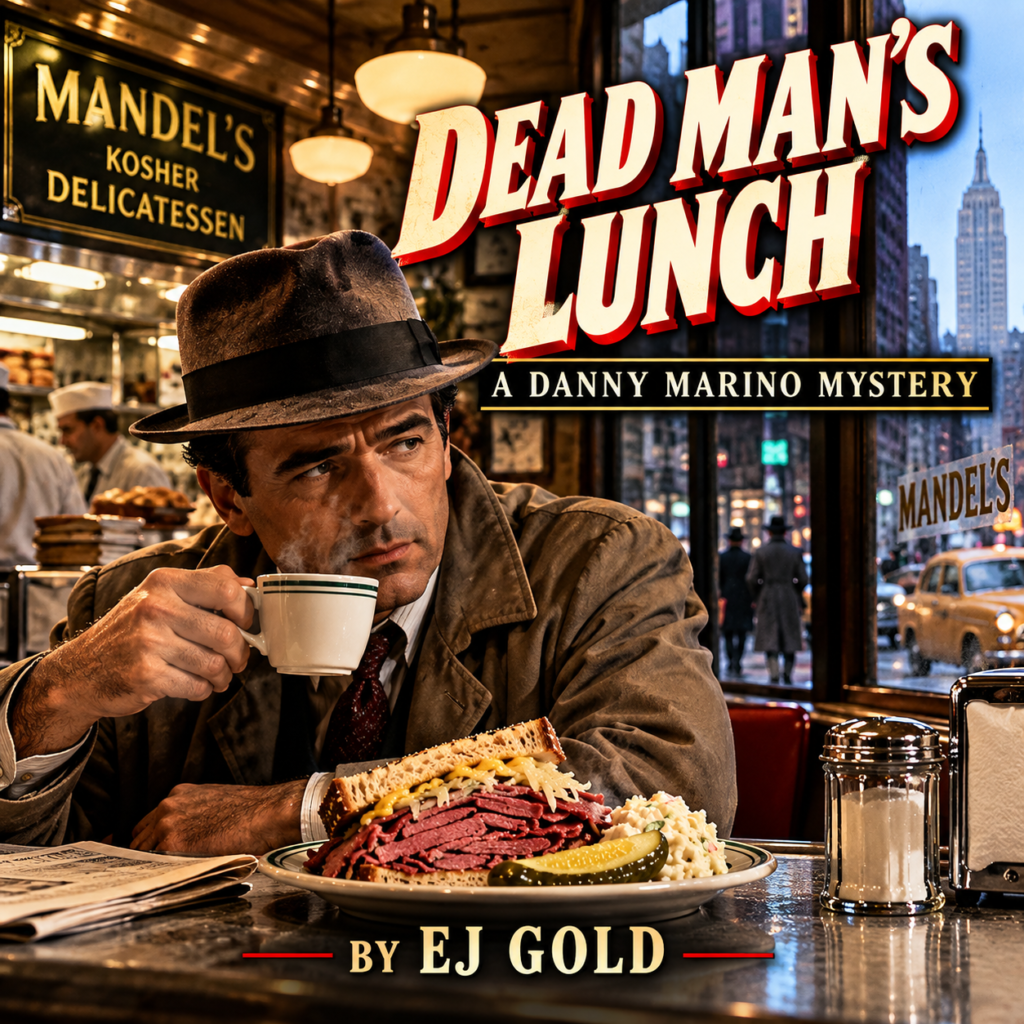
THE DEAD MAN’S LUNCH
A DANNY MARINO MYSTERY
“Marino, I need you to find out why a dead man keeps ordering lunch.”
Danny looked at Tony Spada, who was sitting in the corner. Not eating, not drinking, just sitting. He was a compact, well-dressed man in his middle fifties, with iron-gray hair and the quiet authority of someone clearly accustomed to being obeyed. Exactly what he did for a living was something Danny had never been foolish enough to ask.
“Dead? How dead?” Danny asked.
Tony considered the question. “Dead.”
“That doesn’t answer my question,” Danny said quietly.
“He’s been dead eleven years,” Tony replied with a touch of annoyance.
Danny nodded. “That answers my question.”
Tony was sitting behind the desk in the back room of the Downtown Athletic & Bridge Club, although Danny had never seen anybody engage in athletics there and the only bridge he had ever seen played involved four men who became strangely silent whenever anyone else entered the room.
Nicky Bellomo sat at the card table munching heartily on half a pastrami on rye.
“Who ordered the lunch?” Danny asked.
“The dead man.”
“I understand that part.”
“Then why’d you ask?”
“I thought there might be more to it.”
“There is.” Tony pushed a folded piece of paper across the desk.
Danny opened it. It was a luncheon check from Mandel’s Kosher Delicatessen on West Forty-Seventh Street.
PASTRAMI ON RYE MUSTARD & SAUERKRAUT
POTATO SALAD
HALF-SOUR PICKLE
COFFEE BLACK
At the bottom someone had written in pencil:
MR. JULIUS KESSLER
314 WEST 46TH STREET
APT. 4C
“Who’s Julius Kessler?”
“The dead man.”
“Uh huh,” Danny grunted.
“He used to be in the garment business.”
“What kind?” Danny replied.
“Dresses.”
That covered a substantial percentage of the Lower East Side of Manhattan, including Orchard Street.
Danny looked at the check again. “How often does he order lunch?”
“Every Thursday,” Tony Spada said, with an odd circular wave of his hand.
“How long has this been going on?” Danny demanded.
“Three months,” said Spada.
“Same lunch?” Danny pressed.
“Same lunch,” Tony responded.
“Who pays?” Danny inquired.
Tony looked at him. “If I knew that, I wouldn’t need you.”
Nicky swallowed. “Maybe the dead guy pays.”
Tony turned his head slowly. Nicky returned to his sandwich. Danny put the check in his pocket. “What do you want me to do?” he asked.
“Find out who’s ordering.”
“Why?”
Tony looked surprised. “Because he’s dead.”
“That doesn’t bother him,” Danny replied.
“Well,” said Tony, “it bothers the hell out of me.”
That was obviously all that Tony Spada intended to say, period. Danny had learned not to wait for the rest of a sentence when Tony had already decided there wasn’t going to be one. He stood up somewhat abruptly.
“When’s the next lunchtime at the deli?” Danny asked urgently.
Tony looked at the clock. “It’s now, like from eleven to about two p.m.”
Danny put on his hat. Nicky looked up. “Could you bring me back a corned beef on rye and a side of fries.”
Tony looked at Nicky.
“We’ll see,” he said as gently as possible.
Nicky frowned. “Ah, fuhgetaboutit,” he smiled.
“Anyway,” said Danny, “you don’t need another sandwich.”
“Oh, now you’re a medical doctor?”
“No. Of course not.”
“Then how do you know what I need?”
Tony picked up the racing form.
“Because I’m looking at you.”
Danny left before the medical discussion could deteriorate any further.
New York at noon was not so much a city as a very slow train wreck that was happening all the time.
Delivery trucks stood double-parked on streets designed when a delivery vehicle had four legs. Cabs nosed through openings that did not appear to exist until a cabdriver discovered them.
Unionized teamsters with hand trucks that paid the mob to move goods on the streets rolled cartons of dresses, coats, hats, buttons, belts, feathers and things Danny couldn’t identify running skillfully through bumper to bumper traffic with the confidence of men who assumed that cabbies would stop for them, merely because otherwise there would be days of paperwork.
Women in mostly cloth coats, a few in furs, moved quietly and quickly along the sidewalks. Office boys moved faster. Messengers moved fastest of all. A siren blasted just a few blocks away.
From somewhere came the smell of roasting chestnuts. From somewhere else came the smell of hot grease. Steam rose through a grating and wrapped itself around the ankles of a policeman directing traffic.
Danny walked uptown. He had plenty of time. That was one advantage of not having much business. His private investigator’s license was suspended, which meant that technically he wasn’t supposed to have business anyway.
There had been forms. There were always forms. One form had required another form. The second form had required a signature from a man who was on vacation. By the time the man returned, the first form had expired. Danny had eventually stopped asking.
He had no badge because private investigators did not have badges, no gun because New York City took a dim view of people walking around with pistols unless they had permission, and at the moment no valid license permitting him to do the thing Tony Spada had just asked him to do, a simple inquiry.
None of this particularly troubled Danny. He was going to watch somebody eat lunch. He couldn’t see how much danger there could be in that. Mandel’s Delicatessen was narrow and deep, with a front window crowded by hanging imported foods and peppered with crude, handwritten signs.
Inside, the air had weight.
It smelled of hot corned beef, hot pastrami, chicken fat, mustard, pickles, coffee and something sweet from the bakery case near the register. Steam clouded a mirror behind the counter. A row of men sat on stools eating with the legendary concentration of surgeons.
Behind the glass counter were mountains of food. Corned beef. Pastrami. Tongue. Brisket. Chopped liver. Borscht. Cold Potato Salad with little green flecks in it. Coleslaw. Pickles floated in cloudy brine inside a glass barrel near the wall.
A waiter carrying four plates moved through a space barely wide enough for two people without touching anybody. Danny liked delicatessens. A good delicatessen had the same quality as a railway station. Everybody was going somewhere, everybody had something to do, and nobody thought it unusual if you sat alone. Danny took a table near the rear.
A waiter appeared. “What’ll you have?”
“Coffee,” Danny responded.
“That’s not lunch,” the waiter objected.
“I had lunch.”
“You don’t look like you had lunch.”
“I had a big breakfast.”
“When did you have a big breakfast?”
“This morning.”
The waiter considered this suspicious.
“You want cake?”
“No.”
“Cheesecake?”
“No.”
“Rice pudding?”
“Coffee.”
“You come into a midtown delicatessen in the middle of lunchtime just for a cup o’java?”
“Yes.”
The waiter shook his head, said “I’ll give you two minutes at this table”, she said, and darted away to grab the order on the pass-through to the kitchen.
Danny looked around. There were perhaps eighty or ninety customers. Two garment men were arguing over sleeve lengths. A woman in a fur collar was eating chicken soup. A heavy man with a carnation in his lapel was reading the Journal-American while consuming a brisket sandwich large enough and thick enough to seriously alter his center of gravity.
Near the kitchen stood a small counter used for telephone orders. The telephone rang. A cashier picked it up. “Mandel’s deli.” She listened. “Yeah.” She took a pencil. “Yeah.” Another pause. “Same thing?” She wrote something. “Okay.” She hung up.
Danny watched the slip go through a metal clip above the counter. A man in a white apron pulled it down. “Pastrami!” Danny looked at the clock.
Twelve twenty-seven. A sandwich appeared almost immediately. Pastrami was piled high onto a large slab of Jewish rye bread. Potato salad was sloshed carefully into a cardboard container. A pickle was wrapped in wax paper. A paper cup received a lid. The whole thing went into a brown bag. A boy of about sixteen came through the swinging kitchen door wearing a short jacket and a cap.
“Fourteen,” the cashier said. The boy took the bag.
Danny put money beside his coffee and stood. The waiter appeared. “You didn’t drink it.”
“I changed my mind.”
“You ordered it.”
“I know.”
“You don’t like the coffee?”
“I didn’t try it.”
“How do you know you don’t like it?”
“I like it.”
“Then drink it.”
“I have to go.”
The waiter looked at the untouched cup as though Danny had insulted his family.
Danny went out.
The delivery boy was half a block away.
Danny followed.
It wasn’t difficult.
The boy wasn’t trying to lose anybody. He walked west, crossed Eighth Avenue against the light, nearly disappeared behind a laundry truck, then continued toward Forty-Sixth Street.
The neighborhood changed block by block.
Restaurants gave way to small dumpy hotels, bars that looked closed even when they were open, theatrical agencies and opera coaches upstairs, rehearsal rooms in the back, tailor shops in the front, and narrow apartment buildings with tin mailboxes in the lobby.
The boy stopped at 314 West Forty-Sixth.
It was a six-story brick building with a stone entrance and a small awning that had once been green.
Danny remained across the street.
The boy went inside.
Four minutes later he came out without the bag.
Danny waited until he turned the corner.
Then he crossed the street.
The front door wasn’t locked.
Danny climbed the stairs.
The hallway smelled of boiled cabbage, furniture polish and old steam heat. Somewhere a radio was playing softly. Somewhere else a baby was crying with considerable conviction.
Apartment 4C was at the end of the hall.
Danny knocked.
Nothing happened.
He knocked again.
Still nothing.
He tried the knob.
Locked.
He stood there.
A door opened behind him.
An old woman looked out.
She wore a flowered house dress and held a dish towel.
“You selling something?”
“No.”
“Then what do you want?”
“Mr. Kessler.”
Her expression changed.
“What about him?”
“I wanted to speak to him.”
“You can’t.”
“So I’ve heard.”
“He’s dead.”
“I’ve heard that too.”
The woman looked at him more carefully.
“Who are you?”
“Danny Marino.”
“That doesn’t tell me anything.”
“It tells you my name.”
“What do you want with Julius?”
“Did you know him?”
“Everybody knew Julius.”
“How long have you lived here?”
“Twenty-eight years.”
“Then you knew him.”
“I just told you everybody knew him.”
Danny nodded.
“Did you happen to see a delivery boy come up here a few minutes ago?”
The woman glanced toward 4C.
“No.”
It was a very definite no.
Too definite.
Danny looked at her.
She looked back.
“What was Mr. Kessler like?”
“Dead.”
“I mean before that.”
“Alive.”
Danny waited.
She almost smiled.
“He was a quiet man. Never bothered anybody. Worked downtown. Came home at six. Ate dinner at the same restaurant every night except Sunday. Sunday he ate with his sister.”
“Where’s his sister?”
“Dead.”
“Everybody I ask about seems to be dead.”
“You should ask about younger people.”
Danny looked at 4C.
“Who lives there now?”
“Nobody.”
“For eleven years?”
“Rent-controlled.”
“That doesn’t explain it.”
“It explains more than you think.”
She closed her door.
Danny stood in the hallway.
He could smell corned beef or pastrami from behind a narrow door.
Not strong, just enough to be easily identifiable.
It came from apartment 4C.
Danny knocked again.
“Mr. Kessler?”
Nothing.
He leaned closer.
There was a faint sound inside.
Paper moving.
Then silence.
Danny looked at the bottom of the door.
No light showed beneath it.
He went downstairs.
The superintendent’s apartment was beside the boiler room.
Danny knocked.
A short man in suspenders opened the door.
“Yeah?”
“I’m looking for whoever lives in 4C.”
“Nobody lives in 4C.”
“Somebody just had lunch delivered there.”
“Maybe nobody was hungry.”
Danny looked at him.
The superintendent looked back.
“What happened to Mr. Kessler’s things after he died?”
“What things?”
“Furniture. Clothes.”
“Still there.”
“After eleven years?”
“Family pays the rent.”
“Why?”
The superintendent shrugged.
“Ask the family.”
“Who’s the family?”
“Ask them.”
“Who?”
“The family.”
Danny decided this conversation could continue indefinitely without improving.
“Can I see the apartment?”
“No.”
“Why not?”
“Because you don’t live there.”
“Does anybody?”
“No.”
“Then who would complain?”
“The family.”
Danny went back outside.
He stood on the sidewalk looking up at the fourth-floor windows.
One had a shade pulled down.
The other had curtains.
The curtains moved.
Just slightly.
Danny crossed the street and bought a newspaper.
He stood in the doorway of a cigar store pretending to read it.
Ten minutes passed.
Nothing happened.
Fifteen.
A cab stopped.
A woman got out, carrying two hatboxes.
Twenty.
A man in a gray suit came out of 314.
He was perhaps fifty, thin, with iron-colored hair and a narrow face. He carried the brown paper bag from Mandel’s.
Danny folded the newspaper.
The man turned east.
Danny followed.
The man walked quickly.
At Eighth Avenue he glanced behind him.
Danny stopped at a newsstand and examined magazines.
The man continued.
Danny followed again.
At Forty-Eighth Street the man turned north.
Then west.
Then north again.
Danny began to suspect the man knew he was being followed.
The man entered a hotel.
Danny entered twenty seconds later.
The lobby was empty except for a desk clerk reading a racing form.
“Man in a gray suit just come through?”
The clerk didn’t look up.
“Lots of men wear gray suits.”
“Thin. About fifty.”
“Lots of thin men are fifty.”
“Carrying a bag from Mandel’s.”
The clerk looked up.
“You a cop?”
“No.”
“Then I didn’t see him.”
Danny went through the lobby.
At the rear was a corridor.
At the end of the corridor was a door.
Danny opened it.
An alley.
The gray-suited man was halfway down it.
He looked back.
Then he ran.
Danny ran after him.
The alley emptied behind Wing Lee’s Chinese laundry. The sign in the window said “shits laundered,” with a tiny red “r” handwritten slightly above. Danny concluded that it brought in a regular parade of “hey, your sign’s mis-spelled!” new customers.
The man knocked over a garbage can. Danny went around it. The man went through the laundry’s back door. Danny followed.
For approximately three seconds Danny disappeared into steam. White shirts hung from overhead rails. Two men were pressing trousers. A woman carrying folded sheets shouted something Danny didn’t understand. The gray suit went between two racks of shirts. Danny darted between the same racks. The man burst through the front door.
Danny burst through after him. They were on Ninth Avenue. A vegetable truck was unloading. The man went around it. Danny went under the arm of a deliveryman carrying a crate of lettuce. “Hey!”
“Sorry.”
The man crossed against traffic. A taxi missed him by inches. Danny crossed after him. The same taxi missed Danny by less. The driver leaned on the horn.
Danny reached the opposite curb. The gray suit was gone. Danny looked left. Nothing. Right. Nothing. Then he noticed a brown paper bag lying beside a fire hydrant.
He picked it up.
Inside was wax paper. A cardboard container. A paper coffee cup. And the corned-beef sandwich. Untouched. Danny looked at it. The potato salad was untouched. The pickle was untouched. The coffee lid had not been removed. The dead man’s lunch had not been eaten.
That seemed important.
Danny took the IRT subway downtown. He got off at Fourteenth Street and walked west. His apartment was in the West Village, in a building that had once been used for cheese storage and after forty years of non-occupancy, had apparently never been informed that the cheese had left the premises. The rats were comfortably numb.
The smell was ever so slightly fainter than they were forty years ago. The result was overwhelming, but it was rent-controlled at a hundred and three dollars a month, so he endured it.
Visitors noticed it.
Danny no longer paid any attention to the smell — the sound of rapidly scurrying rats was another matter entirely.
He had two bedrooms, a living room large enough to hold a dance rehearsal and windows that looked toward rooftops, water tanks, chimneys and the backs of buildings whose fronts he had never seen.
The rent was ridiculous.
In the center of the living room stood a large fancy birdcage.
Inside was a green parrot named Oscar. Danny had not named him. Oscar watched Danny enter.
“WHO IS IT?” shrieked the large green bird.
“Me.” Danny humored it.
“WHO?” demanded the parrot.
“Me, Danny.”
“DON’T OPEN THE DOOR.”
“ Too late, I’m already inside.”
“WHO IS IT?” shrieked the bird.
Danny took off his coat.
Oscar cocked his head sideways and plainly considered him.
“FIVE BUCKS.” intoned the parrot.
Danny went into the kitchen.
He put the dead man’s lunch on the table.
He examined the bag.
Mandel’s name was printed on one side.
On the other was a grease spot.
He examined the wax paper.
Nothing.
The coffee cup.
Nothing.
The potato salad container.
Nothing.
Then the luncheon check.
PASTRAMI WITH SAUERKRAUT AND MUSTARD ON RYE
POTATO SALAD
HALF-SOUR PICKLE
BLACK COFFEE
MR. JULIUS KESSLER
314 WEST 46TH STREET
APT. 4C
At the top, in tiny pencil figures, was the number 14.
Danny remembered the cashier.
“Fourteen,” she had said.
He looked at the first check Tony had given him. Same number. He put both checks side by side.
Same handwriting. Same order. Same address. But something was different. Danny stared at them.
Oscar said, “DON’T OPEN THE DOOR.”
Danny looked up. “What?”
“DON’T OPEN THE DOOR.” the parrot repeated.
Danny looked back at the checks.
One had a faint purple smudge across the corner.
The other didn’t.
No… That wasn’t it.
One had been torn from a pad slightly higher.
That wasn’t it either.
Then Danny saw it.
It was the date.
The check Tony had given him was dated Thursday.
Today’s check was dated Thursday.
But the printed sequence number at the bottom of today’s check was lower.
Danny put on his coat.
“WHO IS IT?” Oscar demanded.
“That’s what I’m trying to find out.”
The ride uptown was uneventful. The Stage Delicatessen on Seventh Avenue was crowded, but the Stage Delicatessen was always crowded.
The room seemed built according to a principle that said if forty people could eat comfortably, sixty people could eat slightly less comfortably but much more profitably.
Photographs and caricatures of performers covered the walls. Broadway people came in carrying newspapers and grievances. Sportswriters argued with comedians. Comedians argued with waiters. Waiters argued with everybody.
The sandwiches rose vertically.
Danny sat at the counter.
“What’ll you have?”
“Pastrami.”
“On?”
“Rye.”
“Mustard?”
“Yes.”
“Potato salad?”
“Yes.”
“Pickle?”
“Yes.”
“Coffee?”
“Black.”
The waiter looked at him.
“What are you, rehearsing?”
Danny ate.
He had come there to think.
Mandel’s had been too close to the mystery.
The Stage was safely removed from it.
A man who had been dead eleven years was ordering lunch every Thursday.
Except he wasn’t eating it.
Somebody entered an empty apartment, received the lunch and carried it away.
Why?
The food wasn’t the point.
If the food wasn’t the point, something else was.
The bag?
The receipt?
The delivery?
The delivery boy.
Danny stopped chewing.
The delivery boy knew where to go.
That wasn’t remarkable. The address was on the check.
But the old woman across the hall had lied about seeing him.
The superintendent had lied about knowing anything.
The man in gray had run.
Three people were protecting an empty apartment belonging to a dead man.
Danny finished the sandwich.
The waiter appeared.
“Cheesecake?”
“No.”
“Rice pudding?”
“No.”
“You don’t eat dessert?”
“Sometimes.”
“When?”
“When I want dessert.”
“When’s that?”
“I don’t know until it happens.”
The waiter shook his head.
“People make life complicated.”
Danny paid and left.
The following Thursday Danny was at Mandel’s at eleven forty-five.
This time he sat at the counter.
He ordered breakfast.
The waiter looked at the clock.
“It’s almost lunch.”
“I missed breakfast.”
“You can’t miss breakfast. Breakfast happens whether you’re there or not.”
“Eggs.”
“How?”
“Scrambled.”
“Potatoes?”
“Yes.”
“Toast?”
“Yes.”
“Coffee?”
“Yes.”
“That I understand.”
Danny ate slowly.
At twelve twenty-six the telephone rang.
The cashier answered.
“Mandel’s.”
Pause.
“Yeah.”
She picked up her pencil.
“Same thing?”
Danny watched her face.
She wasn’t surprised.
“Okay.”
She hung up.
The slip went up.
Pastrami
Potato salad.
Pickle.
Black Coffee.
Brown bag.
Number, “Fourteen.”
This time a different delivery boy took it.
Danny left money on the counter.
The waiter pointed at his unfinished potatoes.
“You’re leaving those?”
“Yes.”
“What’s wrong with them?”
“Nothing.”
“Then why are you leaving them?”
Danny went out.
He followed the boy.
Same route.
Same building.
The boy entered.
Danny crossed the street immediately.
He went inside.
Up four flights.
The delivery boy stood outside 4C.
He knocked.
Three times.
Waited.
Then twice.
The door opened three inches.
Danny couldn’t see who was inside.
The boy passed the bag through.
A hand passed something back.
The door closed.
The boy turned.
He saw Danny.
His face changed.
Danny smiled.
“Hi.”
The boy ran.
Danny sighed.
Then he ran.
Down the stairs.
The boy took them three at a time.
Danny took them two at a time because he had longer legs and a stronger interest in reaching the bottom alive.
The boy hit the vestibule.
Danny followed.
The boy went out the front door.
Danny came out six seconds later.
The boy was heading west.
Danny followed.
“Hey!”
The boy looked back.
That made him run faster.
They crossed Tenth Avenue.
A truck blocked the sidewalk.
The boy went around the front.
Danny went around the back.
That was a mistake.
By the time Danny reached the other side, the boy had disappeared.
Danny stopped.
A voice behind him said:
“You shouldn’t do that.”
Danny turned.
The man in the gray suit stood ten feet away.
Today he wore a brown suit.
Danny recognized his face.
“You changed suits.”
The man stared at him.
“You should leave this alone.”
“Why?”
“Because it doesn’t concern you.”
“It concerns a dead man.”
The man’s eyes changed slightly.
“Who sent you?”
“Nobody.”
“Somebody sent you.”
“Then why’d you ask?”
The man stepped closer.
“You don’t know what you’re into.”
“That happens a lot.”
“Forget Kessler.”
“He’s dead.”
“Then it should be easy.”
The man walked away.
Danny watched him go.
He didn’t follow.
Not because he was afraid.
He had just remembered something.
The hand that came through the door of 4C had been holding money.
Not coins.
A bill.
The delivery boy had looked at it before putting it in his pocket.
Danny went back to Mandel’s.
The cashier recognized him.
“You again.”
“Me again.”
“You didn’t like the eggs?”
“I liked the eggs.”
“You left the potatoes.”
“The waiter told you?”
“Everybody tells me everything.”
Danny put the old luncheon check on the counter.
“You know Julius Kessler?”
The cashier looked at the check.
“No.”
“You send him lunch every Thursday.”
“I send lunch to an address.”
“Who calls?”
“A man.”
“What man?”
“A man on the telephone.”
“Same voice every week?”
She thought.
“Yeah.”
“What does he say?”
“He says, ‘Kessler order.’”
“That’s all?”
“I say, ‘Same thing?’ He says yes.”
“Who started it?”
She shrugged.
“It’s been going on forever.”
“Three months?”
She laughed.
“Three months?”
Danny looked at her.
“How long?”
“I’ve been here six years. We were doing it when I came.”
Danny didn’t say anything.
That changed the problem.
“Every Thursday?”
“Every Thursday.”
“For six years?”
“At least.”
“Same order?”
“Same order.”
“Same apartment?”
“Same apartment.”
“Who pays?”
“The kid brings it back.”
“Brings what back?”
“The money.”
Danny thought about the hand.
“How much?”
“Five dollars.”
“The lunch doesn’t cost five dollars.”
“No.”
“What happens to the change?”
“What change?”
Danny looked at her.
“The lunch is a dollar eighty-five.”
“So?”
“If they give the boy five dollars—”
“They don’t give him five dollars for lunch.”
“What do they give him five dollars for?”
She looked at him as though he were slow.
“For bringing back the envelope.”
Danny was very still.
“What envelope?”
“The envelope in the bag.”
There it was.
A clue that had been sitting in front of him wearing a pastrami sandwich for a hat.
“Who puts the envelope in?”
“I do.”
“What’s in it?”
“How should I know?”
“Where does it come from?”
She pointed beneath the counter.
A wooden pigeonhole was marked 14.
Inside were three white envelopes.
Danny looked at them.
“Who brings those?”
She shrugged.
“Different people.”
“When?”
“Whenever.”
“Can I see one?”
“No.”
“Why?”
“Because it isn’t yours.”
“Whose is it?”
“Mr. Kessler’s.”
“He’s dead.”
“Then he should’ve left better instructions.”
Danny smiled.
“Who picks up the five dollars?”
“The boy gives it to me.”
“And?”
“At the end of the day a man comes for it.”
“What man?”
She looked toward the door.
“That man.”
Danny turned.
The brown suit was standing outside.
Looking through the window.
For one second neither man moved.
Then the brown suit moved.
Fast.
Danny went after him.
The man headed east.
He shoved through pedestrians.
Danny followed.
The man cut through a narrow doorway beside a luggage shop.
Danny entered behind him.
Stairs.
Up.
A hallway.
The man went through a door.
Danny followed.
He found himself backstage in a theater.
A chorus line was rehearsing.
Twelve women moved simultaneously across the stage.
The man in brown went between them.
Danny tried to do the same.
A choreographer shouted.
“Who the hell are you?”
“Sorry.”
“You’re not in this number!”
“I know.”
“You’re going the wrong way!”
“I know.”
Danny crossed behind a painted flat representing Paris.
The brown suit went through another door.
Danny followed.
Costumes.
Racks and racks of costumes.
Roman soldiers.
Policemen.
Cowboys.
Evening gowns.
A gorilla.
Danny pushed through.
The gorilla moved.
Danny stopped.
“Sorry.”
The gorilla nodded.
Danny continued.
The brown suit hit the alley.
Danny followed.
This time there was no laundry.
The man reached the street.
A taxi was waiting.
He got in.
Danny came out just as it pulled away.
He read the license number.
Then he looked down.
Something white lay near the curb.
An envelope.
The man had dropped it.
Danny picked it up.
On the front, typed neatly:
J. KESSLER
BOX 814
GENERAL DELIVERY
NEW YORK, N.Y.
Danny turned it over.
Sealed.
He didn’t open it.
That was another thing about not having a badge or a valid investigator’s license in your wallet.
Sometimes you had to remember that you didn’t have one, and act accordingly like a private citizen.
Tony Spada listened without interrupting.
Nicky Bellomo listened while eating spaghetti.
“How does he get spaghetti in here?” Danny asked nobody in particular.
Tony ignored the question.
“So the lunch is a mail service.”
“Looks that way.”
“For eleven years?”
“At least six. Maybe eleven.”
“Why use a dead man’s apartment?”
“Because nobody lives there.”
“Why use the delicatessen?”
“Because nobody notices lunch.”
Tony thought about that.
Nicky twirled spaghetti around his fork.
“Smart.”
Tony looked at him.
Nicky stopped twirling.
Danny put the envelope on Tony’s desk.
Tony didn’t touch it.
“What’s inside?”
“I don’t know.”
“You didn’t open it?”
“No.”
“Why?”
“It’s not mine.”
Tony looked at him for several seconds.
Then he smiled slightly.
“Sometimes, Marino, I don’t understand how you stay alive.”
Danny shrugged. “I’ve been lucky, so far.”
Tony pushed the envelope back. “Yeah, you have. So find out.”
The answer was in the apartment. Danny knew that now. Not in the lunch. Not at Mandel’s.
Apartment 4C had been kept exactly as Julius Kessler left it for eleven years.
Why?
The following morning Danny went back.
The old woman opened her door before he knocked.
“I knew you’d be back.”
“Why?”
“Men like you always come back.”
“What kind of men are those?”
“Men who don’t know when they’ve been told enough.”
“Mrs.—?”
“Rosen.”
“Mrs. Rosen, who pays the rent on 4C?”
She hesitated.
“Julius.”
“Julius is dead.”
“That doesn’t stop the rent.”
“Who actually sends the money?”
She looked at him.
Danny waited.
Finally she sighed.
“His brother.”
“Name?”
“Samuel.”
“Where is he?”
“Florida.”
“Then who’s the man in the gray suit?”
“I don’t know.”
“Brown suit yesterday.”
“I don’t know.”
“He comes here.”
“A lot of people come here.”
“Does he have a key?”
She looked toward 4C.
That was answer enough.
“Mrs. Rosen, what’s in that apartment?”
“Furniture.”
“What else?”
“Julius’s things.”
“Why hasn’t anybody removed them?”
She became quiet.
“Because Samuel said not to.”
“Why?”
“Because Julius said not to.”
“When?”
“Before he died.”
Danny waited.
Mrs. Rosen looked down the hall.
Then she said:
“Julius knew he was dying.”
That changed everything again.
“He was sick?”
“He was sick.”
“Did he die here?”
“No. Hospital.”
“Did he know how long he had?”
“Couple months.”
“What did he do?”
“Went to work.”
“Until when?”
“Three days before.”
“What kind of man was he?”
She thought about it.
“Exact.”
“What does that mean?”
“If Julius said six o’clock, he meant six o’clock. If he owed you twelve cents, you got twelve cents. If you owed him twelve cents, God help you.”
Danny smiled.
“Did he have enemies?”
“Everybody has enemies.”
“Friends?”
“Not as many.”
“Was the man in the gray suit one?”
“I never saw him before Julius died.”
Danny looked at 4C.
“Do you have a key?”
“No.”
“Superintendent?”
“Yes.”
“Will he let me in?”
“No.”
“Will you help?”
“No.”
“Thank you.”
“For what?”
“You’ve been very helpful.”
“I said no to everything.”
“Not everything.”
Danny went downstairs.
The superintendent was in the basement repairing a valve.
“Absolutely not.”
“I haven’t asked anything yet.”
“You were going to.”
“Yeah, I was.”
“The answer is no.”
Danny looked around.
Keys hung on a board.
Each had a brass tag.
4A.
4B.
4C.
The superintendent saw him looking.
“No.”
Danny nodded.
“Okay.”
He went upstairs.
He waited.
Twenty minutes later the superintendent came up carrying a toolbox.
Danny was sitting on the stairs.
The superintendent looked at him.
“What?”
“Nothing.”
“Why are you sitting there?”
“Resting.”
“Go rest somewhere else.”
“Okay.”
Danny stood.
The superintendent continued upstairs.
Danny followed.
The superintendent stopped.
“Why are you following me?”
“I’m going upstairs.”
“Why?”
“To see Mrs. Rosen.”
“She doesn’t want to see you.”
“She didn’t say that.”
The superintendent reached the fourth floor.
Danny stopped at Mrs. Rosen’s door.
The superintendent continued to 4C.
He took out a key.
Danny watched.
The superintendent unlocked the door.
“What are you doing?” Danny asked.
The superintendent jumped.
“Nothing.”
“You’re opening the apartment.”
“Pipe inspection.”
“On a Friday?”
“Pipes don’t know what day it is.”
He went inside.
Danny waited five seconds.
Then followed.
“Hey!”
“I want to see the pipe.”
“Get out.”
Danny looked around.
The apartment had been waiting eleven years.
Dust lay over everything.
A dark sofa.
Two armchairs.
A standing lamp with a fringed shade.
Books.
A radio.
A dining table.
Framed photographs.
A calendar still hung on the kitchen wall.
September 1947.
The air smelled closed and dry.
But there was something else.
Fresh cigarette smoke.
Danny looked at the ashtray.
One cigarette butt.
Still warm.
The superintendent saw him see it.
Then the bedroom door opened.
The man in the brown suit stepped out.
For a moment nobody spoke.
The man looked at Danny.
Danny looked at the man.
The superintendent backed toward the kitchen.
“I’m leaving,” he said.
The brown suit said, “Stay.”
The superintendent stayed.
Danny looked around again.
On the dining table was a typewriter.
Beside it were envelopes.
White envelopes.
The same kind used at Mandel’s.
Danny looked at the man.
“You’re Kessler.”
The man smiled.
“No.”
“Samuel?”
“No.”
“Then who?”
“My name is Arthur Vale.”
“Who’s Arthur Vale?”
“A lawyer.”
“That explains the suit.”
Vale didn’t smile.
Danny looked at the typewriter.
“You’ve been using a dead man’s apartment as a post office.”
“That’s none of your business.”
“It became my business when you started running away.”
“I told you to stop following me.”
“You kept running.”
Vale sighed.
“You really don’t understand danger, do you?”
Danny thought about it.
“No.”
Vale reached inside his jacket.
Danny watched.
Vale took out a wallet.
He showed a card.
Attorney at law.
No gun.
Danny was almost disappointed.
“What are the envelopes?”
“Legal correspondence.”
“Why hide legal correspondence in a pastrami sandwich?”
“Because nobody opens somebody else’s lunch.”
Danny nodded.
That was true.
“Who’s sending it?”
“I can’t tell you.”
“Who’s receiving it?”
“I can’t tell you.”
“Why Julius Kessler?”
Vale hesitated.
That was the first useful thing he’d done.
Danny looked at the calendar.
September 1947.
Then the typewriter.
Then the books.
One book was missing from a shelf.
There was a clean rectangle in the dust.
Danny walked toward it.
Vale moved between him and the shelf.
“Don’t.”
Danny stopped.
“What was there?”
“Nothing.”
“Something was there.”
Vale’s face had changed.
Danny looked at the clean rectangle.
About twelve inches high.
Thick.
Not a book.
A box.
Danny looked at Vale.
“Julius left something.”
Vale said nothing.
“He knew he was dying. He kept the apartment. His brother paid the rent. Somebody sends messages here every Thursday. You’ve been collecting them.”
Still nothing.
Danny looked at the luncheon envelope in his hand.
Box 814.
General Delivery.
Not an apartment.
Not a person.
A mailbox.
A dead drop.
Then he understood.
“Julius wasn’t receiving the messages.”
Vale’s eyes narrowed.
“He was delivering them.”
Vale said nothing.
“For eleven years.”
Nothing.
Danny looked again at the clean rectangle.
“And whatever was there told you where.”
Vale moved.
Fast.
He grabbed the envelope from Danny’s hand.
Danny grabbed his wrist.
The superintendent shouted.
Vale shoved Danny into the bookcase.
Books came down.
Danny held on.
Vale swung.
Danny ducked.
The punch hit the wall.
The superintendent ran for the door.
Vale pulled free and followed.
Danny followed Vale.
All three men hit the hallway.
Mrs. Rosen opened her door.
“What is going on?”
“Close the door,” Danny said.
She didn’t.
Vale reached the stairs.
The superintendent was ahead of him.
Vale shoved past.
The superintendent lost his balance.
Danny caught him by the suspenders.
The suspenders stretched approximately eighteen inches.
The superintendent bounced against the wall.
“Let go!”
Danny let go.
The suspenders snapped back.
The superintendent made a sound Danny had never heard from a grown man.
Vale disappeared down the stairs.
Danny went after him.
Second floor.
First.
Vestibule.
Street.
Vale ran east.
Danny followed.
A fruit cart blocked half the sidewalk.
Vale went left.
Danny went right.
A woman with a poodle appeared.
Danny jumped over the leash.
The poodle objected.
Vale crossed the street.
Danny crossed.
A cab braked.
A truck horn blasted.
Vale reached Eighth Avenue.
The light changed.
Traffic surged between them.
Danny stopped.
Vale didn’t.
He made it across.
Danny watched him disappear into the crowd.
Then someone beside Danny said:
“You Marino?”
Danny turned.
A heavy man in a dark overcoat stood beside him.
“Yes.”
The man handed him a small wooden box.
“What’s this?”
“Kessler said you’d figure it out.”
Danny stared at him.
“What?”
The man walked away.
Danny looked down at the box.
It was about twelve inches high.
Exactly the size of the clean place on the shelf.
Inside were index cards.
Hundreds of them.
Names.
Dates.
Amounts.
Companies.
Garment companies.
Trucking companies.
Union locals.
Politicians.
Police precincts.
Judges.
Payments.
Eleven years of information.
At the front was a card.
JULIUS KESSLER.
Below it:
IF ANYBODY EVER STARTS ASKING ABOUT MY LUNCH, GIVE HIM THE BOX.
Danny read it twice.
Then he laughed.
Tony Spada didn’t laugh.
He sat behind his desk looking at the box.
Nicky had stopped eating.
That worried Danny more than anything else that had happened.
“Julius kept records,” Tony said.
“Looks that way.”
“For who?”
“Everybody.”
“Why?”
“Insurance.”
Tony nodded.
That made sense to him.
Danny continued.
“When Julius knew he was dying, he arranged to keep the system going. Every Thursday somebody sends an envelope through Mandel’s. The lunch is camouflage. The apartment is a dead address belonging to a dead man. Vale collects the envelopes and forwards them.”
“To who?”
“I don’t know.”
“What’s Box 814?”
“I don’t know.”
“Who’s the man who gave you the box?”
“I don’t know.”
Tony looked at him.
“You don’t know much.”
“I know why the dead man keeps ordering lunch.”
Tony considered this.
Nicky looked at the box.
“So who’s paying the rent?”
“Samuel Kessler.”
“Who’s Samuel?”
“Julius’s brother.”
“Why?”
“Because Julius told him to.”
Nicky nodded.
That made perfect sense to Nicky.
Tony opened the box again.
He read three cards.
Then four.
Then one more.
He closed it.
“This box shouldn’t exist.”
“Apparently Julius disagreed.”
Tony pushed it toward Danny.
“I don’t want it.”
“I don’t want it.”
“Then give it back.”
“To who?”
Tony stared at him.
Danny stared back.
Nicky resumed eating.
Finally Tony said:
“What happened to the lunch?”
Danny thought about it.
“I left it in the apartment.”
Nicky looked up sharply.
“You left a hot pastrami on rye?”
“Yes.”
“Good pastrami?”
“Looked good.”
Nicky put down his fork.
“You left perfectly good hot pastrami in an empty apartment?”
“It wasn’t empty.”
“That’s not the point.”
Tony rubbed his forehead.
Danny stood.
“Anything else?”
“Yes.”
“What?”
“Get that box out of here.”
Danny picked it up.
“Where should I take it?”
Tony thought.
Then he looked at Danny.
“Take it back to Mandel’s.”
“And tell them what?”
Tony opened the racing form.
“Tell them Julius Kessler is ordering lunch.”
Danny waited.
Tony looked up.
“What?”
“What should he order?”
Tony thought about it.
“Pastrami.”
Nicky shook his head.
“Corned Beef!” he said firmly.
Tony looked at him.
“Pastrami.”
Nicky repeated, “Corned Beef!”
Danny picked up his hat from the hat rack, on the way out the door.
“I’ll let the dead man decide.”
=========================================================================
The Marino Formula:
Each mystery/adventure is as close to 5,000 words as possible, with a real mystery, and real movement.
For the inevitable Conan Doyle influence, I’d take the technique rather than imitate his exact prose: strong physical observation, memorable rooms and streets, peculiar characters drawn in a few vivid strokes, apparently insignificant details that later matter, and sudden bursts of action after stretches of conversation and investigation.
Danny’s New York City of the 1950s deserves lavish description. We should be able to smell the coffee and steam-table food, hear the elevated trains and taxi horns, see tobacco smoke hanging beneath restaurant lights, feel wet pavement underfoot, notice shop windows, clothing, newspapers, automobiles, doorways, apartment interiors. If Danny enters Mandels Kosher Deli, or The Stage delicatessen in mid-town, we don’t rush him through it, just because the clue is waiting at table six. We enjoy the delicatessen and let the clue reveal itself.
Then periodically, drops a shock with a bang.
Somebody bolts through the kitchen. Danny follows. Out the service door, across a courtyard, over garbage cans, through a laundry, onto another street. Not action-movie action: physical, confusing, slightly comic New York action.
And Danny has that wonderful limitation we’ve established. No badge. No gun. His suspended PI license isn’t presently doing him much good. He has no gun, yet when somebody runs away, Danny follows, because obviously there must be some reason the fellow is running.
I’d also use the Doyle trick of giving us fair clues disguised as scenery. The reader sees the important thing when Danny sees it, but doesn’t recognize its importance. A lunch receipt. A clean plate. The wrong newspaper. A delivery boy who knows which apartment without being told. Eleven years dead—and somebody has been ordering the same lunch in his name.
That means The Dead Man’s Lunch shouldn’t merely be funny. There has to be a genuinely satisfying explanation. By the end, the reader should think, Of course! It was right there.
And after the explanation, don’t hang around. One little exchange, preferably funny, and out.
We’ve got the specifications now: 5,000 words; complete mystery; richly described 1950s New York; fair clues; misdirection; eccentric characters; bursts of action; humor played absolutely straight; Danny unarmed and unofficial; satisfying solution; sharp final line.
That’s the plan! NOW I was ready to write The Dead Man’s Lunch — which I did. See above.
===========================================================================
Here’s the Bardo bus!
===========================================================================