

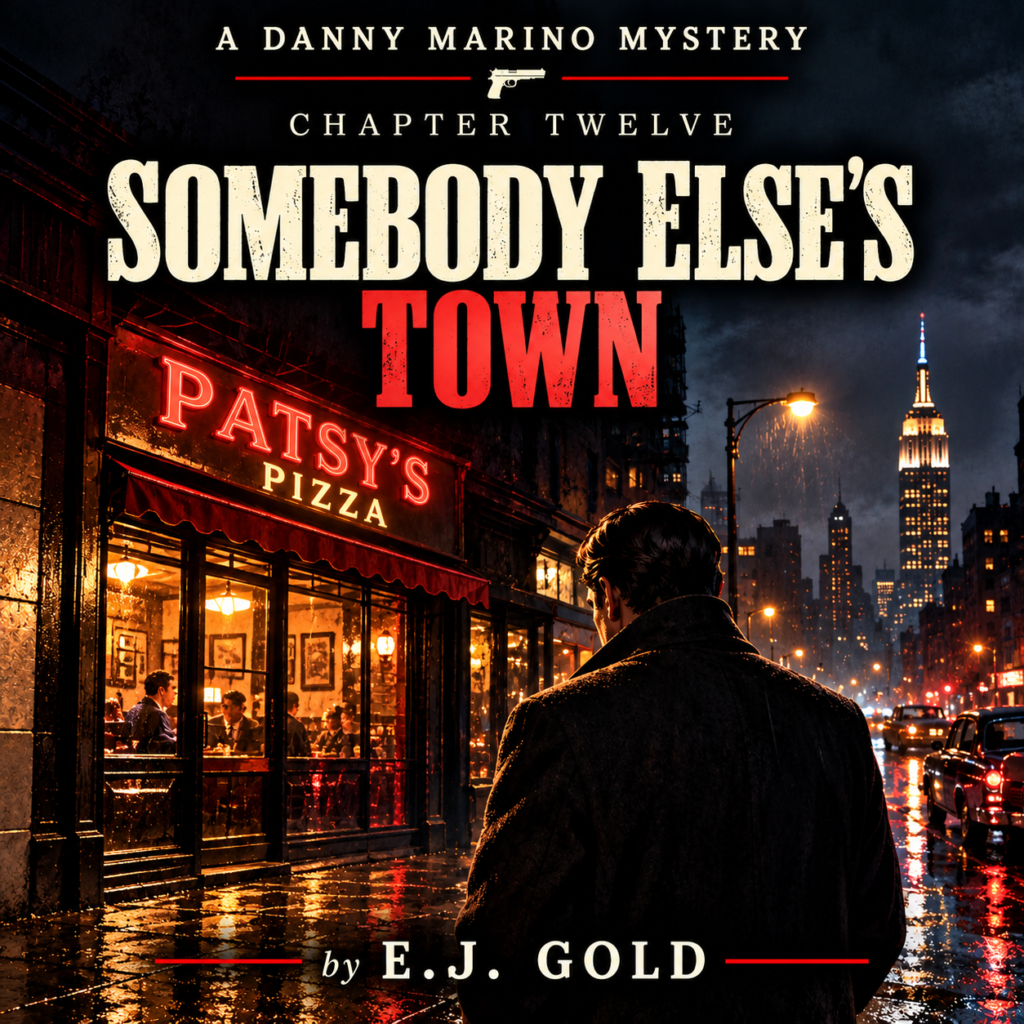
CHAPTER TWELVE
ANOTHER TOWN
The Pontiac sedan was parked under a dead streetlight on Second Avenue.
Rain had polished the pavement black. Storefront signs floated upside down in the gutters, broken into pieces whenever a cab went by. Somewhere down the block a delivery truck was unloading newspapers. The bundles hit the sidewalk one after another with a heavy slap.
New York was getting ready for another day.
Danny Marino sat in the Pontiac and watched it happen.
At four in the morning the city belonged to bakers, cops, truck drivers, drunks, milkmen, and people who had reasons not to be seen in daylight.
Danny was beginning to suspect he belonged to the last group.
The man behind the wheel hadn’t spoken since picking him up.
Danny knew him only as Frankie.
Frankie had a neck like a fireplug and wore a camel-hair coat that probably cost more than Danny had made the previous year.
Finally Frankie said, “You like New York?”
Danny looked at him.
“What kind of question is that?”
“A simple one.”
“Yeah. I like New York.”
“Good.”
Frankie started the engine. They drove downtown. The windshield wipers made a tired little squeak every time they crossed the glass.
They passed restaurants with chairs upside down on the tables. A bakery had just opened somewhere nearby; Danny could smell bread through the heater vents.
Frankie said, “You know what I like?”
Danny waited.
“Pizza.”
Danny looked over.
“That’s what this is about?”
“Not entirely.”
“Uh huh, Danny nodded.”
“I like Chinese food too.”
They crossed Houston Street.
Frankie continued as if they had been discussing something important.
“I like the Yankees. I like the Staten Island Ferry. I like walking through Washington Square when nobody’s trying to sell me something.”
“You’re a sentimental guy.”
“Don’t spread it around.”
They stopped in front of a narrow building with no sign.
Frankie killed the engine.
“Point is,” he said, “I like this town.”
“So do eight million other people.”
“Exactly.”
He got out.
Danny followed him downstairs into a basement room where six men were waiting around a scarred wooden table.
Tony Spada was there.
So was Nicky Bellomo.
Nicky was eating a meatball sandwich over an open newspaper.
Sauce ran down his wrist.
Tony looked at him.
“Nicky.”
“What?”
“There’s plates.”
“I got a newspaper.”
“Use a plate, fuhgetaboutit.”
“Why fuhgetaboutit???”
Tony looked at Danny. “See what I deal with?”
Nicky wiped his hand on the newspaper.
Danny remembered Tony’s description.
A gavone. The man ate like a hog at a trough. At the far end of the table sat Charlie from the funeral parlor. Next to Charlie was a man Danny had never seen before. Gray suit. Gray tie. Gray hair. Everything about him was gray except his eyes.
Those were very much awake.
Charlie pointed to an empty chair. “Sit down, Danny.”
Danny sat.
Nobody introduced the gray man.
Tony lit a cigarette.
“There’s been a change.”
“What kind of change?”
“The kind where yesterday’s problem isn’t today’s problem.”
Danny waited. He knew better than to speak.
Charlie said, “New York is off the table.”
For several seconds nobody spoke.
Danny wasn’t sure he’d heard correctly.
“Off the table?”
“The target changed.”
“To where?”
The gray man answered.
“Washington.”
Nicky stopped chewing. Even Nicky understood that one. Danny looked around the table. “Washington, D.C.?”
Tony gave him a look. “No, Washington Heights. Of course Washington, D.C.”
“What happened?”
“Somebody objected.”
“Who?”
Tony smiled without amusement. “Everybody.”
Charlie leaned forward. “The bosses had a meeting.”
Danny looked at him. “All of them?”
“Enough of them.”
“And?”
“And they don’t want New York blown up.”
Danny waited.
Charlie seemed to think that required no further explanation.
“That’s it?”
Tony shook his head.
“You ever eat at Patsy’s?”
“Sure.”
“Good pizza.”
“Very good pizza.”
“Bamonte’s?”
“Yeah.”
“Umberto’s Clam House?”
Danny nodded.
“The Triangle Social Club? Ravenite?”
“I know them.”
Tony spread his hands.
“So what are we talking about here?”
Danny stared at him.
Charlie said, “These are serious men, Danny. They have routines. They have tables. They have places where they can meet and discuss business, where the waiter knows exactly what they’re going to order, before they even sit down.”
“You’re telling me they objected to the destruction of New York because they like hanging out in the restaurants?”
“Yeah, among other things.”
“What other things?”
Tony thought about it. “The Yankees.”
Frankie, standing by the door, said, “Chinese food.”
Nobody looked at him.
Charlie continued.
“Point is, whoever is behind this thing expected the New York people to cooperate. Instead, the bosses sent word back.”
“What word?”
“Pick another town.”
Danny looked from one face to another.
“That’s the message?”
“More or less.”
“Where?”
Tony shrugged.
“Anywhere else.”
“Anywhere?”
“Anywhere that isn’t here.”
Danny sat back.
“So eight million people get to live because somebody doesn’t want to lose his favorite table at Patsy’s.”
Tony looked offended.
“It’s a very good table, in neutral territory.”
Nicky spoke around the remains of his sandwich. “Washington’s got restaurants too.”
Everybody looked at him.
Nicky shrugged. “I’m just saying.”
Charlie folded his hands. “Apparently somebody listened. New York is off the table.”
Danny said, “And Washington is on it.”
“That’s what we’ve been told.”
For a moment nobody spoke.
Danny wasn’t sure whether he’d just witnessed an act of civic responsibility or the most selfish rescue operation in the history of the United States.
Tony lit another cigarette. “Gangsters make trouble. Racketeers make money. You blow up New York, there’s nobody left to pay you off.”
Nobody laughed. It wasn’t funny.
===========================================================================
CHAPTER TWELVE BREAKDOWN
SOMEBODY ELSE’S TOWN
Chapter Twelve changes the direction of the story without changing the danger.
The four attaché cases are still out there. The threat is still real. What changes is the target.
1. START WITH THE CITY
The chapter opens before dawn on Second Avenue.
Rain, newspaper trucks, bakeries, empty restaurants and reflected signs establish New York as a living place before anyone talks about destroying it.
This is deliberate.
If a place is going to matter to the characters, let the reader experience it first.
2. INTRODUCE CHARACTER THROUGH SMALL TALK
Frankie talks about pizza, Chinese food, the Yankees, the Staten Island Ferry and Washington Square.
At first the conversation seems pointless.
It isn’t.
Frankie is telling us why New York matters to him without ever saying, “New York matters to me.”
Whenever possible, let characters reveal themselves indirectly.
3. GIVE THE VILLAINS SOMETHING TO LOSE
The New York bosses don’t want their city destroyed.
Their reasons aren’t particularly heroic.
They like their neighborhoods. They like their clubs. They like their restaurants. They have favorite tables. They don’t want Patsy’s Pizza, the Triangle Social Club, Bamonte’s, the Ravenite or Umberto’s Clam House disappearing in a flash.
The joke is that saving millions of lives comes down partly to preserving good pizza.
Nobody in the room thinks this is funny.
That’s why it works.
4. LET MOTIVE BE IMPERFECT
A character doesn’t need a noble reason for doing the right thing.
The bosses oppose the destruction of New York because New York belongs to them.
Home, business, habit, territory, food and sentiment all become mixed together.
Their selfish motive happens to produce a desirable result.
That makes them more interesting than simple villains.
5. MOVE THE PROBLEM—DON’T SOLVE IT
New York is saved.
The crisis isn’t.
The target becomes Washington, D.C.
This is an important mystery technique: solving one problem should sometimes expose a larger one.
The reader gets relief and immediately discovers that the danger has merely moved somewhere else.
6. ASK WHO HAS THE POWER
The important question isn’t where the threat moved.
It’s:
Who was able to move it?
Someone communicated with the people behind the four cases.
Someone had enough influence to change their plans.
That means the enemy may have connections inside the organization.
Suddenly the men in the room aren’t merely afraid of the threat.
They’re afraid of one another.
7. TURN THE STORY INWARD
Charlie says:
“There’s somebody inside.”
With that line, the story changes.
The mystery is no longer simply about finding four attaché cases.
Now Danny has to discover who among the people around him is connected to whoever controls them.
The danger has entered the room.
8. END WHERE YOU STARTED
Danny returns to the rainy New York street.
The pizza place across Second Avenue is still there.
Nothing appears to have changed.
But Danny—and the reader—now understands how close the city came to disappearing.
The chapter ends:
Some things, apparently, were sacred.
That line refers to New York.
It refers to territory.
It refers to habit.
And, naturally, it refers to pizza.
THE LESSON
A mystery becomes richer when characters act for their own reasons rather than for the needs of the plot.
The wiseguys don’t suddenly become heroes.
They remain exactly who they were.
They simply discover something they aren’t willing to lose.
And sometimes that’s enough to change everything.
===========================================================================
Here’s the Bardo bus now!!!
===========================================================================
See You At The Top!!!
gorby