

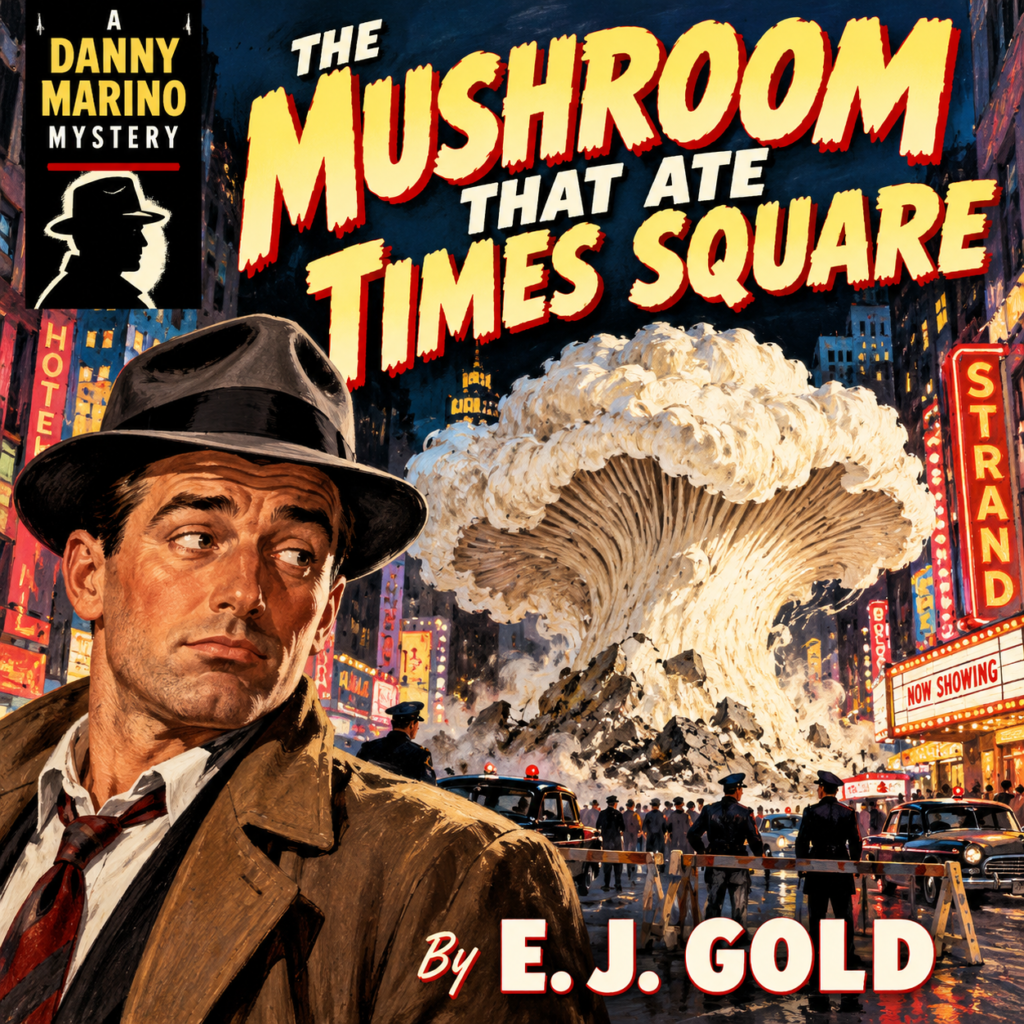
THE MUSHROOM THAT ATE TIMES SQUARE
A Danny Marino Mystery
By E.J. Gold
New York City, 1958
The first mushroom appeared on a Tuesday.
By Thursday, three men were dead, a Broadway theater had been evacuated, and the United States Army was preparing to invade the basement of a delicatessen.
Danny Marino knew none of this when he arrived at the Downtown Athletic & Bridge Club carrying a paper bag containing two piping hot piled high pastrami sandwiches from Katz Deli over on Houston, plus a cardboard container of potato salad, and a pickle wrapped in wax paper.
The pickle was for Nicky Bellomo.
Nicky had been complaining about the pickles lately.
“Too much garlic,” he said.
Danny put the bag on the table.
“Then don’t eat it.”
“I didn’t say I wasn’t gonna eat it. I said there’s too much garlic.”
Tony Spada sat at the head of the table, reading the Daily News.
“Daniel.”
“Yes?”
“You happen to know anything about mushrooms?”
Danny considered the question.
“I know you shouldn’t eat the ones growing in the subway.”
Tony folded the newspaper.
“Somebody’s growing mushrooms under Forty-second Street.”
“People grow mushrooms all over.”
“Not these mushrooms.”
“What’s special about them?”
Tony turned the newspaper around.
The headline read:
MYSTERY FUNGUS THREATENS TIMES SQUARE
Underneath was a photograph of a large white object protruding from a sidewalk grating.
It resembled a cauliflower that had been raised by wolves.
“That’s a mushroom?” Danny asked.
“That’s what they’re saying.”
“Looks like a cauliflower that’s been raised by wolves.”
“That’s exactly what Nicky said.”
Nicky nodded. “I know cauliflower when I see it.”
Tony tapped the newspaper.
“The city wants to close three blocks. The cops are talking about evacuating the theaters. And somebody is telling everybody it’s radioactive.”
Danny looked at the photograph.
“Is it?”
“That’s what I want you to find out.”
“Why me?”
Tony gave him a patient look.
“Because if I send Frankie, somebody gets punched. If I send Nicky, somebody gets eaten. You, on the other hand, can walk into a mob-owned restaurant, and nobody notices, nobody cares.”
Danny took the newspaper.
“Where do I start?”
“At the beginning.”
“Where’s that?”
“Under Forty-second Street.”
Nicky unwrapped his sandwich.
“Bring me back a mushroom.”
The Basement
The mushroom was growing in the basement of the Liberty Star Theater, a former vaudeville house that now showed second-run movies for a nickel, and it featured a very antiquated burlesque performance between films.
The building manager was a thin man named Mr. Kessler, whose principal occupation appeared to be sweating.
“You from the city?” he asked.
“No.”
“Health Department?”
“No.”
“Newspaper?”
“No.”
“Then what could you possibly want?”
Danny showed him a folded ten-dollar bill.
“I want to see the mushroom.”
Kessler looked at the bill.
“Everybody wants to see the mushroom.”
“Everybody got ten dollars?”
Kessler took the money.
“Follow me.”
They descended a narrow staircase into a basement that smelled of damp plaster, old electricity, and something vaguely reminiscent of badly boiled cabbage.
The mushroom occupied most of the far wall.
It was enormous.
Not enormous in the ordinary sense of a large mushroom. Enormous in the sense that a grand piano is enormous when you discover one growing out of your bathroom sink.
The thing was white, with grayish folds, and seemed to emerge directly from the bricks.
It was approximately eight feet across.
Danny stared at it.
“That’s a mushroom?”
“That’s what the professor says.”
“What professor?”
“Professor Murgatroyd.”
“Professor of what?”
“Mushrooms.”
“Where’s he?”
“Upstairs. Talking to the television people.”
Danny approached the object.
It had a peculiar surface, rather like damp felt.
“How fast does it grow?”
Kessler swallowed.
“Yesterday it was six feet.”
“Yesterday?”
“Tuesday it was three.”
Danny looked at the wall.
“What’s behind there?”
“Another basement.”
“Whose?”
“Used to be a restaurant. Closed down years ago.”
“Can we get in?”
“No.”
“Why not?”
“Door’s been bricked up.”
Danny examined the floor.
There was a thin line of white powder along the baseboard.
He rubbed some between his fingers.
“What’s this?”
“Spore dust,” Kessler said.
“Professor tell you that?”
“Yeah.”
Danny smelled his fingers.
“Funny.”
“What?”
“Smells like plaster.”
Professor Murgatroyd
Professor Albert Morrison Murgatroyd wore a white laboratory coat, a black bow tie, and the expression of a man who had been waiting all his life for someone to ask him a question.
“The organism,” he explained, “appears to belong to an entirely new genus.”
“What’s that mean?” Danny asked.
“It means we have never seen anything like it.”
“Ever?”
“Ever.”
“Not even in Queens? What about that creeping garbage fill that’s backing up onto the battery in downtown Manhattan?”
Murgatroyd ignored the question.
“We believe it may be a mutation caused by atmospheric radiation.”
“From the bomb?”
“Possibly.”
“Which bomb?”
“Any bomb.”
Danny nodded thoughtfully.
“How do you know it’s a mushroom?”
The professor blinked.
“What?”
“How do you know?”
“My dear young man, I have studied fungi for thirty years.”
“Sure. But how do you know this one’s a fungus?”
“It has the characteristic appearance.”
“Cauliflower has the characteristic appearance.”
The professor stiffened.
“Are you suggesting this is a cauliflower?”
“No. I’m asking how you know it’s a mushroom.”
Murgatroyd looked at his watch.
“I have an appointment with the press.”
“One more question.”
“What?”
“Has anybody taken a piece of it?”
The professor hesitated.
“We are awaiting the proper equipment.”
“To cut a mushroom?”
“To avoid contamination.”
“Of the mushroom or the knife?”
The professor left without answering.
Danny watched him go.
Then he went downstairs again.
The First Body
The first dead body had been named Eddie Puglisi. He had been found in an alley behind the theater on Wednesday morning. The newspapers said he had suffered a heart attack.
The second dead man, Walter P. Hasnamuss, had fallen down a staircase in a neighboring building.
The third, a night watchman named Mort Greenberg, had been discovered in an empty office above the old restaurant.
Three deaths in two days.
Danny didn’t believe in coincidences that worked overtime. He went to see his friend Charlie at Angelotti & Sons Funeral Home.
Charlie was arranging flowers around a gentleman who had recently stopped complaining about his relatives.
“Danny. What brings you?”
“Three dead guys.”
“That’s usually what brings people here.”
“Eddie Puglisi. Walter P. Hasnamuss. Mort Greenberg,” Danny intoned.
Charlie stopped arranging flowers.
“Who sent you?”
“Nobody.”
“Then you shouldn’t be asking.”
“Why?”
Charlie looked toward the office door.
“Because those three weren’t supposed to be connected.”
Danny waited.
Charlie lowered his voice.
“A building inspector, an electrician and a security guard.”
“All working around Forty-second Street?”
Charlie nodded.
“All three?”
“All three.”
“What killed them?”
“Officially?”
“Unofficially.”
Charlie considered.
“Let’s just say none of them died from eating mushrooms.”
The Man Behind the Wall
That evening Danny returned to the Liberty Star Theater.
He didn’t go through the front door.
Instead, he entered the neighboring building, a former restaurant called the Silver Star, through a service entrance on Forty-first Street.
The lock was new.
The building was supposed to be abandoned.
Inside, the restaurant had been stripped of furniture, but the kitchen remained.
Danny found a staircase leading down.
At the bottom was a steel door.
He listened.
Voices.
“…another twenty-four hours.”
“…can’t hold the city off forever.”
“…then we move the equipment.”
Danny tried the handle.
Locked.
He looked around.
There was a ventilation duct running along the ceiling.
He climbed onto an old refrigerator, removed the duct cover, and looked inside.
The passage was barely large enough for a skinny man.
Danny was a skinny man.
Five minutes later he was lying on his stomach above a brightly lit basement.
Below him stood three men, a large hydraulic machine, and several wooden crates.
One man wore a gray suit.
Another wore overalls.
The third was Professor Murgatroyd.
Danny smiled.
The professor was no longer wearing his laboratory coat.
He was wearing rubber gloves.
The gray-suited man pointed toward the wall.
“How long before the whole thing comes down?”
“Tomorrow night,” Murgatroyd said.
“And the city?”
“They’re evacuating the block.”
“Good.”
“What about the material?”
“Everything goes out in the trucks.”
Danny shifted his weight.
The duct creaked.
All three men looked up.
Danny held his breath.
A rat ran across the far end of the duct.
The man in overalls laughed.
“Rats.”
The gray-suited man said, “Get some traps.”
Danny waited until they left.
Then he climbed down.
The hydraulic machine was a press.
The wooden crates contained bundles of paper.
Danny opened one.
Inside were stacks of twenty-dollar bills.
Very good twenty-dollar bills, possibly too good to be true.
He examined one under the light.
The serial numbers were identical. Somebody was planning to trade these off one at a time, so the counterfeit wasn’t revealed.
Danny folded the bill and tucked it into his lapel pocket.
Then he looked at the wall.
A steel pipe ran through the bricks, directly behind the enormous white mushroom.
He touched the pipe.
Warm.
He examined the press.
Beside it stood several drums labeled INDUSTRIAL CELLULOSE.
On a nearby workbench were sacks of plaster, bags of cotton fiber, and a large container of industrial adhesive.
Danny understood.
The mushroom wasn’t growing.
It was being built.
The Explanation
The next morning Danny reported to Tony Spada.
Tony listened without interruption.
When Danny finished, Tony said, “So it’s fake.”
“Completely.”
“And the professor?”
“Fake too, I think.”
“And the dead guys?”
“Real enough.”
Tony leaned back.
“What’s the point?”
“They’re counterfeiting money. The mushroom scares everybody away. The city closes the block. They get a couple of days without anybody looking around.”
“Why not just work at night?”
“They need to move a lot of equipment. Big trucks. The city evacuation gives them an excuse.”
Tony thought about this.
“That’s pretty clever.”
“Except for one thing.”
“What’s that?”
“The mushroom.”
“What about it?”
“It’s too big.”
Tony frowned.
“Too big for what?”
“Too big to be a mushroom.”
Tony stared at him.
“Daniel, you just told me it wasn’t a mushroom.”
“That’s my point.”
Nicky Bellomo, who had been listening from the next table, raised his hand.
“Can I ask something?”
Tony sighed.
“What?”
“If it’s made out of plaster, can you eat it?”
“No, Nicky.”
“What if you put sauce on it?”
The Night of the Mushroom
By Friday evening, Times Square had become a carnival of panic.
Newspaper photographers crowded the sidewalks.
Police barricades blocked Forty-second Street.
Two Army trucks had arrived from Fort Hamilton in Brooklyn, bringing a dozen soldiers, a lieutenant, and a corporal carrying a Geiger counter.
The lieutenant wanted to know who was in charge.
Nobody seemed to know.
The corporal swept the Geiger counter over a nearby garbage can.
It clicked.
“Radioactive?” somebody asked.
“No,” said the corporal. “Just that somebody failed to pick up today’s garbage.”
A radio announcer described the mushroom as “possibly the greatest biological menace since the discovery of the common cold.”
Professor Murgatroyd appeared on television, warning that the organism might soon develop the ability to reproduce.
Danny watched from across the street.
At eleven o’clock, three trucks arrived.
They carried official-looking signs:
EMERGENCY FUNGAL CONTAINMENT UNIT
The drivers wore protective suits.
The police waved them through.
Danny followed on foot.
He had already telephoned Tony Spada.
Tony had telephoned someone else.
Someone else had telephoned somebody considerably more important.
By midnight, the trucks were being loaded.
Not with mushrooms.
With printing equipment.
Danny stepped into the basement.
“Evening, Professor.”
Murgatroyd turned.
“You!”
“Me.”
“How did you get in?”
“Door was open.”
The gray-suited man reached inside his jacket.
Danny shook his head.
“I wouldn’t.”
“Why not?”
“Because there’s a man behind you.”
The gray-suited man turned.
There was indeed a man behind him.
Frankie.
Frankie hit him with a length of pipe.
The man fell down.
Nicky Bellomo appeared in the doorway.
“Where’s the mushroom?”
Danny pointed.
“Next building.”
Nicky looked disappointed.
“I brought a fork.”
The Great Collapse
At twelve-thirty, the mushroom began to move.
The first indication was a loud cracking sound from the basement wall.
Then the enormous white mass shuddered.
A section of sidewalk rose approximately six inches.
A police officer shouted.
A woman screamed.
Someone yelled, “IT’S ALIVE!”
The mushroom burst through the theater wall.
For one glorious moment, it seemed to be expanding into the street.
Then it collapsed.
Eight tons of plaster, cellulose, adhesive, and assorted theatrical materials poured into Forty-second Street.
A tremendous cloud of white dust enveloped the block.
People ran in every direction.
A newspaper photographer captured the scene.
The photograph appeared on the front page of the Daily News the following morning.
The headline read:
MUSHROOM EXPLODES! TIMES SQUARE SAVED!
The article credited Professor Murgatroyd with having successfully contained the organism.
Unfortunately, Professor Murgatroyd was unavailable for comment.
He was in police custody.
So were the gray-suited man, the man in overalls, and two truck drivers.
The police also recovered nearly four million dollars in counterfeit currency.
Three murders were eventually traced to the operation.
The investigation revealed that Eddie Puglisi, the building inspector, had discovered the secret basement alterations and threatened to report them. Walter P. Hasnamuss, the electrician, had stumbled upon an illegal power connection supplying the printing presses. Mort Greenberg, the night watchman, had interrupted a midnight shipment of counterfeit twenties.
The counterfeiters had evidently decided that murder was cheaper than bribery.
Danny remarked that the whole operation might have been considerably less expensive if they’d simply paid the three men.
Tony Spada disagreed.
“Daniel, some people would rather kill a guy than give him twenty bucks.”
“Even counterfeit twenties?”
Tony considered that.
“Especially counterfeit twenties.”
The city quietly repaired the street. The Liberty Star Theater reopened the following week. Its first attraction was a Japanese monster movie with subtitles in French.
The Last Mushroom
On Monday morning, Danny returned to the Downtown Athletic & Bridge Club.
Tony Spada was reading the newspaper.
“Nice work, Daniel.”
“Thank you, Mr. Spada.”
“City says it was some kind of counterfeit operation.”
“That’s right.”
“Professor wasn’t a professor.”
“No.”
“Mushroom wasn’t a mushroom.”
“No.”
Tony folded the paper.
“Then what was it?”
Danny considered.
“A distraction.”
Tony nodded.
“Good racket.”
“Except for the murders.”
“Except for the murders.”
Nicky Bellomo entered carrying a brown paper bag.
He put it on the table.
“I got mushrooms.”
Tony closed his eyes.
“Nicky.”
“What?”
“Where’d you get them?”
“Market.”
“What kind?”
“Regular.”
Nicky opened the bag.
Inside were six ordinary white mushrooms.
He took one out and examined it.
“You know something?”
“What?” Danny asked.
“I don’t trust them anymore.”
Tony looked at Danny.
“Daniel.”
“Yes, Mr. Spada?”
“Next time somebody tells you there’s a giant mushroom eating Times Square…”
“Yes?”
“Tell them to call the Health Department.”
Danny nodded.
“Sure thing.”
He started toward the door.
Tony called after him.
“Danny!”
Danny turned.
“Yes?” he responded.
“I changed my mind.”
“What?”
“Fahgetaboutit,” he growled, “next time somebody tells you there’s a mushroom eating Times Square, just don’t get involved.”
“Sure thing.”
Danny reached the door.
“… Unless it’s eating Brooklyn.”
Tony looked up.
“Brooklyn?” Danny shrugged.
“Yeah,” said Tony wryly, “If it’s Brooklyn, who the hell cares?”
THE END
===========================================================================
Here’s the Bardo bus now! Yay!
===========================================================================
See You At The Top!!!
gorby