

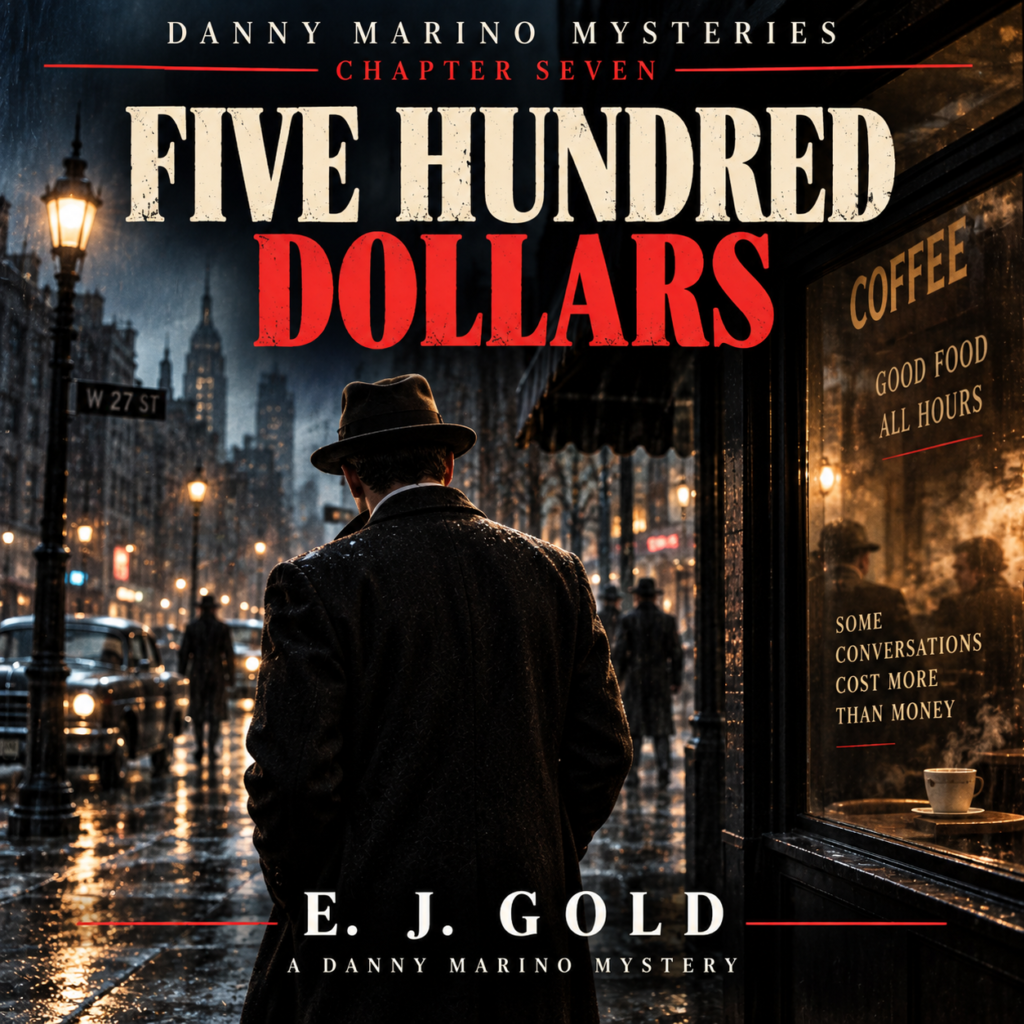
CHAPTER SEVEN
FIVE HUNDRED DOLLARS
Nobody contacted Danny for three days. That bothered him more than if somebody had.
He went about his business, which at the moment consisted mainly of finding inexpensive ways to eat and equally inexpensive ways to stay out of trouble.
On the fourth morning he was sitting in a coffee shop on Second Avenue with a cup of coffee and a newspaper somebody else had paid for.
The dead man wasn’t in it.
Danny checked twice.
A man had been shot in Queens. A woman had fallen from a sixth-floor window in Brooklyn. Somebody had robbed a liquor store in the Bronx.
But nothing about a Buick. Nothing about a body in the street. Nothing about a funeral parlor.
Danny folded the paper.
“Looking for something?”
The waitress was standing beside him with the coffee pot.
“Good news.”
“You picked the wrong paper.”
She filled his cup.
“Anything else?”
“How much is toast?”
“Twenty cents.”
“Too much.”
“Toast?”
“Money.”
She walked away.
A man slid into the booth opposite him.
Danny hadn’t seen him come in.
He was about forty, thin, carefully dressed, with a narrow face and a tie that looked more expensive than the rest of him.
“You Danny?”
“Depends.”
“On what?”
“Who wants Danny?”
The man put a five-dollar bill on the table.
“Eat something.”
Danny looked at the five.
Then at the man.
“That’s not an answer.”
“No.”
“Who are you?”
“Sal.”
“Sal what?”
“Just Sal.”
Danny nodded toward the five-dollar bill.
“What’s that?”
“Breakfast.”
“I already had breakfast.”
“You’re drinking coffee.”
“That’s breakfast.”
“Eat.”
The waitress came back.
Sal said, “Two eggs, bacon, toast.”
“How you want the eggs?”
He looked at Danny.
Danny said, “They’re his eggs.”
“They’re your eggs.”
“Then make them over easy.”
The waitress wrote it down.
“Potatoes?”
Danny looked at Sal.
Sal nodded.
“Apparently.”
When she left, Sal took an envelope from inside his jacket and placed it on the table.
Danny didn’t touch it.
“What’s that?”
“Five hundred dollars.”
Danny looked at him.
“I lost five hundred dollars.”
“I know.”
“Then why give me another five hundred?”
Sal smiled.
“Charlie likes you.”
“That’s unfortunate.”
Sal’s smile disappeared.
Danny filed that away.
“What’s the five hundred dollars for?”
“Expenses.”
“What expenses?”
“Whatever.”
Danny picked up his coffee.
“I don’t understand.”
“You don’t have to.”
“That seems to be happening a lot lately.”
Sal pushed the envelope closer.
Danny left it where it was.
Sal said, “Take it.”
Danny looked at him.
“No.”
Sal’s expression didn’t change, but something behind it did.
“No?”
“I lost Charlie’s five hundred dollars. Now you’re giving me five hundred dollars. That’s not business. That’s a magic trick.”
Sal leaned back.
“You don’t want the money?”
“I want to know what I’m being paid for.”
“You’re not being paid.”
“Then I definitely want to know why you’re giving it to me.”
The eggs arrived.
The waitress put the plate in front of Danny.
“Anything else?”
Danny looked at Sal.
Sal said, “We’re good.”
When she was gone, Sal said, “Eat your eggs.”
Danny picked up his fork.
He cut into one of them.
Sal watched him.
Finally he said, “Charlie wants you to do something.”
Danny kept eating.
“That sounds more like it.”
“There’s a place on West Twenty-Seventh. Garment shop. Third floor. Guy named Rosen.”
“What about him?”
“You go see him.”
“And?”
“Tell him Charlie says Tuesday.”
Danny waited.
Sal waited.
“That’s it?”
“That’s it.”
“What does Tuesday mean?”
“Tuesday means Tuesday.”
Danny put down his fork.
“Suppose Rosen asks me what Tuesday means?”
“He won’t.”
“Suppose he does.”
“Then you tell him Tuesday.”
Danny picked up the envelope.
He weighed it in his hand.
“Five hundred dollars to say Tuesday.”
“No.”
Danny looked at him.
Sal pointed at the envelope.
“That’s your five hundred dollars.”
Danny stopped.
“The same five hundred?”
“The same five hundred.”
Danny opened the envelope.
Five hundred dollars.
He couldn’t tell whether they were the same bills. Of course he couldn’t.
“Why give it to me?”
Sal stood.
“Because Charlie wasn’t selling anything.”
Danny looked up at him.
“What was he doing?”
Sal buttoned his jacket.
“Finding out what you were buying.”
Danny didn’t move.
Sal dropped a dime beside the plate for the waitress.
Then he leaned down slightly.
“Don’t be late.”
Danny answered before he could stop himself.
“Believe me, I won’t. An okay guy is never late.”
Sal’s eyes changed.
Only for a second.
But Danny saw it.
“Who told you that?”
Danny took another bite of egg.
“My grandfather. He was a dress manufacturer in the garment district.”
Sal stood there a moment longer.
Then he walked out.
Danny watched him through the window until he disappeared into the morning crowd.
He looked down at the envelope.
So that was what five hundred dollars had bought.
Not a favor.
Not protection.
Not an introduction.
An audition.
And apparently he had passed.
Danny finished his eggs.
Then he checked the clock.
West Twenty-Seventh Street was forty minutes away.
He gave himself thirty-five.
===========================================================================
HOW CHAPTER SEVEN WORKS
Chapter Seven doesn’t need a lot of action because it is dealing with the consequences of the action in Chapter Six. Danny has seen a man killed, but instead of immediately explaining what happened, we make him wait three days. Waiting creates pressure.
The coffee shop deliberately brings everything back to normal: coffee, newspaper, waitress, eggs, toast. Against that ordinary background, the missing newspaper story becomes important. A man is dead, but apparently the world hasn’t noticed.
Then Sal arrives. The conversation is built around withholding information. Danny wants answers; Sal gives him just enough to keep him moving. Even the simple word “Tuesday” becomes mysterious because nobody will explain it.
The five hundred dollars provides the chapter’s payoff. Danny thought he had lost the money. Instead, he discovers that the original transaction was a test. He wasn’t buying anything from Charlie. Charlie was finding out what Danny was buying.
We also slip in character information without stopping the story. Danny’s remark that an “okay guy is never late” suggests he knows something about this world. His explanation—that his grandfather was a garment manufacturer—makes that knowledge plausible without explaining too much.
Finally, the last two lines turn character into action:
West Twenty-Seventh Street was forty minutes away.
He gave himself thirty-five.
We don’t have to say Danny is punctual. We show him being punctual.
That’s one of the central tricks in mystery writing: give the reader information without explaining what the information means.
===========================================================================
See You At The Top!!!
gorby