

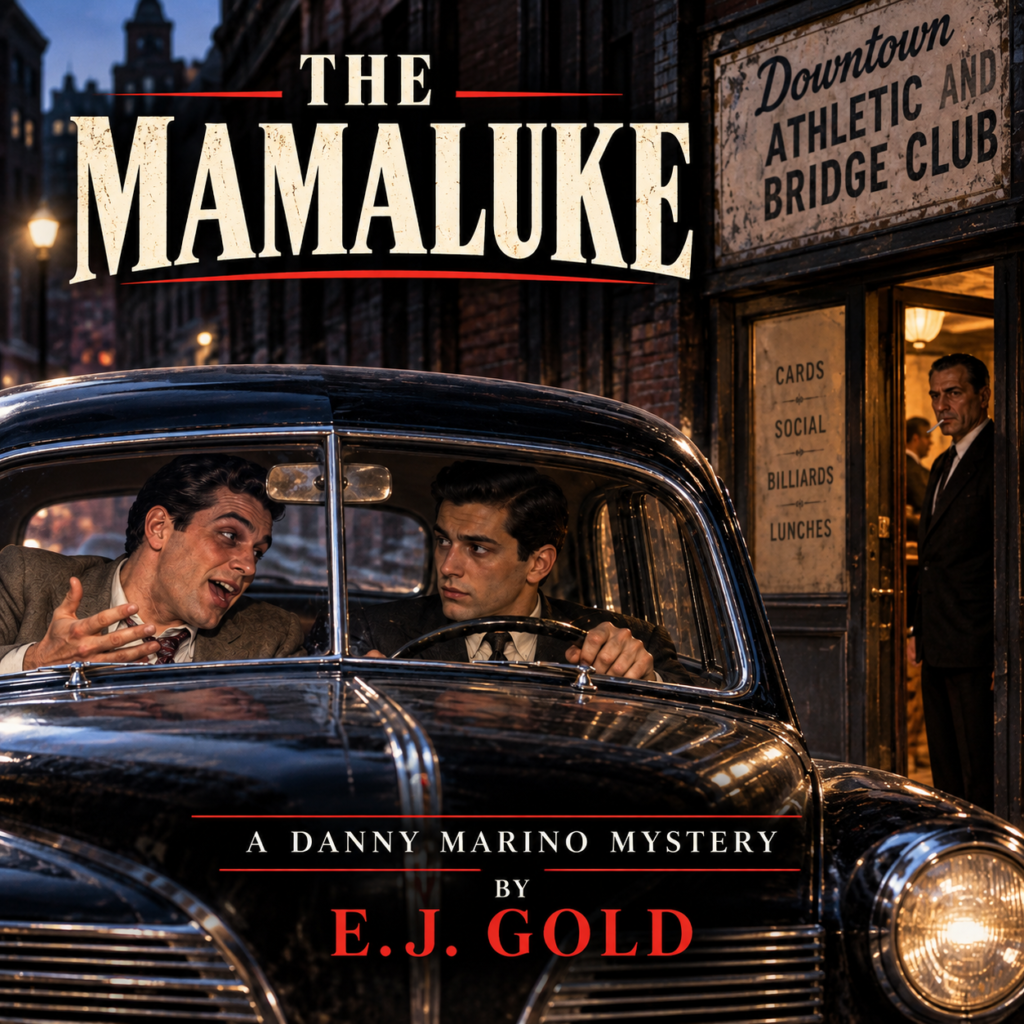
THE MAMALUKE
The five hundred dollars changed Danny’s financial condition from desperate to temporarily mysterious.
He paid what he owed at the rooming house, bought two shirts, had his shoes repaired, and put the rest in his pocket.
Then he waited. Nobody called. By the third day Danny was beginning to understand that waiting might be part of the job.
At four that afternoon he went into the place on Second Avenue where Tony Spada had told him to show up if he had nothing better to do. Sure enough, Danny had nothing better to do.
“Downtown Athletic and Bridge Club” said the very faded sign. It was the dead hour between lunch and dinner, and the place belonged to nobody in particular.
Three men were playing cards at a table near the kitchen. They weren’t playing for much, but they were playing seriously. A delivery driver sat at the bar with a cup of coffee and the afternoon paper folded beside him. Somewhere in the kitchen a knife hit a cutting board in a slow, regular rhythm.
Danny was given a chair near the end of the bar and enough information to understand that he was supposed to stay in it.
Tony was in the back room with two men to whom Danny hadn’t yet been introduced. Every few minutes Danny could hear a few words, then silence, then Tony’s voice again.
Nobody in the front seemed interested in what was being said back there. Danny was learning that this was a place where not being interested was a skill. The bartender was polishing glasses. He had been polishing the same six glasses for twenty minutes.
Then the door opened.
A young man came in wearing a suit that had apparently been purchased for somebody else. The sleeves were too short, the shoulders were too wide, and the trousers had reached an independent agreement with his shoes.
He stopped just inside the door and looked around.
“Tony here?”
Nobody answered.
The young man took this as encouragement.
“I gotta see Tony. Tell him Nicky’s here.”
Still nobody answered.
Danny looked up from his coffee.
The remarkable thing wasn’t that the kid didn’t know what he was doing. Danny didn’t know what he was doing either.
The difference was that Danny was trying not to advertise it.
Nicky walked to the counter, helped himself to an olive from somebody else’s plate, and put the whole thing in his mouth.
“Tony around?”
The bartender stared at him.
Nicky chewed the olive, found the pit, and looked around for someplace to put it. Apparently rejecting several possibilities on aesthetic grounds, he dropped it into an ashtray.
The bartender looked at the olive pit.
Then at Nicky.
“Who sent you?”
“Nobody sent me. I came by myself.”
From the back room Tony said, “Who is it?”
The bartender didn’t take his eyes off Nicky.
“Nicky.”
There was a pause.
“Nicky who?”
Nicky brightened.
“Tell him Nicky Bellomo.”
The bartender called toward the back.
“Nicky Bellomo.”
Another pause.
Tony appeared in the doorway.
He looked at Nicky, the suit, the olive pit in the ashtray, and finally the bartender.
“Who sent him?”
“Nobody sent him. He came by himself.”
Tony closed his eyes.
“Jesus Christ.”
Nicky smiled.
Tony opened his eyes again.
“We got a mamaluke.”
Danny took another sip of coffee.
He didn’t know exactly what a mamaluke was, but one thing he knew — he didn’t want to be one.
Tony crooked a finger at Danny. “You. Come here.”
Danny put down his coffee and followed him into the back room. The two men who had been with Tony were already gone. Danny hadn’t seen them leave.
Tony picked up a folded piece of paper from the desk.
“You drive?”
“Yes.”
“You got a license?”
“Yes.”
Tony handed him the paper.
There was an address written on it in pencil.
“Go there.”
Danny waited.
Tony looked at him.
“What?”
“Nothing.”
“Good.”
Tony reached into his pocket and tossed him a set of car keys.
“39 Pontiac sedan, across the street.”
Danny looked at the keys.
“What do I do when I get there?”
Tony stared at him long enough for Danny to regret the question.
“Somebody will tell you.”
Danny nodded and put the keys in his pocket.
As he turned toward the door Tony said, “Danny.”
He stopped.
“You don’t know me.”
Danny looked back at him.
“I barely know anybody.”
Tony considered this.
“That’s probably why I like you.”
Outside, the late afternoon traffic was beginning to thicken.
The Pontiac was a dark four-door sedan parked across the street, big enough to carry a family of six or three men who didn’t want anybody asking where they were going.
Danny got behind the wheel.
The interior smelled faintly of cigarettes and something sweet he couldn’t identify.
He put the key in the ignition.
The passenger door opened.
Nicky Bellomo got in.
Danny stared at him.
Nicky smiled.
“Tony says I’m going with you.”
Danny looked across the street.
Tony was standing in the doorway.
He shook his head once.
Very slowly.
Danny understood.
Nicky had not been sent.
Danny started the car.
“Where we going?” Nicky asked.
Danny pulled away from the curb.
“Someplace where somebody will tell us.”
Nicky nodded as though this made perfect sense.
They went three blocks before Nicky began talking.
Danny decided it was going to be a long and dangerous afternoon.
===========================================================================
CHAPTER EIGHT BREAKDOWN — THE MAMALUKE
Chapter Eight moves Danny one more step into Tony Spada’s world, but almost nothing is explained to him directly.
The $500 has temporarily solved Danny’s immediate problem. He pays his room rent, buys two shirts, gets his shoes repaired, and then he waits.
The waiting itself becomes part of his education. Nobody tells him when he is working or exactly what his job is. He is learning that availability, patience and silence are part of the employment.
THE SETTING
The faded sign reading “Downtown Athletic and Bridge Club” gives Tony’s headquarters a respectable and deliberately uninteresting identity.
Inside, very little appears to be happening: men play cards, a delivery driver reads the paper, a bartender endlessly polishes glasses and a knife works steadily in the kitchen. But business is being conducted in the back room. The important lesson is contained in one line:
Danny was learning that this was a place where not being interested was a skill.
He is beginning to understand the culture without anyone teaching it to him.
ENTER THE MAMALUKE
Nicky Bellomo provides a demonstration of the opposite approach.
Nicky announces himself, asks questions, touches somebody else’s food, puts an olive pit in an ashtray and generally behaves as though belonging somewhere can be accomplished by acting as though you belong there.
Danny recognizes something important immediately. Neither of them knows exactly what he is doing.
The difference is that Danny is trying not to advertise it.
Tony’s verdict gives the chapter its title:
“We got a mamaluke.”
Danny doesn’t know what the word means, but he has seen enough to know that he doesn’t want to become one.
DANNY GETS AN ASSIGNMENT
Tony gives Danny an address, a set of keys and a ’39 Pontiac sedan.
Danny naturally asks what he is supposed to do when he arrives.
“Somebody will tell you.”
That is nearly the entire job description.
Tony then tells Danny:
“You don’t know me.”
Danny’s answer—“I barely know anybody”—is funny, but it also reinforces something Tony likes about him. Danny has few visible connections, asks relatively few questions and does not pretend to know more than he does.
THE PONTIAC
The old Pontiac is important because it puts Danny physically in motion for the first time under Tony’s direction. He is no longer simply sitting, watching and waiting. He has been trusted with a car, an address and an unspecified task. It is a small promotion, although nobody calls it one.
THE PROBLEM
Then Nicky gets into the passenger seat and claims Tony sent him. Tony, standing across the street, gives Danny one slow shake of the head. That tiny gesture is another lesson. Tony does not come over. He does not remove Nicky. He does not explain anything.
Danny has to deal with it.
And now we have a useful dramatic mechanism for what comes next. Nicky talks too much, misunderstands boundaries and wants badly to demonstrate that he belongs. Danny is still inexperienced himself, but he watches, listens and learns.
Nicky is not merely comic relief.
A mamaluke trying to be helpful can be dangerous.
By the time Nicky begins talking three blocks later, Danny already understands that what should have been a simple errand has changed.
It was going to be a long and thoroughly dangerous afternoon.
===========================================================================
An Art Note:
For serious art, a gallery itself isn’t necessarily what you’re selling. You’re selling access, judgment, provenance, confidence and the opportunity to see something the client couldn’t ordinarily find. So instead of waiting for 5,000 pedestrians to walk past the window, you arrange lunch with the one person who might actually buy the Renoir.
And Schrafft’s is perfect in spirit, although the classic New York Schrafft’s chain disappeared decades ago. Schrafft’s The contemporary version could be a good Midtown hotel restaurant, club, or quiet old-school place where nobody minds a portfolio appearing after dessert.
The gallery becomes portable: excellent photographs on a tablet, documentation, perhaps two or three works brought to a private viewing when appropriate. No storefront. No employees standing around. No rent meter running while Afraz and 40,000 other people walk straight past. 😄
And there’s something wonderfully old-fashioned about the business model:
“I have something I think you should see.”
That’s a much stronger opening for serious art than “Please come visit my gallery.”
===========================================================================
Here’s the Bardo bus now!!!
===========================================================================
See You At The Top!!!
gorby