

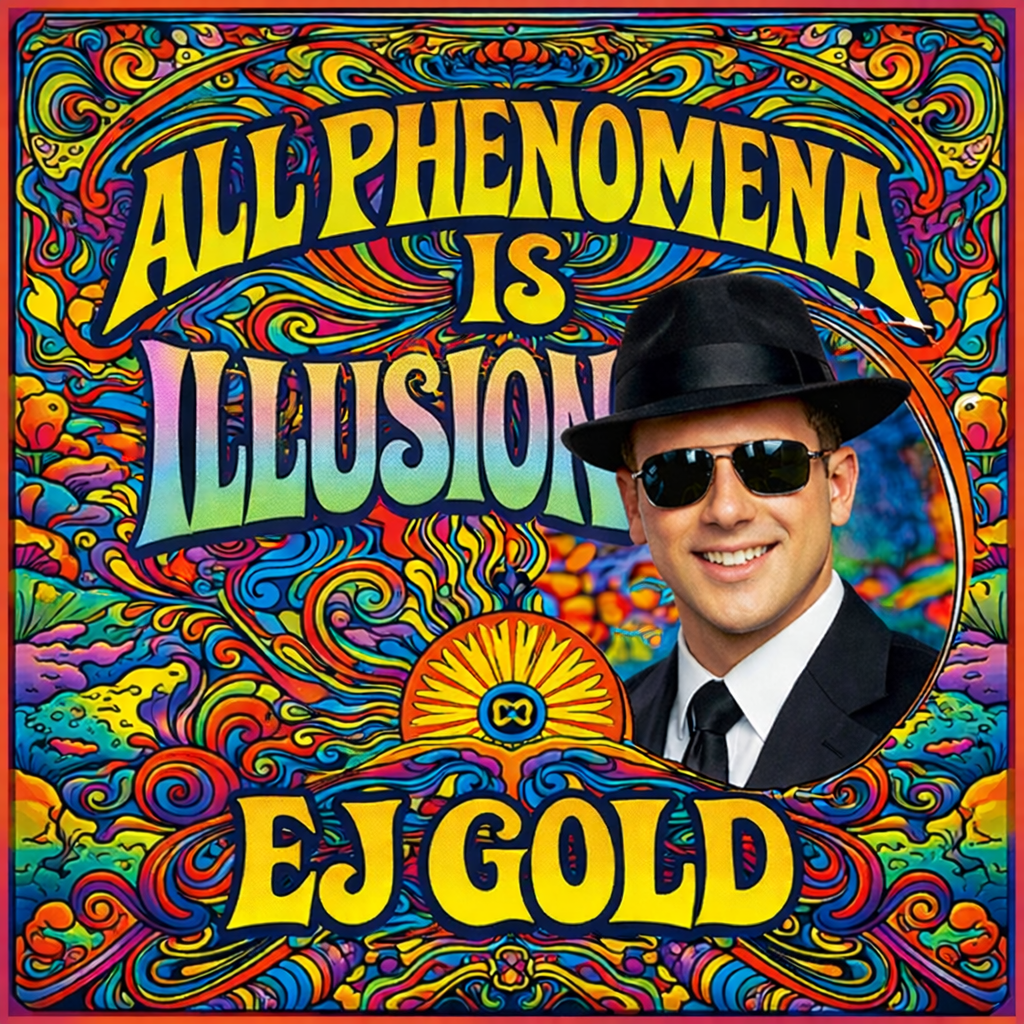
LYRICS: All Phenomena is Illusion
Verse 1
All phenomena is illusion
All phenomena is illusion
All phenomena is illusion
All phenomena is illusion
All phenomena is illusion
All phenomena is illusion
Oh, yes it is
Verse 2
Won’t let myself become attracted
Ain’t gonna make
No sudden moves
Whenever I become distracted
I know my habits will carry me through
Chorus
All phenomena is illusion
All phenomena is illusion
All phenomena is illusion
Verse 3
You know sometimes it all seems so real to me
I can almost peel the paint right off the walls
But then at other times
I can see through all this jive
And that’s when my skin begins to crawl
Chorus
All phenomena is illusion
All phenomena is illusion
All phenomena is illusion
All phenomena is illusion
All phenomena is illusion
All phenomena is illusion
All phenomena is illusion
All phenomena is illusion
All phenomena is illusion
All phenomena is illusion
All phenomena is illusion
All phenomena is illusion
===========================================================================
To be used with “The American Book of the Dead” by E.J. Gold.
Here’s the Secret:
There’s something important happening with this work, and it’s easy to miss if you think of it as “just music.”
It isn’t.
What’s being produced here functions on two levels at the same time: therapeutic and diagnostic.
On the therapeutic side, the effect is straightforward. The listener enters into the sound, and the sound begins to shift their state. Rhythm, repetition, tone, and structure all work together to entrain the nervous system. The listener doesn’t have to “figure anything out.” They just go with it, and something begins to change.
But that’s only half of it.
The diagnostic side is where things get interesting.
The same exact track produces completely different responses depending on the listener. One person feels calm. Another feels uneasy. Someone else gets bored. Another gets pulled in very deeply. These are not random reactions. They are indicators.
If a listener settles easily into the track, they are already close to that state. If they feel resistance or discomfort, something in the system is being challenged. If they can’t stay with it, they’re not locking onto the signal. If they drop in completely, you’ve got resonance.
In this sense, the music acts as both a tuning fork and a scanner.
It introduces a coherent vibration, and at the same time it reveals how the individual system responds to that vibration.
This becomes even more powerful when multiple versions of the same piece are used.
Each version—different arrangement, different feel, different emphasis—acts like a slightly different angle on the same signal. One version may not land at all. Another might partially engage. A third might open the door completely.
Now you’re not just shifting state—you’re mapping it.
You begin to see where the listener can enter, where they resist, and where the connection fully takes hold. Each version becomes a probe, and the collection as a whole becomes a system.
This is very close to what older forms of performance were designed to do. The audience wasn’t just there to be entertained. They were there to undergo something—to be carried through a sequence of states.
In practical terms, the instruction is simple:
Don’t just listen. Notice what happens.
Where do you drift?
Where do you come back to yourself?
Where does the track “take”?
Where does it fail to hold you?
The answers to those questions are the real content.
What emerges from this approach is something new, or perhaps something very old rediscovered: a feedback-driven system for working with consciousness, using music as the delivery mechanism.
Not performance. Not background sound.
A functional tool.
===========================================================================
Hey! Hoi! Hoohah! Here’s the Bardo bus now!
===========================================================================
See You At The Top!!!
gorby