

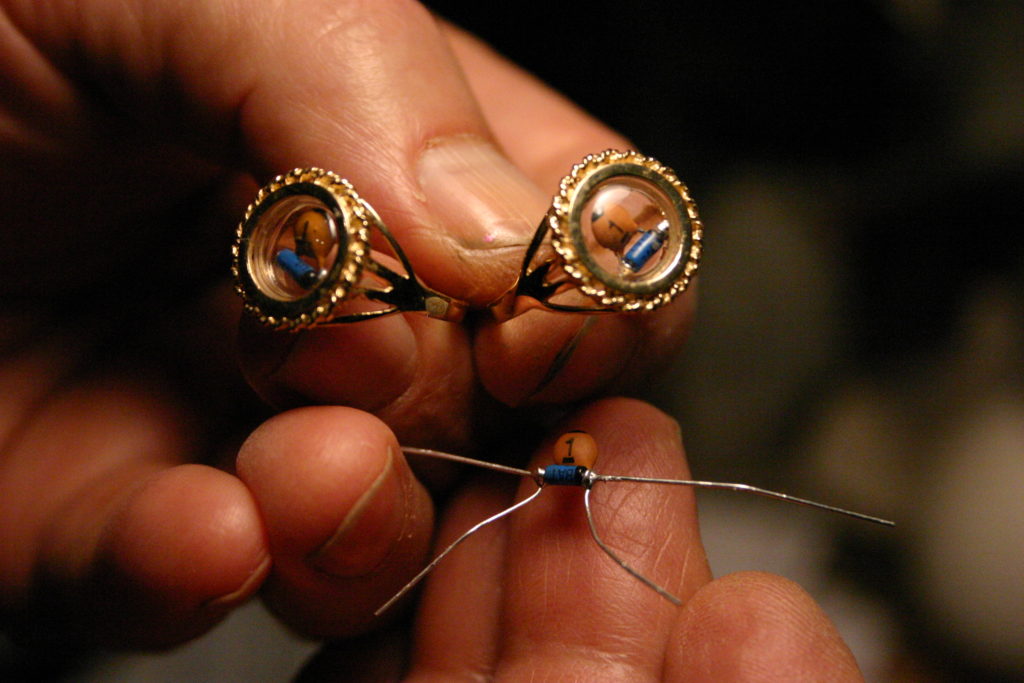
My mother was a master silversmith, a student of Art Smith, one of the most famous modernist silversmiths on the planet — his work — and her work — appears in several books on modernist jewelry of the twentieth century.
She told me, very simply, that the secret of silver is to polish it until it looks liquid.
At the time, I thought I understood what she meant. You polish, and then you polish some more, and eventually the pockmarks go away, and it shines with its own light. But it took me years—decades, really—to understand and apply to my jewelry the secret to which she was actually pointing.
My father suggested a similar idea to me, something often attributed to Michelangelo: “Only work can eliminate the traces of work”.
Boy, is that ever true. Those two thoughts, coming from very different worlds, are really saying the same thing.
Most people think they know when something is finished. The piece looks good. It works. It passes inspection. So they stop. And there’s nothing wrong with that, if the goal is simply to complete a task or sell some fashioned metallic object.
But there is another level—a quieter one—that not everyone sees.
In silver, you can polish a surface until it is bright. That’s one kind of “done.” But if you keep going, carefully, patiently, removing each trace, each slight dent left by the last pass, something begins to change. The light stops scattering. The surface deepens. At a certain point, it no longer looks like metal at all.
It looks like liquid.
What’s happened is not that you added something—but that you removed everything that didn’t belong. Every scratch, every tiny mark of effort, every trace of the process itself.
The same is true in marble. If you look at some unfinished works, you can still see the chisel marks, the struggle between tool and stone. In a finished piece, those marks are gone. Not because the sculptor did less work—but because they did more. Enough more to erase the evidence of work.
That’s the paradox. It takes work to remove the traces of work.
And this doesn’t apply only to silver or stone. It applies to almost anything worth doing. Writing, for example. A first draft gets the ideas down. A second makes them clearer. But real finishing—the kind most people never quite reach—is when the words stop calling attention to themselves. When the reader no longer notices the sentences, only the deeper meaning.
Or in music, where technique disappears and only expression remains.
Or in the way a person lives their life—where effort, discipline, and practice eventually give rise to something that looks natural, even effortless, but requires work to achieve.
Most people stop at “good enough.” And again, that’s understandable. The final stretch is slow. It requires patience. And perhaps most importantly, it requires the ability to see what is still unfinished when others would say it’s done.
But that last stage, when it’s 99% done, is where something special happens.
That is where the work disappears.
And when the work disappears, what remains has a kind of inevitability. It feels complete, not because someone declared it finished, but because there is nothing left to remove.
When I studied sculpture with Russell Cangialosi and later with Lorenzo Fenci, there was only one rule — simplify the form.
At first I didn’t understand what that actually meant. It didn’t mean to abstract the form, it meant to take out all the little lumpies and tool marks. All of them.
What that actually meant was to bring the valleys and the little mounds into a continuous flow, taking out the pock marks and dips and blobs, which I eventually learned to do — I learned how to take out the little lumps and dips that inevitably appear in a sculpture, whether of wood, plaster, marble, bronze or clay, all of which I eventually learned to handle.
My mother didn’t explain any of this to me. She didn’t need to. She just said: “Polish it until it looks liquid”, and that was enough.
===========================================================================
Hola, here’s the Bardo bus! Hurry, get a seat!
===========================================================================
See You At The Top!!!
gorby