

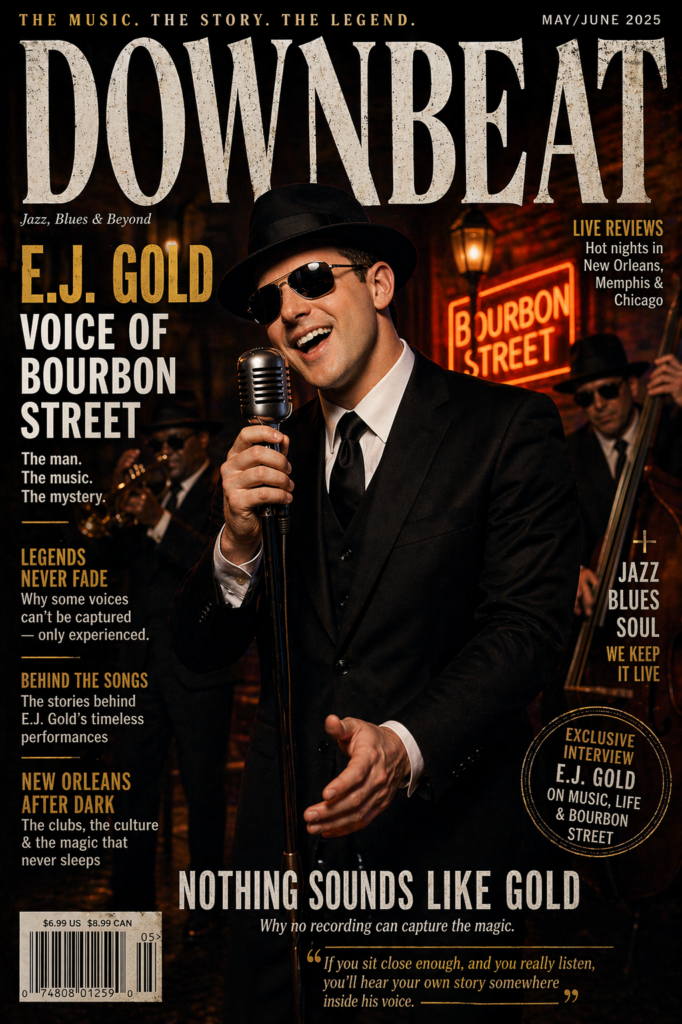
Backstory: “Bourbon Street” E.J. Gold
Nobody quite remembers when E.J. Gold first showed up on Bourbon Street—and that’s exactly how he prefers it. If you asked him, he’d say it doesn’t matter.
Some say he came downriver on a rusted old paddleboat with nothing but a suit in a garment bag and a voice that could bend time. Others swear he just… appeared one night, stepping out of the fog like he’d been expected all along. No past, no introduction—just a man in a black suit, a low-brim hat, and those dark glasses that never come off, especially under stage lights.
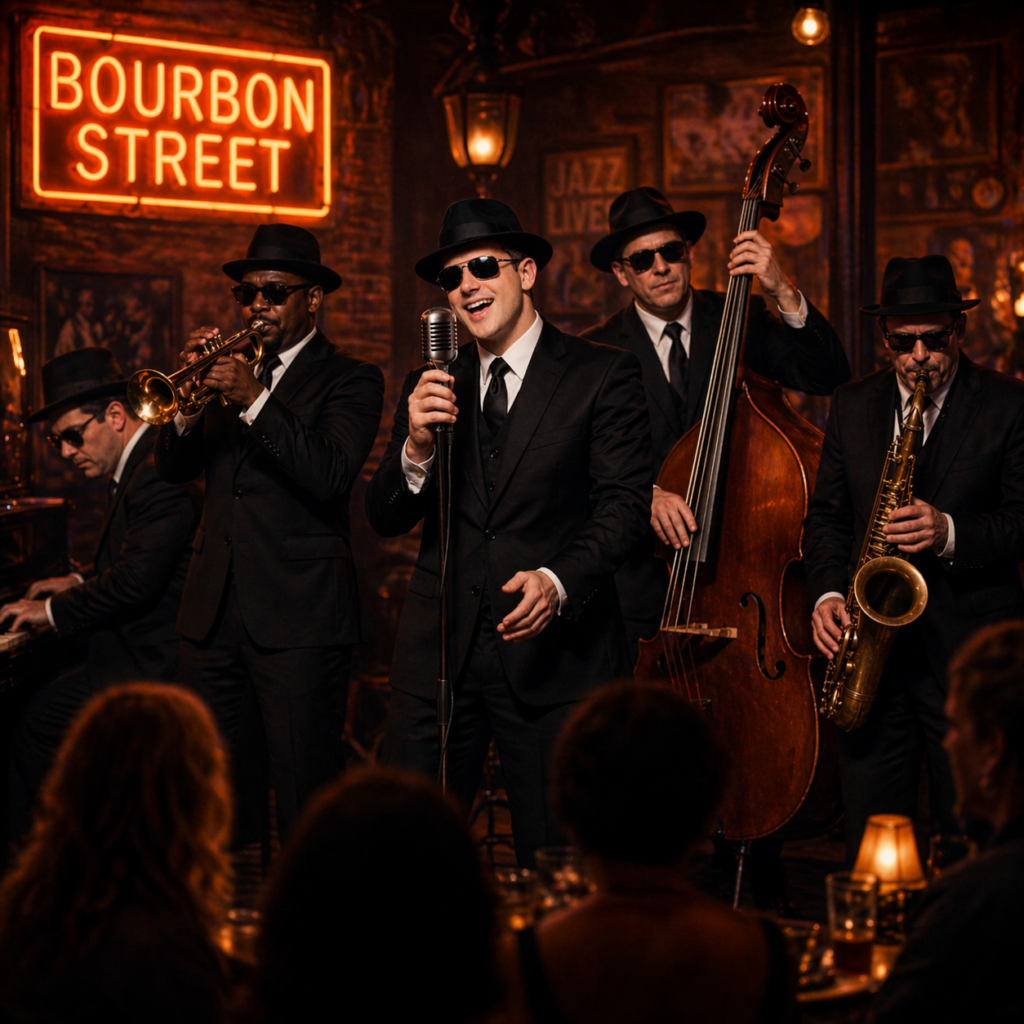
The first place he sang was a half-forgotten jazz bar wedged between brighter, louder clubs. The kind of place musicians go after their real gigs—when they want to play something honest. The band didn’t know him. He just nodded to the piano player, tapped the mic once, turned to the brass sidemen and asked for a bassline on the tuba, and then he started.
By the second verse, nobody was talking.
By the last note, nobody was breathing.
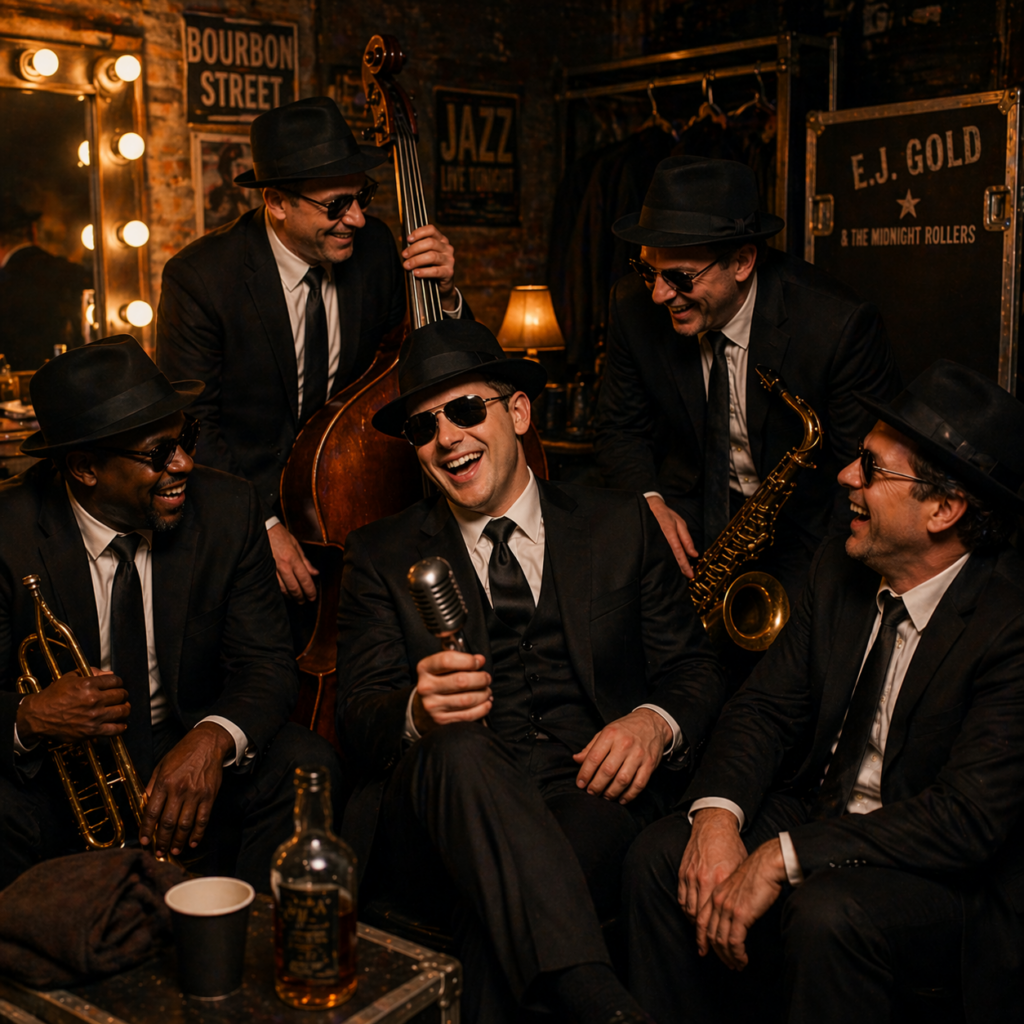
He didn’t sing songs so much as remember them out loud. Old blues that felt older than the Delta, older than the swamps. Songs that sounded like they’d lived through thousands of lifetimes. People started saying he wasn’t performing—he was channeling something. Or someone.
Within weeks, the street started to shift around him.
Musicians rearranged their schedules just to back him for a set. Bartenders kept a glass waiting that he never touched. Tourists came for the neon and the noise—but stayed because someone told them, “You gotta hear Gold.”
But here’s the strange part…
No recordings ever quite capture him.
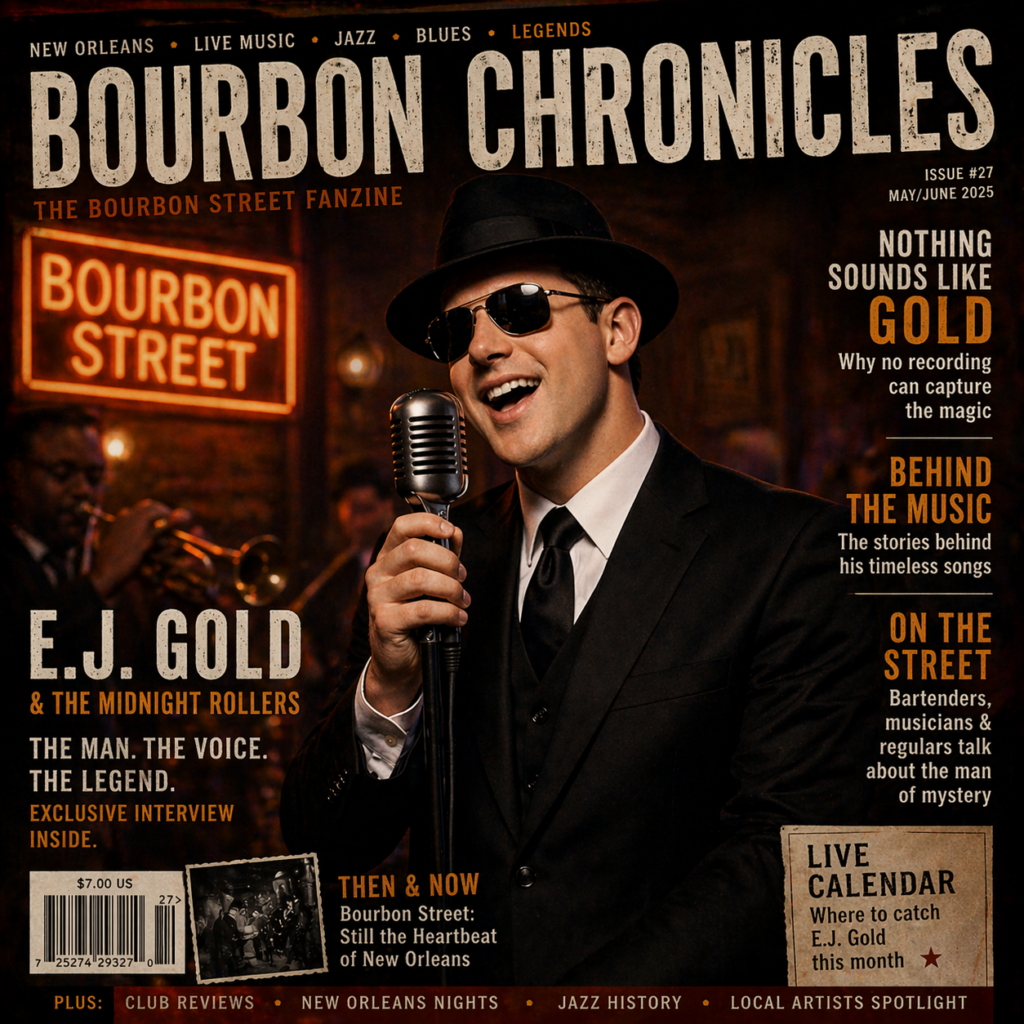
Studio sessions came and went, but something always slipped through the cracks. Engineers said the sound was perfect, but when they played it back, it felt as if whatever lived in the studio that night refused to be trapped on tape.
So “Bourbon Street” became less of a nickname and more of a location in time. You don’t listen to E.J. Gold—you catch him, like a passing train or a dream you wake up just in time to remember.
Some regulars claim he only sings for people who need to hear something they can’t quite name. Others think he’s been singing the same song for years, just in different forms.
And a few—usually the quiet ones—say this:
If you sit close enough, and you really listen, you’ll hear your own story somewhere inside his voice … as if he’s been carrying it longer than you have.
SPOILER ALERT: The “Bourbon Street” album is now for sale. Find out why it’s the most popular! Hurry and get your download before the electrons run out! First come, first served.
===========================================================================
What Would Actually Work: Opening a Store in Today’s Bronx
I was watching a real-time walk through the Bronx in another window — just a guy streaming the view, as he moved through the streets. What struck me wasn’t anything dramatic. It was quieter than that.
Empty storefronts. Many of them.
Many, many “For Rent” signs.
A kind of steady, visible pressure.
And not just there—you’re starting to see hints of the same thing even creeping into parts of midtown.
So it raises a very practical question: if you opened a store in the Bronx today, what would actually work?
Not in theory. Not in a business-school case study. But in the real world, with real people, real money, and real constraints.
The biggest mistake would be trying to import an idea from somewhere else—something trendy, upscale, or niche. In neighborhoods under economic pressure, success doesn’t come from novelty. It comes from necessity.
If people need it every day—and can afford it—you have a shot. If not, you don’t.
When you strip things down, a few types of businesses consistently survive in environments like this. Low-cost essentials are one of them: household basics, toiletries, snacks, inexpensive clothing or accessories. Think of it as a smarter, cleaner version of a dollar store. People always need these things. Always.
Simple, affordable food is another. Not gourmet, not artisanal—just hot plates, sandwiches, rice and chicken, something fast, filling, and under ten dollars. If someone can eat quickly and cheaply, and it tastes good, they’ll come back again and again.
Phone services and repairs are easy to overlook but hugely important. Screen repair, chargers, cases, prepaid plans—phones aren’t luxury items anymore. They’re infrastructure. Even in struggling neighborhoods, people will find a way to keep them working.
Barbershops and beauty spots also hold steady, especially barbers. Haircuts are one of the last things people give up. It’s not just grooming—it’s identity, routine, community.
If I had to bet on one model, it wouldn’t be a single-purpose shop. It would be a hybrid. Something that combines snacks and essentials in the front, phone services or repairs in the back, and maybe even a small food counter on the side. Multiple income streams mean multiple reasons for people to walk in. That’s resilience.
On the other hand, certain ideas usually fail in this environment. Boutique stores, high-end coffee, niche hobbies, anything dependent on tourists, or anything priced even slightly out of reach. These aren’t bad ideas in general—they’re just mismatched to the reality on the ground.
It’s easy to look at vacant shops and think there’s no opportunity there, but that’s not quite right. Empty storefronts usually mean rent is still too high relative to local income, margins are thin, and only high-frequency, everyday businesses can survive. The game isn’t about big wins. It’s about steady, repeat transactions.
And the real advantage isn’t just the business model. The winning store becomes something more. It becomes familiar, trusted, part of daily life. It’s the place people stop without thinking, the place they know will be open, the place that feels reliable.
That matters more than branding. More than design. Even more than pricing, sometimes.
If you wanted to open something in the Bronx today, the best idea wouldn’t be flashy. It would be simple: a clean, well-lit place where people can get what they need quickly, affordably, and without friction.
Not glamorous. But real. And in the long run, that’s what actually works.
=========================================================================
Oh! Look! Here comes the Bardo bus!
===========================================================================
See You At The Top!!!
gorby