

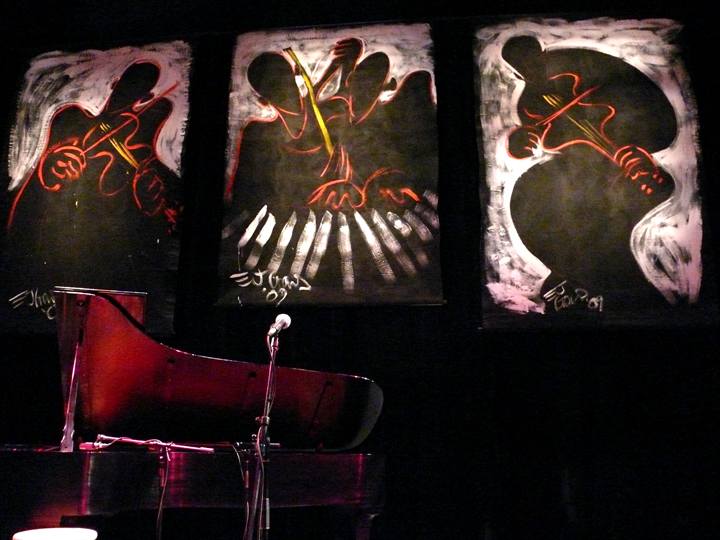
This isn’t really an art presentation for marketers; it’s a working presentation to help an art consultant/decorator/designer understand what they have available to sell and how to position the collection.
I have unusual collections available to me — great works of fine art by great and famous artists, all the way from Rembrandt to Hockney, and any one of these collections could provide income for a gallery for several decades.
Let’s start with one collection:
monumental jazz art.
Why? because it’s big art great for mansions and high and open spaces, and it’s associated with jazz greats, and would make wonderful donations to jazz institutions and art museums, and we have bonafide registered sales at five and six figures.
Monumental jazz art sounds particularly suited to homes of the very rich. I wouldn’t lead with conventional gallery thinking. I’d lead with placement: large walls, hospitality spaces, music venues, restaurants, casinos, hotel interiors, executive spaces, jazz clubs, entertainment properties, high-end residences. The size becomes an advantage rather than a problem.
Everybody has the small stuff, the cheap prints and posters. Original high-end art is a field all its own.
I’d probably divide the presentation into just three parts:
- THE ART — show the monumental jazz pieces full-screen, preferably followed by installation shots or mockups that establish scale. Don’t explain too much initially. Let them hit.
- THE STORY — who E.J. Gold is, the connection to jazz/music/performance, and what makes these works something more than generic decorative jazz imagery.
- THE SALE — don’t ask, “Who would like to buy a painting?” Ask, “Where does this belong?” Once somebody says, “That would look terrific in the lobby at ___,” you’ve moved from selling art to solving a placement problem.
For a consultant, I’d offer a very simple mental sales tool:
WALL → CLIENT → STORY → PRICE → CLOSE.
See a wall that needs something powerful. Identify who controls it. Put the right work in front of them. Give them the story that makes the work memorable. Then talk price.
One thing I’d definitely prepare at some point — one photograph of a monumental work by itself and one convincing mockup of that same work installed in a spectacular Vegas-scale environment. That before/after could communicate the entire proposition in about ten seconds.
And Tom X. gives us a second product line, which is valuable—you aren’t sending someone into the world trying to sell one artist. You’re giving them the beginnings of an art inventory they can curate for particular spaces.
It’s hard to find art large enough to make an impact in a mansion space, so it gives you a tremendous advantage to have these inventories to work with.
===========================================================================
Here’s the Bardo bus now!!!
===========================================================================